
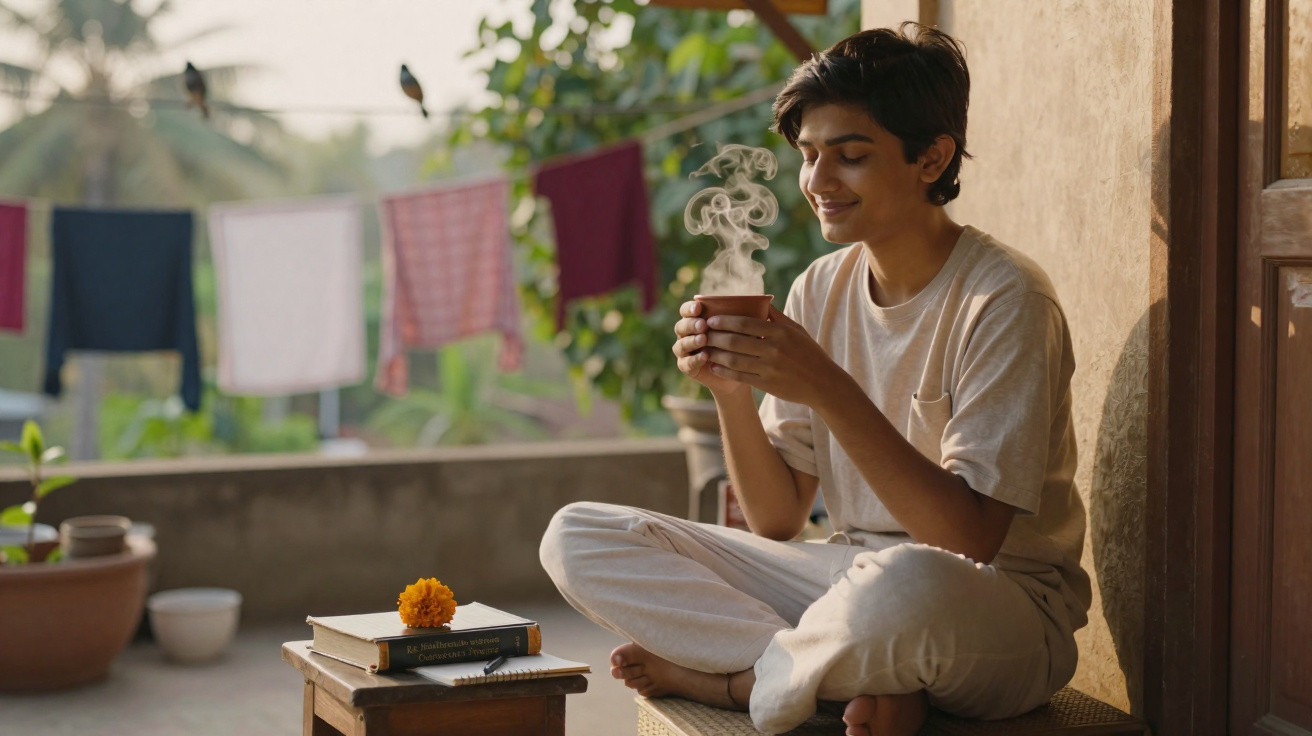
The phrase attributed to Rabindranath Tagore offers a straightforward reversal: happiness may lie less in the relentless pursuit of extraordinary experiences and more in the ability to recognise value in everyday life. The Indian poet and philosopher repeatedly explored ideas including simplicity, nature, contemplation and inner life, advocating an existence less governed by the need to accumulate outward achievements.
What did Tagore mean by this phrase about happiness?
The message suggests that continually seeking something exceptional can turn happiness into a goal that never arrives. There will always be a more remarkable journey, a greater achievement or an even rarer experience. When wellbeing relies on that next event, what is already present can begin to feel inadequate.
Simple things operate according to a different principle. A relaxed conversation, a shared meal, a few minutes outdoors or an unhurried morning do not need to surpass previous experiences in order to matter. This appreciation of simplicity recurs throughout Tagore’s work, including in poems where ordinary elements of nature express fullness and beauty.
- Finding enjoyment in experiences already included in everyday routines;
- Avoiding making all wellbeing dependent on a major future achievement;
- Focusing on the present moment rather than living only in anticipation;
- Understanding that intensity and happiness are not necessarily the same thing.
Why can always seeking the extraordinary make satisfaction harder?
The constant search for novelty can steadily raise the standard used to judge whether something is enough. An experience that first seemed special soon comes to be viewed as ordinary, creating the need to find another that is even more intense. The phrase associated with Rabindranath Tagore challenges precisely this reliance on the exceptional as a condition for feeling fulfilled.
What does learning to enjoy the simple things mean?
Simplicity does not mean giving up ambition, money, travel or major projects. It means refusing to let only those events be allowed to create happiness. Important goals can be pursued while still recognising the worth of small experiences repeated each day.
In Tagore’s work, seemingly unremarkable images such as dew drops, leaves, flowing water, light, clouds and the arrival of morning receive considerable poetic attention. This choice demonstrates how something ordinary can take on meaning when it is observed without needing to turn it into a spectacle.
- Drinking coffee without doing another task at the same time;
- Giving full attention to a conversation without constantly checking a mobile phone;
- Noticing changes in light, temperature and sound during a walk;
- Appreciating everyday meetings that would normally go unnoticed;
- Celebrating small steps forward rather than waiting only for the final outcome.
Who was Rabindranath Tagore and why have his ideas endured across generations?
Born in Calcutta in 1861, Tagore was a poet, writer, composer, educator and thinker. He initially wrote in Bengali and also brought part of his work into English. In 1913, he became the first Asian author to receive the Nobel Prize in Literature, an honour particularly linked to the strength of his poetry and the international reach of his work.
- Born on 7 May 1861 in Calcutta;
- Wrote poetry, short stories, novels, plays and essays;
- Founded an experimental school in Santiniketan;
- Received the Nobel Prize in Literature in 1913;
- His work brought Indian and Western intellectual traditions closer together.
Simplicity may be the most difficult part
The idea used in the theme resembles another phrase widely attributed to Tagore: the notion that being happy may be simple, while being simple is difficult. The distinction matters. It is not a claim that a life without problems automatically brings happiness, but an invitation to see how expectations, comparisons and successive desires can make inadequate what might once have provided satisfaction.
That is why the reflection of Rabindranath Tagore remains recognisable more than a century later. Enjoying the simple things does not require rejecting extraordinary experiences; it requires no longer depending on them. In this view, happiness may emerge precisely when a meal, a conversation, a landscape or a few minutes of silence stop being treated as intervals between important moments and begin to be recognised as part of life itself.






Comments
No comments yet. Be the first to comment!
Leave a Comment