
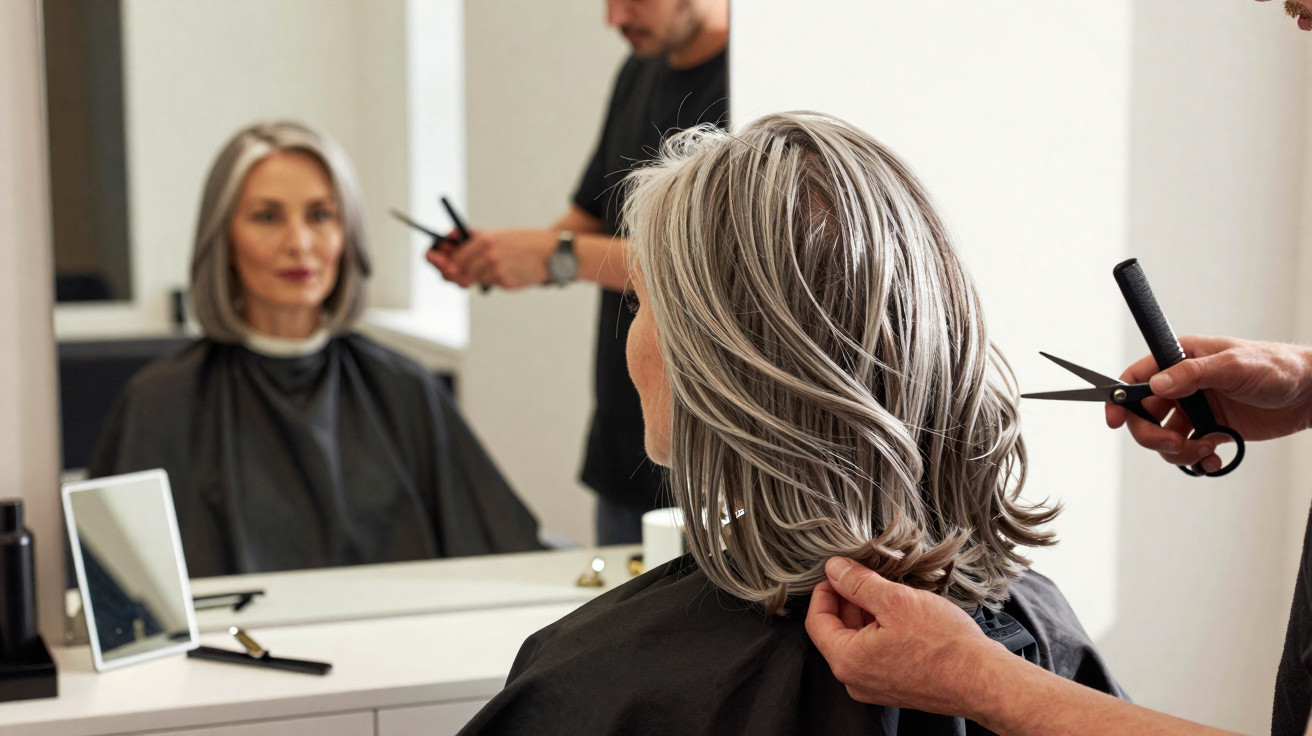
Salt and pepper strands can appear sleek and contemporary, yet one specific hair length can subtly add ten years to your face.
Stylists say the cut matters more than the number of grey hairs you have. At the wrong length, even hair that is healthy and shiny can pull your features downwards.
Why salt and pepper hair is suddenly everywhere
Hair that was once concealed beneath repeated colouring is now being embraced as a style choice. More people are growing out their natural greys, prompted by social media, lockdown roots and a broader move towards low-maintenance beauty. Salt and pepper hair – a blend of dark and silver – can look luminous and full of texture in person.
The contrast may look dramatic on camera. In real life, however, the result relies heavily on the cut, the length and where the grey is most visible. This is where certain lengths can begin to work against your appearance.
Grey hair itself does not automatically age you; the wrong length and shape usually do the damage.
Colour is only one part of the picture. The outline of your cut, the way it moves as you turn your head and how it sits around your jaw can have more effect than several white strands.
The ageing length stylists warn against
When experienced hairdressers are asked which length to avoid as salt and pepper hair emerges, their answer is often the same: a flat, shoulder-skimming cut that simply hangs in place.
The most ageing length for salt and pepper hair is the heavy, mid-length style that hits exactly at the shoulders with no movement or shape.
This “no man’s land” cut generally falls between the collarbone and the top of the shoulders. It is sufficiently long to weigh down the face, while not being long enough to seem deliberately elegant. With mixed grey hair, this area can soon look weary rather than effortless.
Why this length makes you look older
Stylists identify several particular reasons why this in-between length can be problematic:
- Weight at the ends: At this length, hair can appear thicker at the bottom, creating a solid, block-like line across the neck.
- Zero movement: Straight hair that brushes the shoulders may flick out awkwardly or lie flat, making the jawline appear harsher.
- Grey placement: When the cut has no layers, salt and pepper growth at the temples and along the parting becomes the focal point.
- Neck coverage: Hair ends exactly where the neck joins the shoulders, which can make the neck look shorter.
Together, these factors create shadows around the chin and mouth, potentially emphasising features you may prefer not to draw attention to, such as jowls or marionette lines.
Lengths that flatter salt and pepper hair
The answer is not merely to cut it short or grow it long. The key is choosing a purposeful length and giving it structure.
| Length option | Who it suits | Why it works with salt and pepper hair |
|---|---|---|
| Chin-length bob | Fine to medium hair, oval or heart-shaped faces | Displays silver around the face, lifts the jawline and keeps hair light and buoyant |
| Textured crop | Thicker hair, strong features | Makes grey look like intentional texture, builds volume at the crown and removes bulk from the sides |
| Collarbone lob | Most face shapes, especially round or square | Offers length without dragging the face down, falls below the ageing shoulder line and suits soft waves |
| Long layers past the shoulders | Healthy, medium to thick hair | Produces vertical movement, disrupts pronounced grey bands and looks deliberate rather than grown-out |
Within all of these options, a shift of just one or two centimetres can dramatically alter the result, particularly where salt and pepper hair has a high level of contrast.
The power of shape: layers, fringes and partings
Adding movement without losing length
If you prefer your hair to sit close to the shoulders, it is important to disrupt the heavy horizontal line. Long layers, particularly those that begin at the cheekbones or jaw, can lift the face and make the shift from dark to silver strands appear softer.
Any cut that keeps movement away from the face and weight at the jawline tends to age salt and pepper hair unnecessarily.
Gentle, invisible layers at the back and sides can prevent the rigid “triangle” shape that often develops as previously dark, single-process hair starts to become flecked with grey.
Fringe or no fringe with salt and pepper?
A fringe can make a significant difference when grey first appears around the hairline. A wispy curtain fringe can soften a high forehead while disguising the earliest streaks. By comparison, a thick blunt fringe with shoulder-length salt and pepper hair may enclose the face and add years.
Side-swept fringes can work especially well because they break up the marked colour contrast at the parting and shift attention from the roots to the eyes.
Texture: the secret weapon against an ageing cut
Grey strands are frequently coarser and more wiry than pigmented hair. When left pin straight at shoulder length, they may stick out rather than settle smoothly. Texture-building styling methods – air-dried waves, a relaxed bend created with a curling wand or even salt spray – can make a substantial difference.
Soft movement offers three useful benefits:
- diffuses harsh lines between grey and darker hair
- creates root volume rather than width at the ends
- encourages the eye to travel instead of settling on one heavy length
This explains why the same salt and pepper shade can look fresh in a tousled collarbone-length lob but dated in a rigid shoulder-length cut.
Maintenance: small adjustments that reduce the ageing effect
Many people embrace salt and pepper hair to avoid regular dye appointments. That does not mean avoiding haircuts altogether. Trims every 8 to 10 weeks keep the length clear of the middle zone where it reaches the shoulders and begins to fan out.
A handful of practical changes can help salt and pepper hair sit more attractively at almost any length:
- Gloss treatments or clear glaze to increase shine, which grey hair can often lack.
- Strategic lowlights that soften stark white streaks instead of providing complete coverage.
- A slightly off-centre parting to avoid a severe grey line through the middle.
- Rounded rather than pin-straight ends, helping to soften the neckline.
Keeping salt and pepper hair flattering is less about hiding grey and more about controlling line, shine and movement.
Face shape, neck length and how they play with grey
That well-known shoulder length is not equally unflattering on everybody. It can look acceptable on a long neck, although it may still not be the most flattering choice. On someone with a shorter neck or a stronger jaw, it can visually compress the whole area. Salt and pepper tones naturally highlight bone structure, so they require space around it.
For round faces, a collarbone length or slightly longer can elongate the silhouette. Square faces benefit from soft layers starting beneath the cheekbone, which interrupt any horizontal lines created by the cut. Heart-shaped faces often suit shorter textured styles, as attention is directed towards the eyes and cheekbones rather than the jaw.
Practical scenarios and how to adjust your cut
Suppose you have spent a year growing out your colour and your hair now rests directly on your shoulders, with most of the grey visible at the temples and parting. You may feel washed out and notice more visual weight around the jaw. Rather than returning to full colouring, a stylist might:
- lift the back slightly so it falls a centimetre or two above the shoulders
- introduce long face-framing layers beginning near the cheekbones
- create a soft side-swept fringe to cover the first grey band at the hairline
- place several ash-brown lowlights beneath the surface to blend the salt and pepper
This adjustment retains your natural tone but redirects attention upwards, away from the jaw and shoulder line that had previously made you look older.
For somebody determined to keep their hair longer, the recommendation may be to grow it fully beyond the shoulders, until the ends pass the top of the back. That added length gives more room for layers and waves, interrupting the solid bar that had made the hair seem heavy.
Key terms that help in the salon chair
When you book a hair appointment, certain phrases can make it easier to explain what you want. Requesting a “lob” (long bob) usually indicates a cut that falls between the collarbone and upper chest, rather than directly on the shoulders. Asking for “soft, face-framing layers” signals that you want movement around your features instead of a blunt, single-length style.
If you say you want to avoid “a boxy shape at the ends”, your hairdresser will understand that the length should be subtly staggered rather than cut straight across. For salt and pepper hair in particular, requesting “dimension” – achieved through lowlights or toners – can stop the colour looking flat, an issue that is especially visible at that ageing mid-length.
The aim is to make your salt and pepper hair look like a conscious style decision, not a halfway point where the cut and colour never quite agree.






Comments
No comments yet. Be the first to comment!
Leave a Comment