
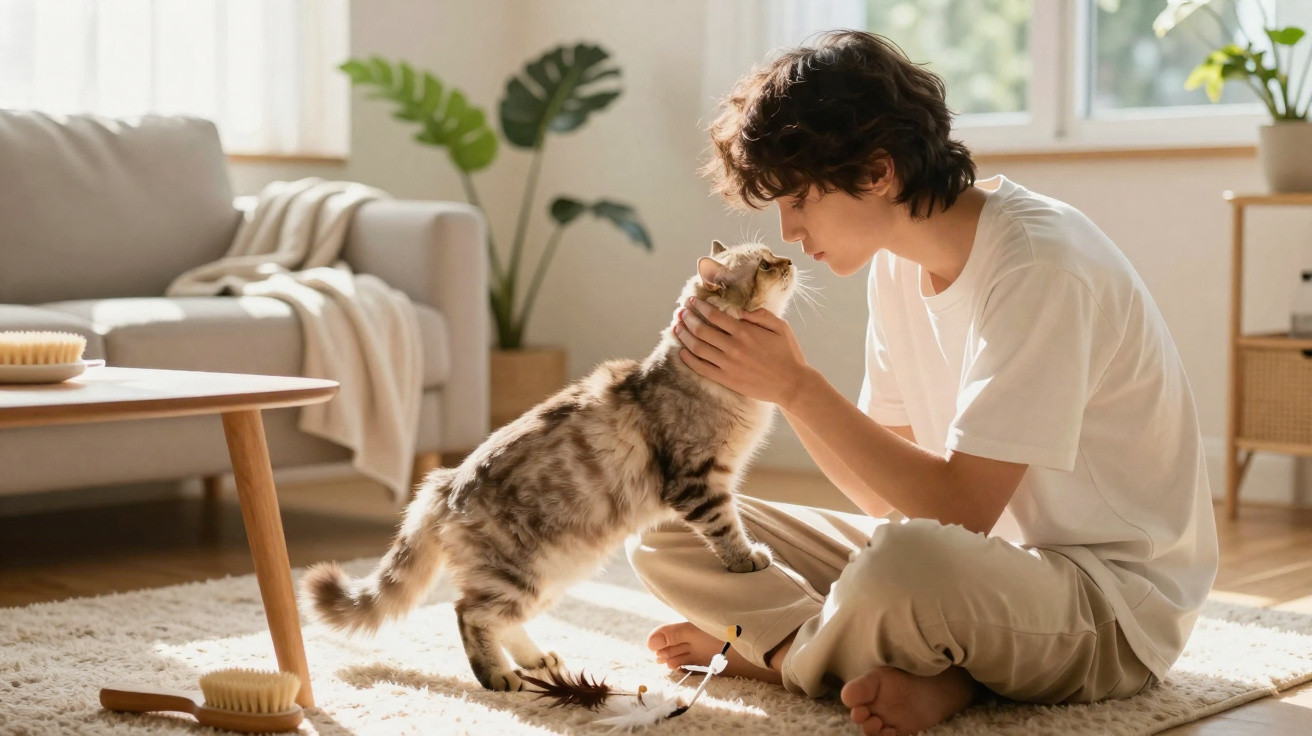
Cats are often thought of as fiercely independent, yet growing evidence indicates that humans can form a distinctive bond with them, driven in part by brain chemistry.
The key chemical is oxytocin, widely known as the “love hormone”. This is the same neurochemical that rises when a mother holds her baby or friends embrace, encouraging affection and trust. Research now suggests that oxytocin also matters in the bond between cats and people.
Across many species, humans included, oxytocin is vital to social attachment, trust and the regulation of stress. A 2005 experiment, for instance, found that oxytocin made human participants considerably more prepared to trust other people in financial games.
It can also calm both people and animals. Oxytocin suppresses cortisol, the stress hormone, while activating the parasympathetic nervous system, or “rest and digest” system, allowing the body to unwind.
Scientists have long understood that positive encounters release oxytocin in dogs and their owners, establishing a reciprocal bonding cycle. Far less, however, was known about the equivalent effect in cats until recently.
Cats tend to express affection in less obvious ways. Even so, their owners frequently describe the same comforting companionship and reduction in stress reported by dog owners, and a growing body of research supports those accounts.
Oxytocin and cat-human bonding
Japanese researchers reported in 2021, for example, that short sessions of stroking cats raised oxytocin levels in many owners.
For that study, women spent several minutes interacting with their cats while scientists measured the owners’ hormone levels. Compared with a quiet rest period without the cat, friendly contact, including stroking the animal and speaking softly, appeared to be associated with increased oxytocin in the humans’ saliva.
For many people, stroking a purring cat feels calming, and evidence suggests that the effect involves more than the animal’s soft coat. Petting a cat, and even hearing it purr, may prompt oxytocin to be released in our brains.
A 2002 study found that this surge of oxytocin resulting from gentle contact with a cat can reduce cortisol, our stress hormone. In turn, this may lower blood pressure and even lessen pain.
When is oxytocin released between cats and humans?
Research is beginning to identify the particular moments in this cross-species friendship that prompt the hormone’s release. For cats, gentle touch appears to be one of the principal triggers.
A February 2025 study found that owners’ oxytocin levels generally increased when they gently stroked, cuddled or cradled their cats, as did the cats’ levels, provided the animal was not made to take part.
The researchers tracked cats’ oxytocin during 15 minutes of play and cuddling at home with their owner. Cats with secure attachments that began contact themselves, by sitting on a lap or nudging, experienced an oxytocin surge. The longer they remained near their humans, the larger the increase.
But what happens with cats that are less keen on cuddles? That same research identified different responses among cats with more anxious or distant attachment styles. Avoidant cats, which maintained their distance, showed no meaningful change in oxytocin. Anxious cats, meanwhile, which repeatedly sought their owner while becoming easily overwhelmed by being handled, already had high oxytocin levels.
In both avoidant and anxious cats, oxytocin was found to fall after an unwanted cuddle. The hormone is more likely to flow when an interaction respects a cat’s boundaries, whereas a cat that feels trapped may not experience the same bonding effect.
Perhaps people can take lessons from feline companions about handling different attachment styles. Understanding a cat’s way of communicating is central to building a relationship with one.
How cats communicate trust and affection
Unlike dogs, cats do not use sustained eye contact as a primary way to connect. They rely instead on quieter cues. The best known is the slow blink: a feline smile that communicates trust and safety.
Purring also contributes to cats’ relationships with people. A cat’s low-frequency purr has been associated not only with healing benefits for cats, but with calming effects in humans as well. Hearing purring can reduce heart rate and blood pressure, with oxytocin mediating those benefits.
The presence of a cat, strengthened by the small oxytocin rises produced through everyday exchanges, may help protect against anxiety and depression. In some cases, it can provide reassurance comparable to human social support.
Are cats just less loving than dogs?
Studies do generally identify stronger oxytocin responses during dog-human interactions. In a much-discussed 2016 experiment, researchers measured oxytocin in animals and owners before and after ten minutes of play. Dogs recorded an average 57 percent rise in oxytocin after playing, while cats showed an increase of about a 12 percent.
For humans, oxytocin increases during social interactions that matter to us. Research indicates that contact with someone we love produces more powerful oxytocin responses than contact with strangers. In that sense, an enthusiastic greeting from a dog resembles the rush of seeing a child or partner.
As pack animals bred for continual companionship with humans, dogs are almost hard-wired to seek our eye contact, approval and touch, behaviours that stimulate oxytocin release in both dog and person.
Cats, by contrast, developed from more solitary hunters that did not require conspicuous social signals to survive. They may therefore show oxytocin-driven behaviour less readily or less consistently. Instead, a cat may save oxytocin-releasing behaviour for occasions when it genuinely feels secure.
A cat’s trust is not given automatically: it has to be earned. Once it is offered, though, it is strengthened by the same chemical that connects human parents, partners and friends.
So when your cat slowly blinks from the other side of the sofa, or settles on your lap for a purr-filled cuddle, something unseen may be occurring too: oxytocin is increasing in both your brains, reinforcing trust and easing the stresses of everyday life. In their own manner, cats have drawn on the ancient biology of love.
Laura Elin Pigott, Senior Lecturer in Neurosciences and Neurorehabilitation, Course Leader in the College of Health and Life Sciences, London South Bank University
This article is republished from The Conversation under a Creative Commons license. Read the original article.






Comments
No comments yet. Be the first to comment!
Leave a Comment