
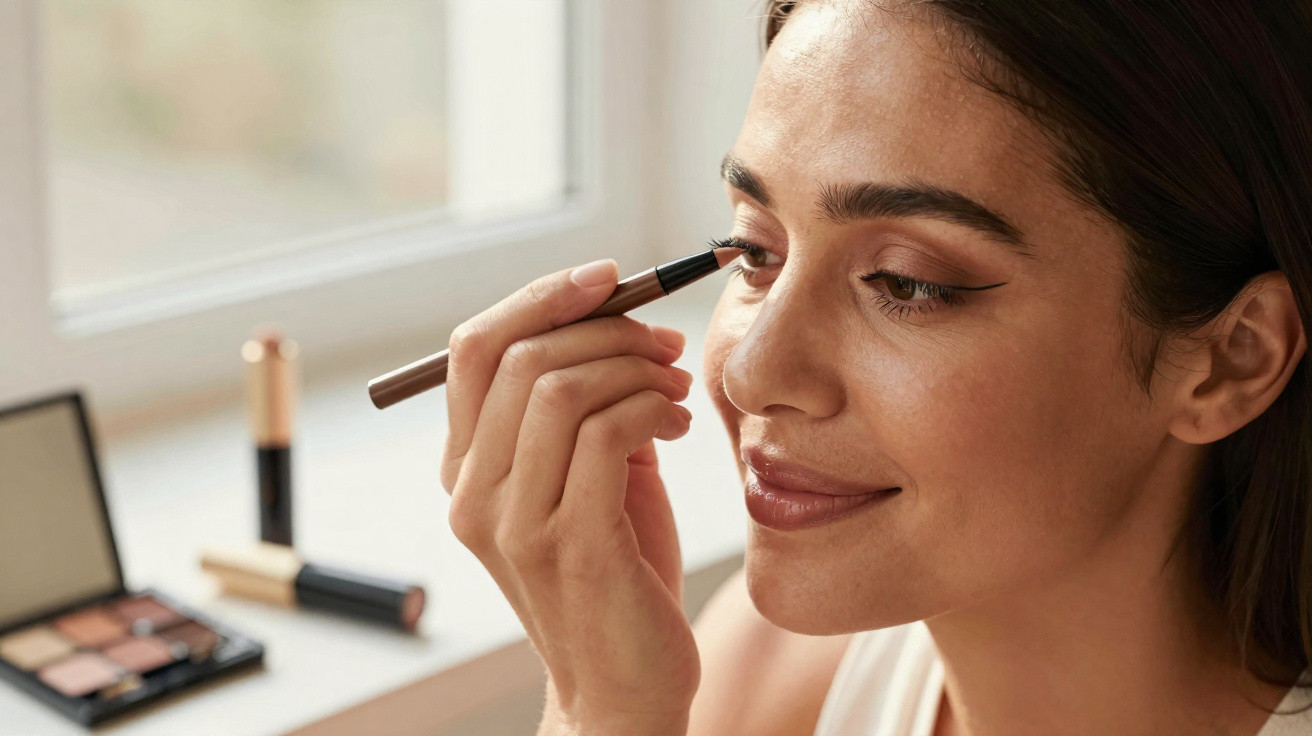
Many women notice from around the age of 50 that their trusty black kohl pencil suddenly no longer has the same effect: the eyes look smaller, the gaze appears to droop, and make-up settles into fine lines. Professionals therefore recommend changing strategy. Rather than applying thick lines around the entire eye, the focus is now on fine, carefully placed eyeliner techniques that visually lift hooded eyes without overwhelming them.
Why classic kohl often makes hooded eyes look worse
Eye shape changes over the years. The skin on the upper lid becomes softer, drops slightly and falls over the mobile crease. A rich kohl line along both the upper and lower lash lines may once have looked great, but can suddenly appear harsh and drag the eye down.
“A thick, dark line takes away visible eye area – making the eyes look smaller and more tired.”
Three factors in particular can make classic black kohl problematic:
- Too much product on the lower lid: Fully lining the lower waterline with kohl makes the eye appear smaller.
- Wide lines on the upper lid: If the line sits too low, it disappears beneath the crease or angles downwards.
- A harsh black shade: Pure black can quickly look severe and emphasise every shadow beneath the eyes.
For hooded eyes, make-up artists therefore tend to favour long-wearing eyeliner in brown, taupe or dark grey. These shades are softer, more flattering and look more modern than the heavily applied kohl pencil of the past.
The “reverse” eyeliner technique: creating a lifting effect
A much-quoted make-up artist in the beauty world uses an unusual take on the classic winged eyeliner, developed specifically for hooded eyes. Instead of drawing upwards from the lower lash line, she deliberately begins the other way round.
Step by step to a lifted outer corner
The central principle is that the wing does not follow the natural angle of the lower lid – because with drooping lids, this often slopes downwards. Instead, it takes its direction from the upper lash line.
- Look into the mirror with your eye open. This gives you a realistic view of how the lid sits in everyday life, rather than only while applying make-up.
- Draw a fine line along the upper lashes. Begin very close to the roots and keep it barely visible across the inner third.
- Sketch the wing “from top to bottom”. Start at the outer third of the upper lash line and draw slightly downwards towards the temple – it may feel unusual at first.
- Choose the endpoint. Place a small dot where you want the outer corner of the eye to appear lifted.
- Connect the dot to the lash line. This creates a small triangular section, which can then be filled in neatly.
When you look down, this wing can appear almost wrong: slightly bent or crooked. But once the eye is open normally, the line fits precisely into the shape of the drooping lid and creates a mini lifting effect at the outer corner.
“What matters is not how the wing looks with closed eyes, but how it sits in everyday life with the eyes open.”
Tightlining: the invisible trick for fuller-looking lashes
A second technique that can make a significant difference for hooded eyes is called tightlining. Rather than creating a visible line on the lid skin, colour is applied directly into the gaps between the lashes.
Here is how to do it:
- Use a well-sharpened waterproof eyeliner or gel liner, applying it from underneath the upper lash line.
- Gently press the colour into the tiny spaces between the lashes.
- Keep your gaze as straight ahead as possible; if your eyes are sensitive, you can carefully lift the lid.
The result is a denser-looking lash line and a more defined eye, without using up valuable space on already limited lid skin. This is particularly beneficial for heavily hooded eyes, as nothing smudges or settles into fine lines.
Inverted eyeliner – when the upper crease conceals almost everything
With very pronounced hooded eyes, even an exceptionally fine line on the upper lid may not work because the mobile lid disappears entirely beneath the overhanging skin. In these situations, professionals often use an inverted eyeliner variation.
Fine lower line, lifting effect above
With inverted eyeliner, attention is placed on the lower lash line – but in a very subtle way:
- Draw a fine line only along the outer third of the lower lash line.
- Extend the line softly outwards and on a slight upward diagonal.
- Smudge the colour lightly so that no hard edge remains.
Combined with an extremely fine, progressive line on the upper lid that becomes slightly wider only at the outer edge, this creates a visual upward direction. It is an effective replacement for the old fully outlined kohl look.
| Old habit | New alternative for hooded eyes |
|---|---|
| Thick black kohl all the way along the lower lid | A fine, soft line only on the outer third |
| Wide eyeliner across the whole upper lid | Progressive line: barely visible on the inside, subtly strengthened on the outside |
| Pure black on the waterline | Soft brown or taupe close to the lash line, tightlining |
Textures and colours that work especially well
These techniques call for products that allow precise application and stay put throughout the day without smudging. Many make-up artists reach for:
- Gel eyeliner in a pot with a fine brush – ideal for tightlining.
- Liquid eyeliner with a felt tip for crisp wings.
- Waterproof pencils that can be blended easily before setting in place.
When choosing a colour, it is worth looking beyond standard black. Dark brown, espresso, cool taupe or a rich dark plum shade appear softer, make the whites of the eyes look brighter and suit mature skin better, as it can be more sensitive to stark contrasts.
How hooded eyes develop – and what this means for make-up
Hooded eyes can be genetic or develop with age. Over time, the skin loses elasticity, subcutaneous fat is redistributed and muscles weaken. As a result, the upper lid drops slightly.
For make-up, this has two implications:
- The mobile lid area becomes smaller, leaving less room for striking eyeshadow looks.
- Lines that once sat perfectly may now crease, bend or vanish completely into the eyelid fold.
That is why it is useful to reassess old routines and choose techniques that work with the new anatomy rather than against it. Fine, clever eyeliner techniques can make more difference than a fifth coat of mascara.
Practical additions: eyeshadow, mascara and a few no-gos
A successful eyeliner look for hooded eyes rarely stands alone. A few complementary techniques can make it noticeably more effective:
- Matte rather than intensely glossy: Matte, lightly tinted eyeshadows reduce shine on lid skin, which can otherwise quickly look puffy.
- A light shade at the inner corner: A champagne or ivory shade makes the eyes look fresher.
- Focus mascara on the outer lashes: Applying more mascara to the outer third of the lashes reinforces the lifting effect of the eyeliner.
Highly glittery textures applied directly to the overhanging crease are less helpful, as they highlight unevenness. Extremely harsh, angular lines can also make the face look more severe, especially on mature skin.
Anyone trying an inverted wing or tightlining for the first time should take their time and start with only a small amount of product. The techniques look more complicated than they are. After a few attempts, the movement usually becomes second nature – and the eyes look more awake without making you look as though you have tried to make yourself look ten years younger.





Comments
No comments yet. Be the first to comment!
Leave a Comment