
The morning I realised my haircut was working against me, I was already running late. My coffee was cooling, my shirt was only half-buttoned, and I was trying to tame that odd halo of frizz that materialises exactly when you need to look remotely polished. I gathered my hair into a claw clip, checked the mirror and found… chaos. Not effortless. Not French-girl tousled. Just, “did the bus window do that to you?” energy.
At the office, a colleague arrived five minutes later with slightly damp hair, a random barrette and the sort of “I woke up like this” look we secretly spend 20 minutes attempting to achieve. We had the same clip and the same humidity. Yet the result was completely different.
That was when I understood a mildly cruel truth: certain haircuts make every rushed hairstyle seem deliberate, while others reveal every hurried move.
The difference is not in your hands. It begins with the cut.
The secret power of the “structured messy” haircut
Watch people on the Tube for five minutes and you will spot it. Two people may have near-identical hair textures, yet one looks artfully undone while the other appears to have slept awkwardly. The difference is seldom just styling products. It lies in the structure built into the hair.
A haircut that makes everyday hairstyles look intentional has one key advantage: shape already worked into it. This means layers that sit where your hair naturally curves, ends that taper rather than forming a weighty block, and a length suited to what you genuinely do with your hair from Monday to Friday.
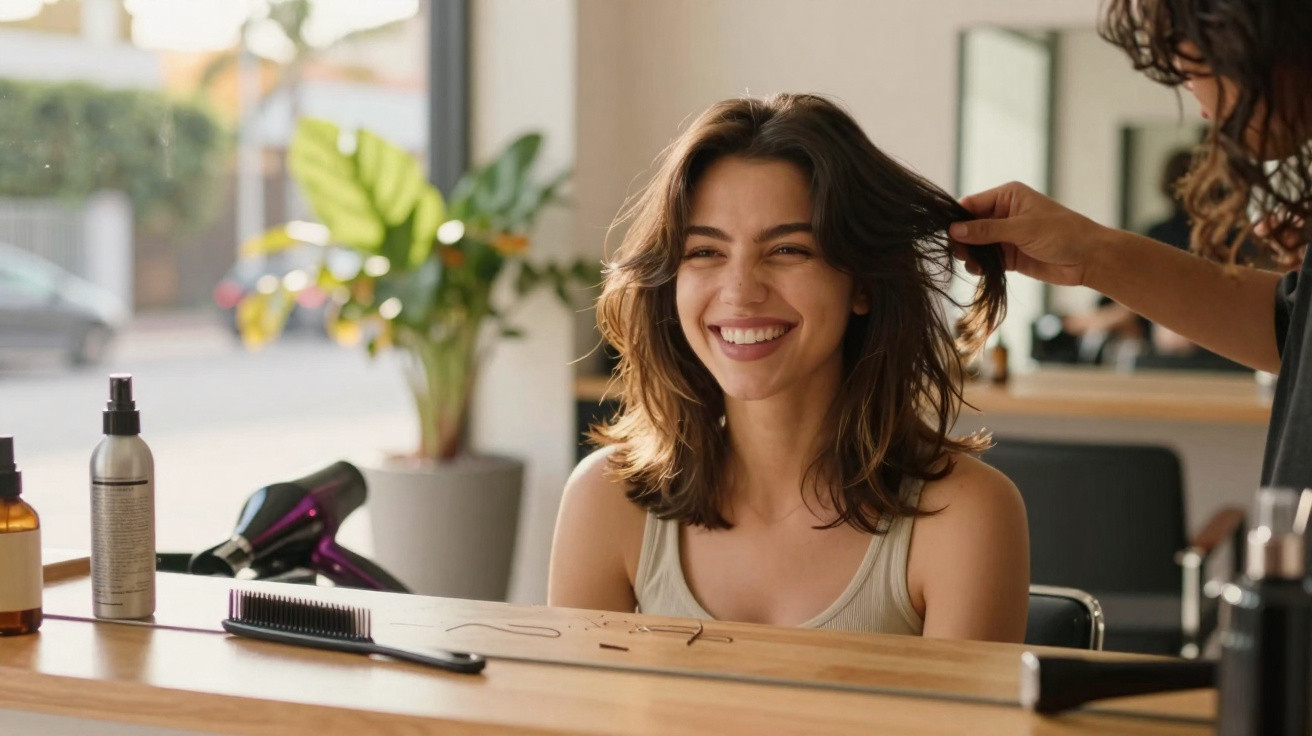
Consider the mid-length shaggy lob that seems to be everywhere at the moment. On Instagram, it looks as though someone simply ran their fingers through it. Closer up, though, there are soft layers around the face, invisible internal layers to take away excess weight, and a line that is lightly broken rather than sharply straight.
One woman I interviewed said her mornings changed when she traded a blunt cut for a shattered one. Previously, her low bun always seemed like a final resort. With the new cut, the identical quick twist suddenly released small sections at her cheekbones and nape, as though they had been deliberately styled. Same elastic. Same five seconds. An entirely different message.
There is a reason for this. Hair with no shape acts like one heavy curtain: it clumps together, pulls the face down and leaves every clip or elastic to battle gravity by itself. Hair with purposeful layers acts more like a series of soft panels. Each section settles separately, so when you push it into a claw clip or half-up knot, the loose pieces frame your face in a consistent way.
This also explains why some people can air-dry their hair while others end up with a triangle. The right cut spreads volume vertically rather than sideways. Messy starts to look “editorial” rather than “I gave up”.
The haircut that does the styling for you
Ask a skilled hairdresser about low-effort hair and they will mention “built-in styling”. It is the understated skill of cutting hair so it handles part of the work itself. They assess where cowlicks push, where waves begin and where your part naturally falls when you are not forcing it. Then they create a shape that makes those characteristics appear intentional.
For many people, that means a version of a layered, mid-length cut: long enough to tie back, yet short enough that it does not fall flat. These are not the choppy layers of the 2000s, but soft, airy layers that remain closer to the roots and become looser through the ends. When you put your hair up, they spill out in just the right places.
One stylist I spoke to favours “air-dry haircuts”. She asks clients one direct question: “What do you actually do with your hair on a Tuesday morning?” There is no aspirational routine involved, only real life. One woman confessed, a little guiltily, “I wash it at night, sleep on it, and hope for the best.”
Rather than lecturing her about heat styling, the hairdresser added long internal layers designed to support the woman’s subtle wave pattern. The following day, the client slept with damp hair, woke up, secured it in a claw clip and sent a photograph. Her hair looked purposeful, with soft bends around the jaw. Same routine. New structure.
This succeeds because a well-considered cut accommodates your laziness just as much as your texture. Honestly, nobody does this every single day. You do not get up early before work to wind tendrils around a curling iron. You put it in a ponytail while reading emails, insert a clip in the lift and alter your part in the camera app.
With the right cut, all those small, automatic actions leave you looking stylish rather than chaotic. The haircut turns your shortcuts into a look. Without it, those same shortcuts highlight every flat, bulky or frizzy section you did not have time to deal with.
How to ask for the “effortless on purpose” cut
The process starts well before the scissors come out. Before your next appointment, photograph your hair on ordinary days: in a gym ponytail, a hurried bun, worn down after air-drying and with a headband. Do not take pictures only when you have made your best effort. Take them while you are simply getting on with life. These images are invaluable to your hairdresser.
At the salon, do not just say, “I want it to look effortless”. Explain what you really do: “I wear it up four days a week”, “I always tuck it behind one ear”, “I never blow-dry the back.” Then show the photographs. A good stylist will interpret them like a map and cut around your habits, not against them.
The usual error is requesting a blunt cut because it seems “clean” or “simple”. Blunt cuts look sleek and glossy on Instagram. In everyday life, however, they require styling. That dense line at the ends has nowhere to go when you twist your hair up or pull it half back. It can create bulky buns, flat crowns and that unusual shelf-like ponytail which droops within an hour.
Over-layering is another frequent problem, particularly with fine hair. Too many short layers can make the sections escaping clips or elastics appear wispy rather than relaxed. The ideal balance normally falls somewhere between the two: longer layers beginning around the cheekbones or collarbones, paired with a soft, broken outline that does not announce “fresh from the salon”.
“My rule is simple,” one stylist told me. “If it only looks good the day I blow-dry it in the salon, then I didn’t cut it for your life, I cut it for my Instagram.”
- Bring “real life” photos – Show your hair on average and bad days, not only on its best days. This gives your stylist honest information.
- Ask for soft, internal layers – These reduce bulk without forming obvious steps, so loose pieces look intentional.
- Discuss your ponytail or clip.
- Maintain a medium length if you depend on updos.
- Avoid a heavy, ruler-straight bottom edge unless you enjoy using styling tools.
Let your hair look like your life, not your calendar
There is a quiet relief in catching your reflection at 3 p.m. and noticing that your “whatever” bun looks like a style decision. Not because you put effort into it that morning, but because someone once considered how you truly live with your hair.
The haircut that makes everyday hairstyles look intentional is not one fashionable shape. It is a partnership between your texture, your routines and a stylist who does not roll their eyes when you say, “I just throw it up most days”. The same cut will not behave identically on two heads, but the principle remains: built-in shape, soft layers and a length that works both up and down without fuss.
We have all experienced that pause before switching on a laptop camera, wondering whether our hair says “messy chic” or simply “messy”. The right cut moves that boundary in your favour. A crooked part begins to appear deliberate. A strand that falls across your cheek feels like styling rather than failure.
Perhaps the real change is not just how you look, but how little thought you need to give it. Once your haircut is doing half the work, your everyday gestures stop seeming apologetic and begin to express something. That is when a simple clip, a hurried bun or an air-dried wave finally looks as you intended.
| Key point | Detail | Value for the reader |
|---|---|---|
| Built-in shape | Soft, internal layers and a slightly broken perimeter | Every quick style settles into place and appears intentional |
| Cut for your habits | Consultation based on genuine routines and everyday photographs | You stop battling your hair and save time each morning |
| Medium, versatile length | Long enough for clips and buns, light enough to move | One haircut that works for both “up” days and “down” days |
FAQ:
- Question 1 What exactly should I ask my hairdresser for if I want this kind of cut?
- Question 2 Does this work on very curly or coily hair, or only on wavy/straight textures?
- Question 3 How often do I need to trim this type of haircut to keep the effect?
- Question 4 Can I still have bangs if I want my hair to look effortless when it’s messy?
- Question 5 Are there any styling products that help everyday hair look more “on purpose”?



Comments
No comments yet. Be the first to comment!
Leave a Comment