
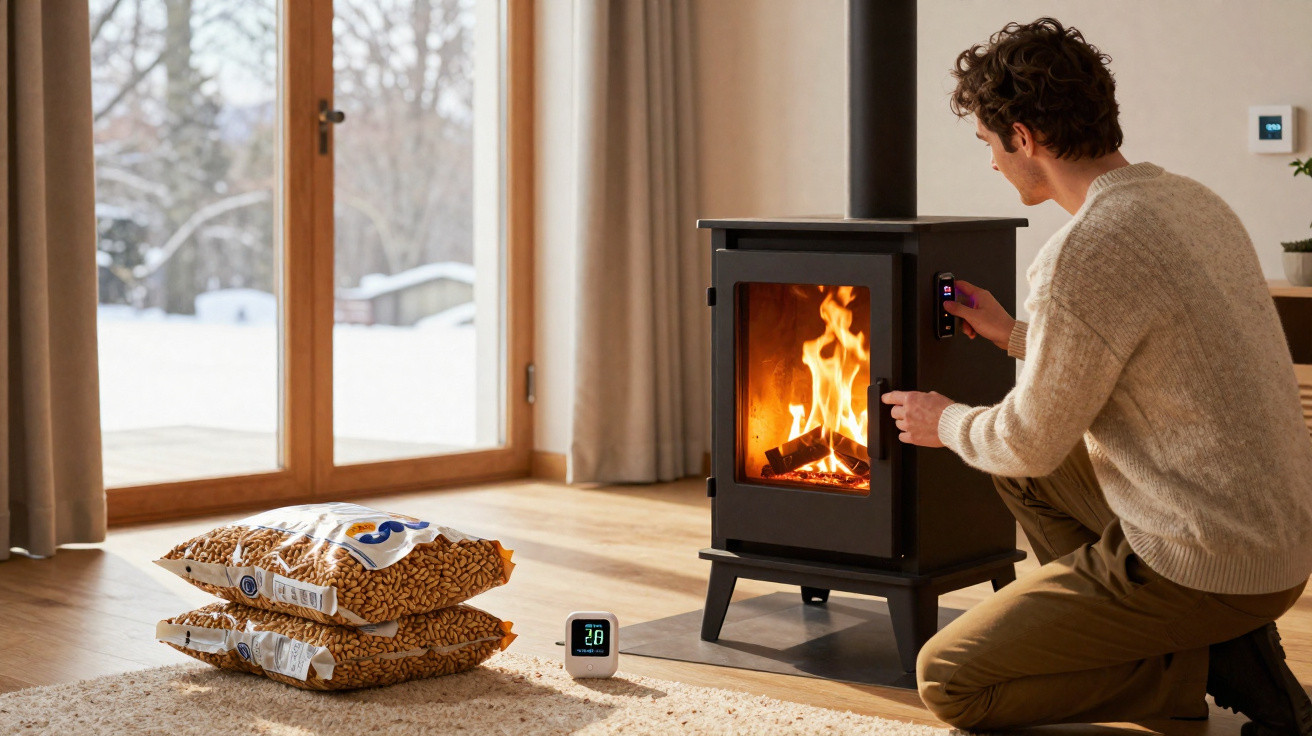
Energy costs are still unpredictable, climate regulations are becoming stricter, and the appetite for wood pellets continues to grow. For many households, the issue is no longer whether pellets are the right choice, but how to burn substantially less fuel without losing comfort. The solution is less about installing a larger stove and more about improving how the appliance and the wider heating setup are operated, maintained and supported.
Rethinking pellet heating in 2026
Pellet stoves have traditionally been marketed as a “set and forget” option: fill them with fuel, press a button and enjoy the heat. Today, that approach can prove expensive.
Factory settings are intended to function in every situation, rather than being tailored to your living room, insulation standard or local climate. At the same time, the difference in quality between budget and premium pellets has widened, while many properties still lose heat faster than their stove can replace it.
Used intelligently, the same stove can often heat your home on 10–25% fewer pellets without sacrificing comfort.
For 2026, energy advisers in France, Germany and the UK are promoting the same principle: view your pellet system as a precision appliance, rather than an elaborate electric heater that simply burns wood.
Fine-tuning the stove: small tweaks, big savings
Begin with the stove itself. An appliance that is not properly calibrated will consume pellets unnecessarily.
Match the power setting to the room, not the brochure
Pellet stoves are frequently too powerful for the rooms they serve. A 9 kW stove in a well-insulated 25 m² lounge may repeatedly switch on and off, or operate at full output in brief bursts. This uses extra pellets and produces less consistent comfort.
- Select the lowest output level that can still hold a stable temperature.
- Prioritise extended, steady burning over short periods of intense heat.
- If the stove repeatedly exceeds the set temperature, lower its rated output or ask a technician to alter the combustion settings.
A correctly adjusted stove can use up to a fifth fewer pellets than the same model left on factory settings.
Balance the airflow: the flame shape is important
Most current stoves allow adjustments to fan speed and, in some cases, the air supply. Together, these settings determine how efficiently the pellets burn.
- A very short, loud flame can indicate an excessively powerful fan, which may send heat up the flue rather than into the room.
- A weak, sluggish flame that creates dark smoke during start-up may signal insufficient air.
You are looking for a bright, active flame that is not overly fierce, alongside very little smoke. A qualified technician can make these adjustments in a single visit, potentially reducing your costs throughout the heating season.
Cleaning: unglamorous but effective
Even a light ash coating on heat exchangers works like insulation, limiting heat transfer. The stove must then burn additional pellets to achieve the same room temperature.
- Empty the ash pan as regularly as the manufacturer’s manual recommends, or more frequently when using the stove every day.
- Clean the heat exchanger tubes each week during the coldest part of winter.
- Have the flue swept no less than annually to protect both draught performance and safety.
Many owners do not realise how sharply output can decline when maintenance is neglected for only a few weeks.
Smarter pellet choices: the bag price can be misleading
Pellets do not all perform alike in the firebox. Their moisture level, density and ash content influence both combustion and heat output.
Cheaper pellets with higher moisture often cost more over the season, because you need more of them to reach the same warmth.
What to check on the bag
- Certification: Standards such as ENplus or DINplus suggest low moisture levels and reliable density.
- Moisture content: Look for roughly 8–10%. Above this range, energy is spent evaporating water.
- Ash content: A low ash percentage limits build-up and helps maintain efficiency between cleans.
- Wood type: Softwoods are used in many European pellets and can burn extremely efficiently when manufactured well. Hardwoods usually burn a little longer, but are not necessarily superior.
Trying two or three brands over several weeks can provide useful comparisons. Track hopper refill frequency, the ash left behind and whether the stove glass darkens rapidly. Select the pellets that provide the strongest mix of cost and performance, rather than simply choosing the cheapest bag on the shelf.
Insulation: the overlooked route to pellet savings
A frequent complaint from pellet users is that they still feel persistent draughts despite having a high-output stove. Usually, the problem lies not with the heating appliance but with the building fabric surrounding it.
Deal with the easiest heat leaks first
Several improvements can be completed in an afternoon yet deliver benefits for years:
- Fit new seals, or replace deteriorated ones, around windows and doors.
- Hang thermal curtains in the rooms heated by the stove.
- Close openings around pipes, cables and loft hatches.
Simple airtightness work can cut heating needs by several hundred kilos of pellets per year in a draughty house.
Look upwards: roofs and lofts
Because heat rises, the loft in many older properties effectively becomes a vast open chimney through which warmth escapes. Improving insulation at this level is often the most effective individual energy measure.
Home energy advisers say that households combining a pellet stove with good roof insulation often reduce fuel use by 20–30%, while benefiting from more uniform temperatures between rooms.
New habits: heating the spaces you really use
Equipment alone will not solve high pellet bills. Everyday behaviour has a subtle but significant impact.
Set a sensible target temperature
Most European health bodies now advise around 19–20°C for living areas, with bedrooms kept slightly cooler overnight.
- Every additional degree above 20°C generally increases heating demand by about 7%.
- Reducing the indoor setting from 22°C to 20°C often becomes comfortable after a week or two, while noticeably lowering pellet consumption.
Make use of timers and zoning
Although programmable schedules are available on many stoves, users often keep them in manual operation.
- Set the stove to heat the home shortly before you wake and before you arrive back in the evening.
- Allow the temperature to drop slightly when nobody is at home, rather than maintaining a high setting throughout the day.
- Keep doors shut in unused rooms so the stove does not have to heat a larger volume than needed.
Heating only the spaces you occupy turns your stove from a blunt tool into a targeted comfort system.
How much could you really save? A simple scenario
Consider a typical family living in a 100 m² semi-detached home and relying principally on pellets for warmth. At present, they use approximately 3 tonnes each winter.
| Action | Estimated pellet reduction |
|---|---|
| Professional tuning + better cleaning | 5–10% |
| Switch to high-quality certified pellets | 10–15% |
| Basic draught-proofing & loft insulation upgrade | 10–20% |
| Temperature lowered from 22°C to 20°C | 10–15% |
These reductions overlap, so they cannot simply be totalled. However, applying them together could credibly lower this household’s seasonal use from 3 tonnes to between 2.1 and 2.4 tonnes, without making the home cold.
Key concepts worth knowing
What “efficiency” really means for pellets
When a manufacturer states an efficiency figure of 90%, it refers to the share of energy held in the pellets that becomes heat within the appliance under test conditions. In an occupied home, total effectiveness also depends on the destination of that heat: whether it remains in the room, moves to other rooms through open doors and fans, or escapes directly through walls and the roof.
That distinction helps explain why two households using the same stove and broadly similar fuel may report very different levels of pellet consumption.
Health, air quality and long-term comfort
Using fewer pellets is about more than saving money. Reduced fuel consumption means fewer fine particles, less ash to dispose of and less frequent flue sweeping. In urban locations already affected by air quality issues, every household that modestly improves its stove settings and insulation helps to reduce winter smog peaks.
Comfort is another consideration: a correctly tuned pellet system in a reasonably insulated property provides steadier temperatures, less sound from repeated on-off cycles and a more comfortable humidity level. These details are important during the long evenings spent indoors in the colder months of 2026.






Comments
No comments yet. Be the first to comment!
Leave a Comment