
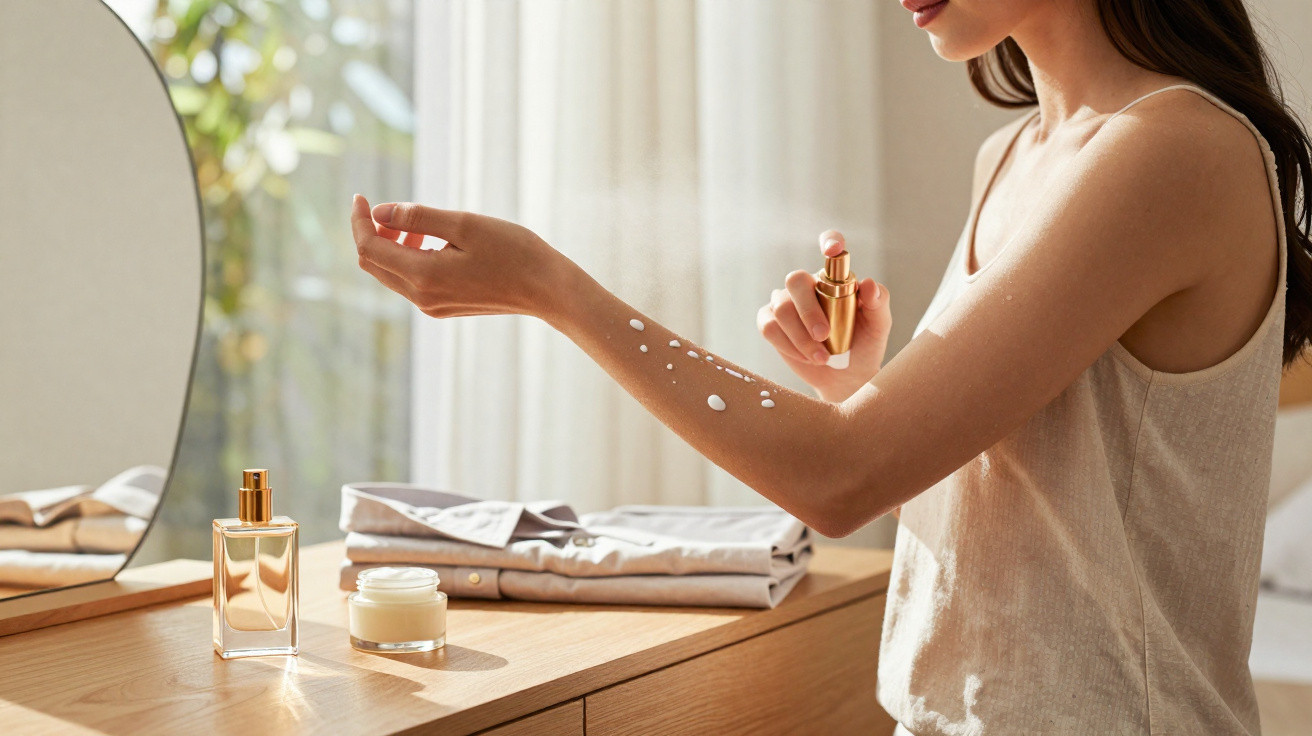
Perfume can seem magical on the skin, but for plenty of people that effect is gone well before the day ends.
Some people fault the bottle, while others keep changing fragrances, yet the answer usually comes down to skin type, poor spraying techniques and one small trick that makes a real difference.
Why the same perfume lasts all day on some people and vanishes on others
The same fragrance can perform entirely differently on two people. One person leaves a gentle scented trail for hours, while the other can no longer smell it by lunchtime. The formula itself has not changed; the difference is the surface it sits on – your skin.
The hidden role of skin type
Perfumers understand that oily and dry skin act rather like two distinct materials. Oily skin tends to retain fragrance more effectively. The lipids in its outer layer work as a light adhesive, keeping volatile molecules in place so they disperse gradually. On dry skin, however, those molecules evaporate more quickly, making the scent appear to “disappear”.
Perfume does not always fade. In many cases, it simply flies off dry skin faster than you can notice the transitions.
This explains why one person may happily wear one fragrance for years while another constantly searches for “something stronger”. The perfume may not be lacking in strength; the skin beneath it may be working against it.
Hydration: the quiet fix no one talks about
Rather than immediately replacing your fragrance, it can be more useful to adjust how you prepare your skin. Moisturised skin holds perfume more effectively.
Many professional perfumers and make-up artists rely on one particularly straightforward technique:
- Use a fragrance-free, neutral moisturiser or a very small amount of petroleum jelly.
- Put it solely on the areas where you intend to apply perfume.
- Leave it for a minute before misting perfume over those points.
This fine layer creates a gentle occlusive barrier. It reduces evaporation, helping the scent remain unified rather than dissolving into faint, short-lived traces.
Think of moisturiser as double‑sided tape for perfume: invisible, simple, and surprisingly effective.
Why rubbing and over-spraying actually damage your fragrance
Current viral advice focuses on one of the most widespread habits: spraying perfume onto the wrists, then rubbing them together or sweeping them towards the neck. People often do it automatically because they believe it “activates” the fragrance. In fact, it has the reverse effect.
Stop rubbing your wrists: what really happens on your skin
Most contemporary perfumes follow what perfumers describe as an olfactory pyramid, with fresh top notes, more intricate heart notes and richer base notes. Rubbing introduces unnecessary heat and physical disruption to that composition.
When your wrists are rubbed together, you:
- Create heat, which hastens the evaporation of top notes.
- Physically disturb certain delicate aromatic molecules.
- Reduce the natural development of the fragrance on your skin.
Consequently, the opening you enjoyed at the fragrance counter may seem sharper, briefer and less layered once you wear it at home.
Spray, then leave the skin alone. Doing nothing after application often gives a richer, longer and more faithful scent.
Why your neck is not always your best target
The neck is often recommended because it is warm and near the nose. Yet it also perspires, brushes against collars and scarves, and is exposed to sunlight and skincare products. Each of these factors can affect the fragrance or potentially irritate sensitive skin.
For this reason, many fragrance specialists now recommend avoiding direct application to the neck. Choose alternative pulse points instead, allowing the scent to rise naturally rather than collecting as one intense area beneath the chin.
Smarter perfume application: where to spray for all-day wear
The most considered approach to wearing perfume draws on warmth, movement and clothing rather than simply saturating the upper body.
The classic “hot spots” that actually help
These so-called warm points are places where blood circulation is nearer the skin’s surface. Their mild heat can help fragrance project gently as time passes. Useful areas include:
- Wrists – apply lightly and do not rub them.
- Inner elbows – protected locations with natural warmth.
- Behind the ears – particularly beneath the earlobe rather than along the hairline.
- Behind the knees – warm, discreet and mobile beneath clothing.
A reliable routine combines fragrance with hydration. Begin by applying a neutral cream to these points. Next, allow it to settle. Finally, spray perfume from a short distance and leave it to dry without disturbance.
| Zone | Strengths | When to use |
|---|---|---|
| Wrists | Simple to access, with subtle wafts as your hands move | Office, meetings, public spaces |
| Inner elbows | Sheltered and less impacted by washing | Long workdays, travel |
| Behind knees | Excellent diffusion through movement, concealed | Evenings out, summer outfits |
| Torso under clothes | Forms a personal scent bubble | Daily wear, colder seasons |
Discreet zones for a softer, more intimate trail
A powerful, room-filling scent is not for everyone. If you prefer a more personal fragrance cocoon, applying perfume to lower parts of the body can be especially effective.
Applied behind the knees, on the ankles or along the inner arms, perfume gradually warms beneath clothing. Every movement and step then releases a small cloud of scent. It feels comforting to the wearer while staying considerate towards those nearby.
Hair can retain fragrance particularly well because its cuticle naturally captures aromatic molecules. Alcohol, though, may dry the hair fibre with repeated use. Daily direct spraying can therefore leave hair brittle.
A gentler approach is to spray perfume once into the air and then walk through the mist, leaving only a light veil across the hair and shoulders. Alternatively, spray it on to a brush, wait a few seconds, and then lightly run it through the lengths.
Think about movement when choosing where to spray: areas that swing, bend and turn release scent more subtly throughout the day.
Using clothes to extend your fragrance without staining them
Your skin is not the only surface that can help. Natural clothing fibres often preserve perfume for longer than bare arms do, particularly during winter or if your skin is dry.
The right distance and fabrics
Cotton, wool, cashmere and linen are all very good at holding scent. Synthetic materials, by contrast, can alter the fragrance or shed it more rapidly.
There is one central rule for perfuming fabric safely: keep your distance. Position the bottle roughly 30 centimetres away, then spray into the air before the garment. Allow the light mist to settle instead of soaking a single area.
To minimise the possibility of marks, avoid fragile fabrics such as silk and very dark suede. If in doubt, try it first on a hidden section. Scarves, coat linings and the inside of jackets can be excellent lower-risk places to apply fragrance.
Storage habits that quietly ruin your fragrance
Many people place their preferred perfume bottle in the bathroom alongside toothpaste and skincare. This setting seldom benefits the formula. Steam, sudden shifts in temperature and direct light speed up the degradation of particular molecules. In time, notes may become dull, sour or “off”.
To maintain the scent as close as possible to its original character, keep bottles:
- Somewhere cool and dry, away from moisture.
- Away from direct sunlight, preferably inside a drawer or cupboard.
- Securely closed, rather than leaving the cap off after use.
Extra tips: matching your perfume and lifestyle
How you apply perfume should complement the type of fragrance you wear. Lighter options, including colognes and hair mists, fade more quickly by nature. They may require a top-up around midday, particularly in warm weather or on active days. More concentrated eau de parfum and extrait formulas last longer, but may become overpowering when over-applied to upper-body points.
For office settings or public transport, a sensible strategy is to combine lighter scents with discreet, lower application areas. For outdoor evenings or open environments, stronger formulas applied to pulse points and fabrics can be very effective without becoming too intense.
Perspiration, medication, diet and even hormones may subtly alter the way a fragrance develops on your skin over time. Wearing a new perfume throughout a normal full day gives a truer indication than a quick test on a paper blotter.
Simple practices – moisturising, avoiding rubbing, choosing suitable zones, making strategic use of clothing and storing bottles properly – can determine whether a scent has gone by midday or quietly stays with you from an early coffee to late-night trains.



Comments
No comments yet. Be the first to comment!
Leave a Comment