
A small rug, a television wedged into the one available corner, and a familiar sensation: wherever you stood, you seemed to be blocking the way. The owner, a young father, laughed apologetically while squeezing around the coffee table. “We tried everything,” he said, “but this room is just… small.”
The decorator then did something remarkably straightforward. There were no walls removed and no costly purchases. Instead, she made a handful of subtle changes that seemed almost absurdly easy. Fifteen minutes later, the very same room appeared to have room to breathe. Nobody was knocking into anyone else, and conversation seemed to move more freely.
In practical terms, almost nothing was different. Visually, however, everything was. The technique decorators rely on in compact living rooms is nearly undetectable if you do not know what to look for. But once you spot it, it begins to appear everywhere.
The surprising effect of “stolen space”
The designers’ smart solution is neither a magical sofa nor a miraculous paint colour. It involves borrowing visual space from the walls and returning it to the room. By adjusting height, sightlines and boundaries, they encourage your brain to reinterpret “small” as “spacious”.
Walk into any professionally styled compact living room and one detail stands out: your gaze seldom comes to rest at the furniture’s edges. Instead, it travels upwards, across and on the diagonal. The room seems to extend beyond its actual physical limits.
That is the illusion at work. The square metreage remains unchanged; what changes is how your eye interprets the space.
I spent a day following a decorator called Maya as she used this approach in a 17 m² city flat. Its living room was little more than a corridor with a window. The owner worked from his sofa, ate on it and watched Netflix from it. Despite being 38 with a well-paid job, his home had the appearance of a student bedroom.
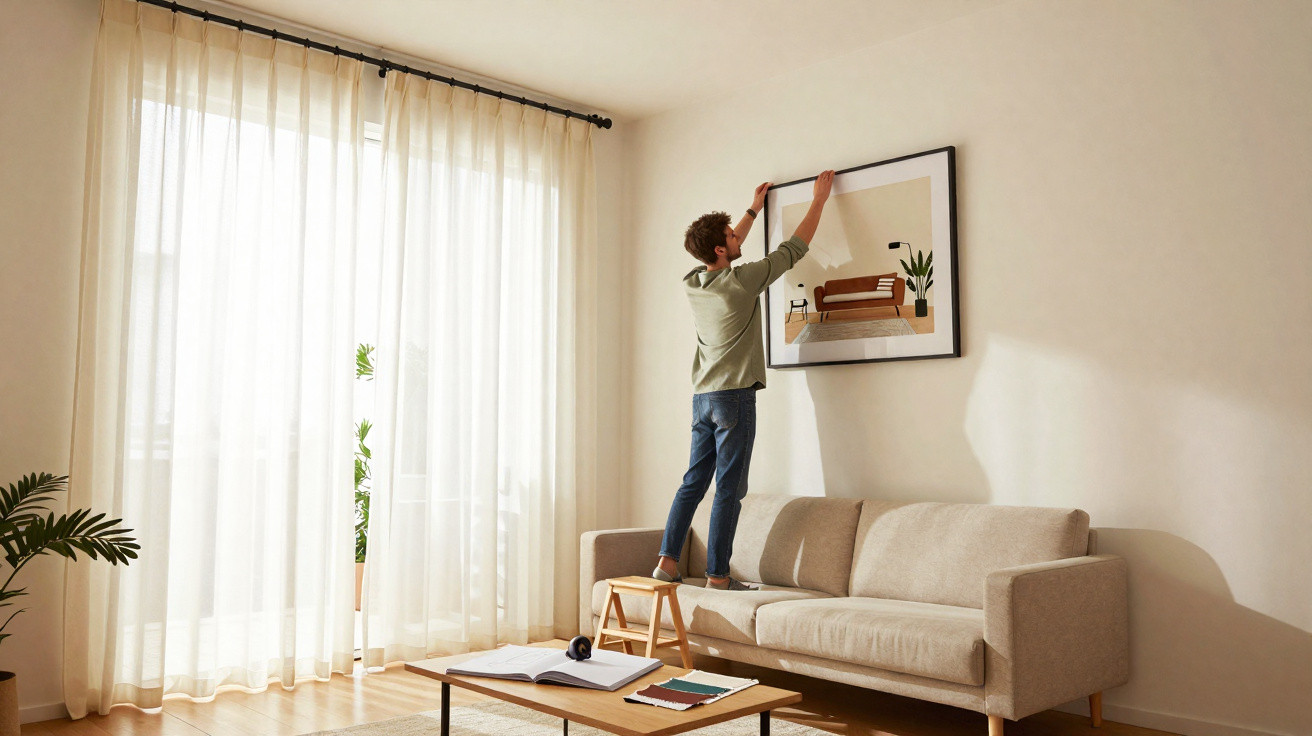
Maya did not begin by buying furniture. Her first focus was the walls. She positioned the curtain pole close to the ceiling, displayed a large vertical artwork that was wider than the small console beneath it, and swapped a short, heavy floor lamp for a tall, slender design extending above eye level.
When the owner returned that evening, he blinked in surprise. The floor, window and sofa were all the same, yet the room now felt like a “proper” living area. “Did you move a wall?” he asked, half joking, half serious.
Our brains do not assess rooms as a surveyor would. They respond to signals: the point where the eye lands, where light gathers and where furniture appears to divide the space. Low, bulky and scattered objects make a room look smaller. Long, vertical or unbroken lines, by contrast, make it appear larger.
Decorators use these cues discreetly. They draw the gaze upwards to amplify perceived height. They suggest more width by allowing rugs, art and shelving to extend beyond the furniture associated with them. They also keep as much floor visible as possible, allowing it to register as one continuous plane rather than a patchwork of obstructions.
This approach suits every budget, style and country. The principle does not change: direct the path your eye takes.
The decorator’s favourite move: oversizing and lifting
The most powerful form of this illusion comes from a single combined strategy: select fewer items, but make them larger and taller. Decorators refer to this as “oversizing with intention”. It may sound counterintuitive in a small room, yet it is often what gives the space a more generous feel.
Picture full-length curtains hung near the ceiling above a short window. Choose one substantial artwork rather than a collection of little frames. Use a rug large enough to sit well beneath both the sofa and armchair instead of a small mat stranded in the centre. Even a coffee table slightly longer than seems sensible can work.
Every one of these choices serves the same purpose: extending the room’s lines beyond its genuine boundaries.
The process is easier than it sounds. Begin with the ceiling. Fix curtain poles 10–20 cm above the window frame and allow the fabric to just touch the floor. The unbroken vertical line tells the eye that “this room is tall”, whether or not it actually is. Hang your largest artwork roughly at eye level, ensuring it rises well above the sofa back.
At floor level, select a rug broad enough to extend beneath every main seat. Even when it leaves only a narrow edge of bare flooring, it visually brings the furniture together as a single island. Next, elevate as many items as possible: use wall-mounted shelving rather than another sideboard, a floating television unit in place of a heavy media cabinet, and armchairs with slim legs rather than fully skirted designs.
The room itself does not become larger. Its negative space does.
In reality, people often become hesitant at precisely the point where the transformation begins. They fear a large rug will “eat” the room, or that a big artwork on a narrow wall will seem “too much”. They therefore opt for tiny pictures, low storage and little lamps. The outcome is a collection of separate pieces that breaks the room into visual fragments.
At its worst, this can make a home resemble a storage unit rather than a living space. At best, it remains mildly irritating. We have all experienced the moment guests arrive and we suddenly see just how cramped our home looks.
Designers encounter this reluctance constantly and treat it much like stage fright. Their remedy is to commit to one or two bold, oversized features and give them breathing room. Keep the surrounding pieces lighter and simpler. Choose fewer items and make stronger decisions.
“People think a big sofa or a huge painting will make the room feel smaller,” explains interior stylist Lina Ortiz. “It’s rarely true. What makes the room feel small is twenty little objects all screaming for attention at the same height.”
Rather than quietly resenting your limited square footage, try testing these adjustments in your own living room:
- Raise one element: the curtains, a lamp or a shelf
- Make one flat element oversized: the rug or main artwork
- Clear one area of flooring by choosing wall-mounted furniture or slim-legged pieces
Each modest adjustment redirects the eye just enough. Together, they create the “Did you enlarge the room?” effect that visitors may notice before you do.
Living with the illusion in a small living room
Once you understand how decorators deceive the eye, it is difficult not to notice it. You begin to see the generously sized rug in a tiny Airbnb you enjoyed, the curtains in a friend’s studio that begin suspiciously close to the ceiling, and the tall plants and high shelving that help your favourite café make a narrow room feel loft-like.
This does not require a spending spree or an immaculate Instagram-ready interior. Let’s be honest: nobody really does that every day. The most successful improvements can often be made on a Sunday afternoon with a drill, a tape measure and two things you already own, simply repositioned higher or replaced with something larger.
The more meaningful change happens in your attitude. Instead of battling against your small living room, you begin working with it. Walls become partners rather than mere backdrops. You recognise that one well-proportioned table can look better and work harder than five tiny side tables.
You may still catch a corner occasionally. That is part of living in a compact home. Yet the room’s overall feeling shifts from “we’re making do” to “this is how it’s meant to feel”.
That distinction is difficult to convey on a screen. In person, you sense it in your shoulders as soon as you enter. Your eyes travel slightly further, you breathe slightly more deeply, and visitors stay longer without quite understanding why.
That is the understated success of decorators’ favourite technique: no demolition, no magic mirror and no false claim of “doubling” your square metres. It simply takes a few more confident lines, a little extra height and the choice to stop thinking small just because the room is small.
| Key point | Detail | Benefit for the reader |
|---|---|---|
| Use height | Raise curtain poles, shelves and light fittings, and let curtains brush the floor | Instantly creates the impression of a higher ceiling and more generous volume |
| Be bold with larger pieces | Choose a large rug, a substantial artwork and a well-proportioned main furniture piece | Visually unifies the living room and avoids an overwhelming cluttered effect |
| Keep the floor clear | Favour furniture with slim legs or wall-mounted pieces, and limit small objects at floor level | Lets the floor read as a continuous surface, making the room look bigger to visitors |
FAQ:
- Should curtains always be hung at ceiling height in a small living room? Not directly against the ceiling in every case, but placing them higher than the window frame is almost always more flattering. Aim for 10–20 cm above the frame’s top edge so the eye sees one tall column of fabric.
- Will a large rug overwhelm a very small room? A rug that is too small visually divides the room. A larger one beneath all the main seating brings the area together, making it feel like a coherent zone rather than a set of unrelated objects.
- Can I create a gallery wall in a small living room? Yes, provided it remains compact and organised. In especially small rooms, one large, uncomplicated artwork will often stretch the wall more effectively than numerous small frames.
- How can I make a rented living room look larger without drilling? Try tension poles for higher curtains, tall floor lamps, mirrors or artwork leaned against the wall, and oversized rugs. Height and scale can still be used without altering the walls.
- Is more small furniture better than fewer larger pieces? Fewer, slightly larger pieces nearly always create a calmer and more spacious result. Three strong, carefully selected items are better than seven small ones competing for attention.





Comments
No comments yet. Be the first to comment!
Leave a Comment