
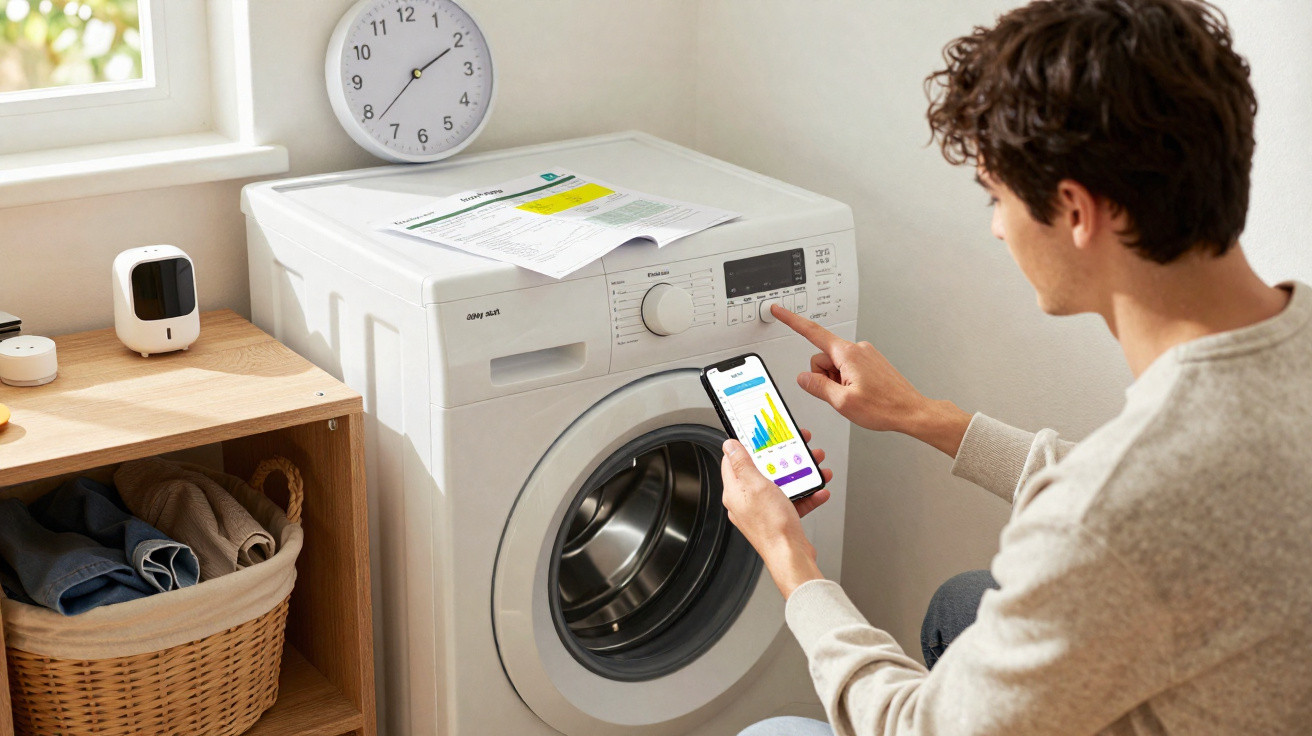
Most homes use the washing machine almost automatically: once the laundry basket is full, a cycle goes on. Yet the moment you press “start” can discreetly double or halve the electricity required for each wash. With electricity networks increasingly relying on renewable generation and flexible tariffs, the time you do the laundry can now be nearly as important as the washing machine itself.
The new power hour for your washing machine
Utilities across Europe and in many areas of the US increasingly reward customers who move their electricity use away from periods of peak demand. These incentives commonly come through “off-peak” or “time-of-use” tariffs, which charge less at selected times and more during the busy evening period.
For a washing machine, the difference in timing can have a major effect. Using the same programme just a few hours too early or too late can cost almost twice as much.
In many contracts, the cheapest window for a wash sits in a block of roughly eight off-peak hours, often at night or mid-day.
Traditionally, off-peak periods were concentrated from late evening until early morning, for instance from 10 p.m. to 6 a.m. As grids take on more solar generation, however, some areas now offer another low-demand period around midday, when rooftop and large-scale solar panels supply the network with inexpensive electricity.
How time-of-use pricing really hits your bill
Under a typical European-style regulated tariff for 2025, electricity at peak times costs around €0.27 per kWh, compared with approximately €0.2068 per kWh off-peak. Shifting each unit of electricity away from the busiest hours therefore gives a reduction of more than 23%.
A conventional washing machine consumes about 1 to 2 kWh for each cycle, with usage varying according to water temperature, programme duration and energy-efficiency class. If you do five loads each week, that can amount to roughly 500 washes annually. Moving those loads to off-peak hours can reduce annual spending by several tens of euros, without cutting back on washing or switching detergent.
For families who feel every price rise, shifting laundry to cheaper hours delivers an immediate, concrete cut in monthly bills.
In places including the UK and parts of the US, newer smart tariffs are even more flexible, with prices changing every half-hour. Under these plans, the difference between the lowest-priced and highest-priced periods can be substantial, particularly during cold winter evenings.
When exactly should you start a washing machine cycle?
There is no longer one ideal washing time for everybody in a country. Every contract has its own daily price pattern, so two neighbours with different tariffs may pay very different amounts for precisely the same spin cycle.
Step one: know your cheap hours
Most time-of-use tariffs show their off-peak periods clearly, either on your bill or in an app. These may be presented as:
- one overnight period, such as 11 p.m.–7 a.m.;
- two separate periods, for example 2 a.m.–6 a.m. and 1 p.m.–3 p.m.;
- changing daily “green” hours, frequently based on available wind or solar power.
After identifying those periods, try to time the washing machine so the entire programme runs within them. A quick wash may last only 30–45 minutes, whereas eco and cotton settings can take more than two hours.
Step two: use technology to do the boring part
Cheap laundry does not mean getting up at 3 a.m. Most current washing machines have a delay-start setting. Load the drum in the evening, set it to finish at 6 a.m., and it will begin automatically during the lower-cost period.
Where an older appliance does not offer this option, a simple plug-in timer can provide much the same outcome. Set the time at which the socket comes on, and the washing machine starts when power is supplied.
The true “best” moment is the overlap between your off-peak window and a time that still fits your routine and noise tolerance.
Some households keep laundry to one or two set days each week. This approach can make it easier to fill the drum, reduce the weekly number of cycles and fit all washing within off-peak periods.
The hours to avoid if you care about your bill
Even when a tariff initially appears to be flat-rate, the system's actual costs are often greatest in late afternoon and early evening. From around 6 p.m. to 9 p.m., demand reaches its steepest rise in many regions, as people arrive home, prepare meals, shower and switch on lights and screens.
Using the washing machine then does more than increase costs under time-of-use tariffs. It also puts additional pressure on the grid, which may contribute to higher underlying tariffs in future as network operators fund extra capacity.
For homes with rooftop solar panels, the calculation is different. Their lowest-cost electricity is often available at noon, when their own system produces the most power. Washing at lunchtime may therefore save more than washing overnight, even where midday is not listed as off-peak on the bill.
Small habits that silently burn more power
Two behaviours use unnecessary energy whatever time you wash:
- running half-full drums as frequently as fully loaded ones;
- routinely choosing high-temperature programmes, including for only lightly soiled clothing.
For normal laundry, washing at 30–40°C is usually sufficient and uses considerably less electricity than a 60°C programme. Heating the water accounts for a significant proportion of a washing machine's electricity consumption before the drum even spins.
How much difference a modern washer really makes
Good timing is useful, but the appliance establishes the starting point for consumption. Compared with a 10-year-old washing machine, newer high-efficiency models in the highest bands of the European energy label can reduce electricity use by around half.
Many such machines also use load sensors to adjust water and electricity consumption to the amount of laundry inside. As a result, a genuinely small load needs less energy rather than using the equivalent of a full-drum cycle for a handful of T-shirts.
| Washer type | Approx. use per cycle | Yearly cost (500 cycles, peak) |
|---|---|---|
| Older, basic model | 2 kWh | About €270 |
| Modern efficient model | 1–1.2 kWh | About €135–€162 |
When paired with smart scheduling, a more efficient washing machine can greatly reduce the electricity associated with laundry. In certain cases, these savings recover the difference in purchase price within a few years, particularly in countries with persistently high tariffs.
Why this “tiny” gesture changes more than your laundry
Once people begin checking the time before running their washing machine, they often apply the same practice to other energy-hungry appliances, including dishwashers, tumble dryers and electric water heaters.
Shifting several large appliances into cheaper hours can turn a small saving on laundry into a broader reduction in household energy spending.
Using electricity with time in mind also supports greater use of renewable energy on the grid. When appliances run in sunny or windy conditions, system operators depend less on gas-fired power stations. This reduces both emissions and vulnerability to fossil-fuel price shocks.
Extra ways to sharpen your savings
Pair timing with better laundry tactics
A few straightforward changes can add to the savings from running cycles at the right time:
- choose eco or cold programmes for most loads;
- separate laundry so that heavily soiled garments do not require every item to be washed hotter;
- use a faster spin speed if you intend to tumble-dry, reducing drying time;
- dry clothes outdoors or indoors on an airer whenever weather and space permit, removing one appliance entirely from the energy calculation.
For households with children or in shared accommodation, displaying an off-peak calendar on the fridge can make it easier for everyone to follow the same schedule.
Run your own quick simulation
The effect of changing laundry times can be calculated using three basic figures:
- average kWh per cycle, shown on the washing machine's label or in its manual;
- how many cycles you run each week;
- the price difference between peak and off-peak electricity on your tariff.
Multiply the kWh used per cycle by the number of annual cycles, then calculate the result at each tariff rate. The difference between the “all-peak” and “all-off-peak” totals reveals how much money scheduling alone could otherwise leave on the table. Even moving only half your loads into cheaper periods may be enough to make a different routine worthwhile.
The same calculation works for dishwashers and, in all-electric homes, for immersion heaters and storage radiators. Once you know how your tariff divides the day, every major appliance becomes a modest opportunity to spend less without giving up the same level of comfort.






Comments
No comments yet. Be the first to comment!
Leave a Comment