
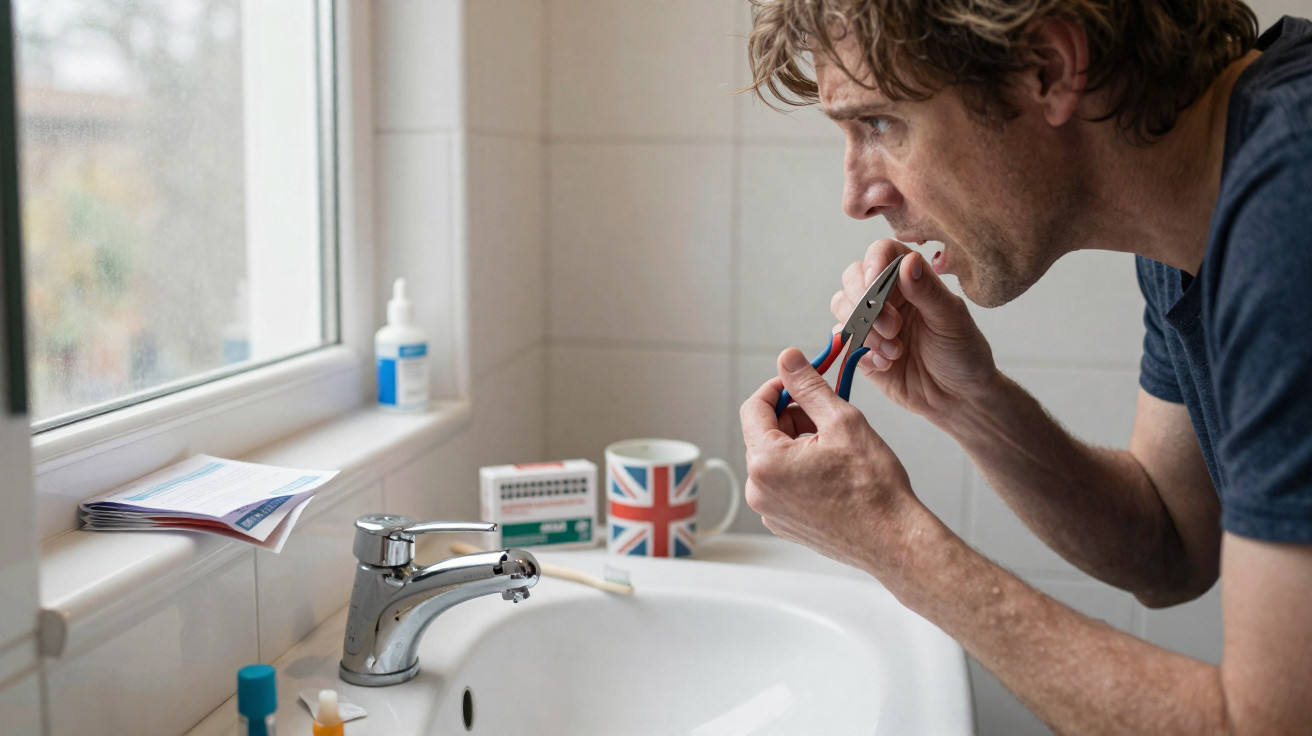
For many people across the UK, getting sufficient dental care to maintain healthy teeth has become increasingly difficult. NHS dentistry is declining, while dental hygiene poverty is growing.
Funding reductions are helping to create "dental deserts" nationwide: areas with little or no NHS dental provision, where private treatment is beyond the financial reach of many residents.
Pandemic lockdowns also stopped many people from obtaining healthcare, including NHS dental treatment. Consequently, reports from recent years of people taking desperate action to resolve dental problems are unsurprising.
A YouGov survey published in March 2023 found that one in ten Britons had "performed dentistry on themselves", including "using cement and superglue to fix crowns and dentures, killing an infection with urine, using "heated polybeads" to replace a missing tooth and applying chemical metal (an adhesive usually used for household or outdoor repairs) as a filling."
In 2022, researchers at the University of Plymouth's Peninsula Dental School documented one patient who had "used a dart to remove gross deposits of calculus", while another tried to remove 13 teeth with vodka and pliers.
DIY dentistry and the dangers of self-extraction
Many of the instruments found in a dental surgery are smaller or more specialised forms of tools that may already be in a household toolbox.
However, dental instruments are made to prevent microbes from colonising their surfaces and are sterilised after every use. The pliers used to repair the fitting behind your toilet last month are unlikely to be equally hygienic.
Removing a tooth yourself can result in an oroantral fistula: an abnormal passage between the mouth and the maxillary sinus, the hollow area within the bones surrounding the nose. A fistula measuring under two millimetres will generally close by itself, but larger ones present a substantial risk of infection.
Microbes from the mouth, along with liquids and food particles, can be pushed through the opening into the warm, damp maxillary sinus. Infection can then develop and worsen there, potentially requiring invasive surgery.
Moreover, taking out a tooth may not resolve the issue where an infection sits at the point where the tooth meets the bone. A person who gets plucky with pliers could therefore be no better off in the best-case scenario, or left in severe pain with an open wound vulnerable to secondary infection in the worst.
People carrying out DIY dentistry may also leave part of the tooth inside the gum. Fragments of the root commonly remain because roots taper to a fine point and frequently break during extraction.
This presents another infection hazard because teeth contain few, or no, blood vessels, meaning immune cells cannot combat bacteria there.
Someone extracting their own tooth would not be able to tell whether a section of root had been left behind. Should it cause trouble later, oral surgery may be needed to remove it, which can be both costly and extremely painful.
Self-extraction can also permanently change the mechanics of a person's bite, making eating painful while disturbing other healthy teeth in the jaw or injuring the mouth's soft tissues.
It's not all white
Although pain relief appears to be the reason most people turn to self-dentistry, some social media users take alarming risks purely in pursuit of a film-star smile.
There are instances of people using nail files to flatten the natural contours and irregularities of their teeth. This is highly dangerous.
Doing so strips away the teeth's tough, protective enamel and creates micro-cracks that extend into the layers underneath. This raises the likelihood of infection and decay, as well as the possibility of tooth death - all of which can lead to future pain and suffering.
Another practice is at-home whitening with hydrogen peroxide. Some people apply hydrogen peroxide solution straight onto their teeth, accepting the risk of lasting damage for a potentially short-lived benefit.
Permitted whitening products are regulated to contain no more than 0.1% hydrogen peroxide, yet users may expose their teeth to concentrations many times greater.
Hydrogen peroxide is a bleaching chemical that harms any tissue it contacts. As a result, it may seriously injure the gums or, if swallowed, the digestive tract.
These dangers underline why seeing a dentist should be the priority during an oral emergency or when pursuing cosmetic treatment - and why expanding affordable dental provision ought to be a government priority.
Quick fixes and hacks usually prove more expensive over time.
Adam Taylor, Professor and Director of the Clinical Anatomy Learning Centre, Lancaster University
This article is republished from The Conversation under a Creative Commons license. Read the original article.






Comments
No comments yet. Be the first to comment!
Leave a Comment