
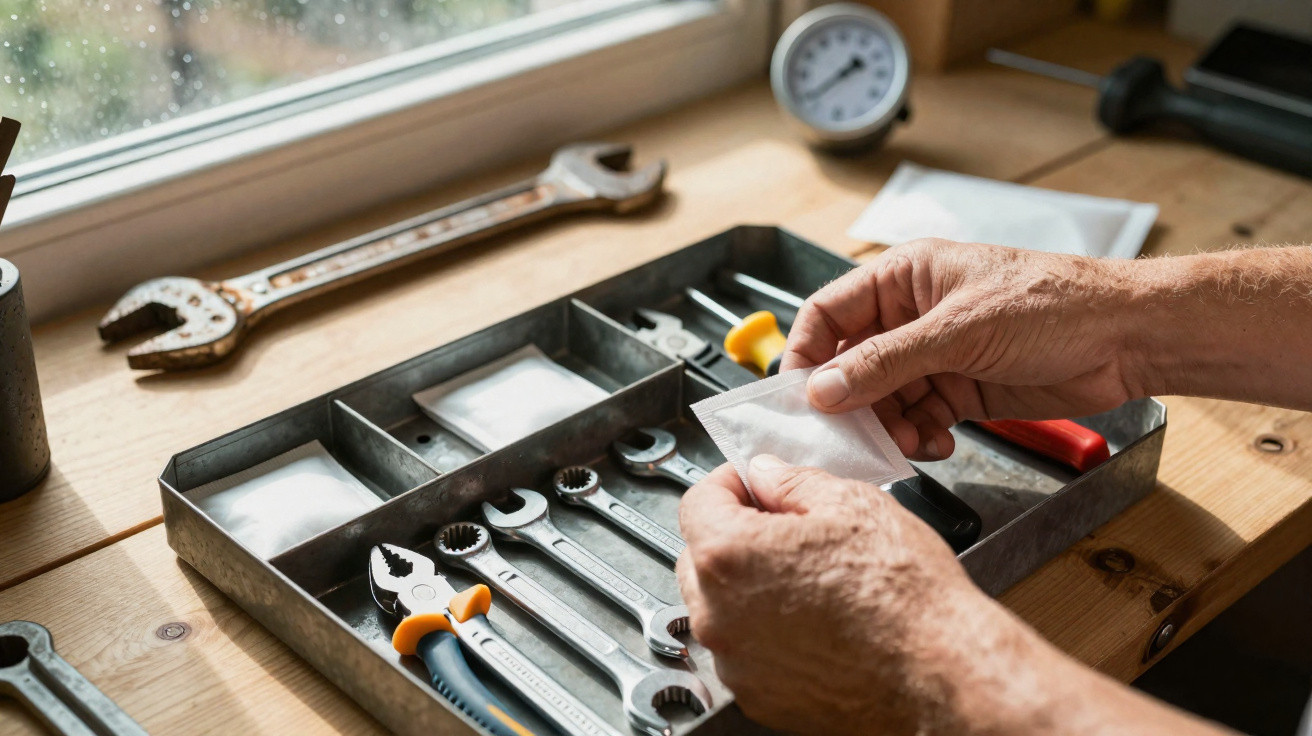
Keeping silica gel sachets in the toolbox can help lower humidity around pliers, spanners, drill bits and other metal items. The material holds back some of the water vapour in the air and, in tightly closed containers, may reduce the conditions that encourage rust to develop.
What does silica gel do inside the toolbox?
Silica gel consists of highly porous granules that trap water molecules on their surface through a process known as adsorption. Unlike a sponge, it does not soak liquid water into its interior; instead, it retains moisture from the air circulating within the compartment.
- Lowers humidity in small, enclosed spaces;
- Helps shield steel tools from corrosion;
- Reduces condensation caused by temperature changes;
- Protects drill bits, screws and accessories stored for extended periods;
- Can be replaced easily once it is no longer effective.
Why does moisture encourage rust formation?
Rust results from reactions involving iron, oxygen and moisture. When a tool is left in a damp box, a microscopic layer of water forms on the metal, making corrosion easier to occur. Dust, salts and residues left by hands can speed up this deterioration even further.
Silica gel used as a desiccant reduces the amount of available vapour, but it does not completely stop corrosion in every circumstance. Wet or contaminated tools, or those stored in a box that is continually exposed to humid air, may still rust even when several sachets are present.
How should sachets be placed in the toolbox?
Before putting tools away, clear away soil, sawdust and residue, dry every surface, and leave the box open until the inside is fully dry. Then position several sachets in the corners and between the compartments, without tearing them or scattering loose beads.
- Use undamaged sachets intended for humidity control;
- Place them in more than one area of the box;
- Do not store wet or perspiration-covered tools;
- Keep the lid shut whenever the box is not being used;
- Avoid placing the toolbox directly on damp floors;
- Check hinges, drill bits and steel components regularly.
How many sachets are needed, and when should they be replaced?
There is no universal quantity. Their effectiveness depends on the size of the box, the quality of its seal, the initial humidity, the temperature and the product's capacity. Silica can retain a substantial proportion of its own weight in water when exposed to high humidity, although that capacity differs between product types and conditions of use.
With indicating versions, a colour change shows that the material is nearing saturation, although the shades differ by manufacturer. Sachets without an indicator should be replaced periodically or according to the instructions on the packaging. Only attempt to regenerate them by heating if the manufacturer states that this is permitted.
Is silica gel on its own enough to preserve tools?
The sachets provide supplementary protection. Prevention also requires cleaning and drying tools, fixing leaks, keeping the box closed, and applying a suitable protective film to carbon-steel items where necessary. A box with holes, or one opened repeatedly, allows moisture to enter continuously and shortens the life of the desiccant.
Other household storage uses for silica gel packets follow the same principle: the material works best in small, enclosed spaces. In a toolbox, it helps slow rust, but the best results come when it is combined with cleaning, drying and regular inspections.






Comments
No comments yet. Be the first to comment!
Leave a Comment