
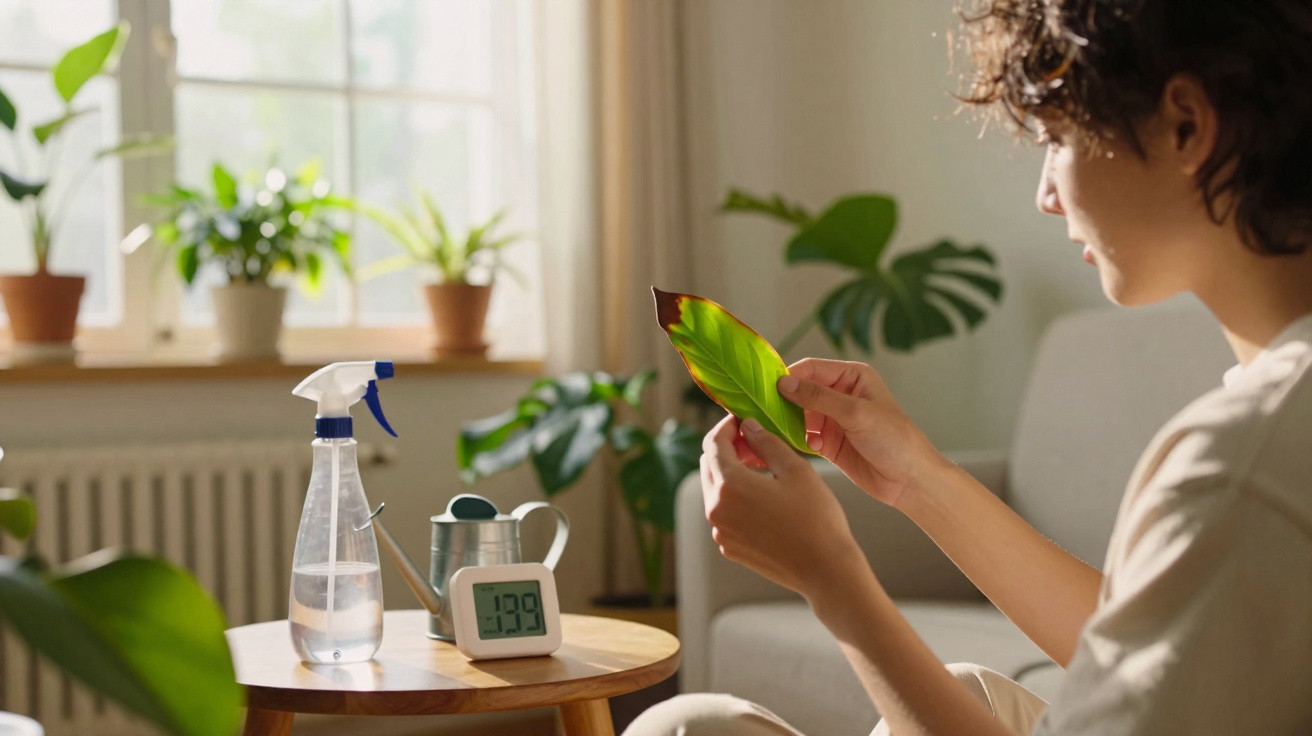
That slim brown border spreading along a leaf that was entirely green only last week is unsettling. You brush it with your thumb, hoping it might lift away like dust. It will not. Instead, it is dry, brittle and almost scorched, even though the rest of the leaf appears healthy. Alive, yet damaged.
Then you inspect another plant and find the same issue. Your spider plant has tiny brown ends, your peace lily carries a rusty rim and your fiddle-leaf fig has a caramel-coloured line along its leaf edge. It seems unfair. You water them, speak to them and turn them towards the light, but the brown tips keep reappearing.
What is going wrong in the background when it feels as though you are doing everything properly?
The real reason your houseplants get brown tips
Most people immediately assume, “I must be underwatering.” They reach for the watering can, give the plant another drink and feel they have done the right thing. A week later, there are more brown tips. The foliage can look as if it has been dipped in tea and allowed to dry, and frustration starts to build.
The surprise is that these crisp tips are usually not caused by too little water. More often, the issue lies in what the water contains and how it travels through the potting mix. The plant is taking in water, but it is also gradually accumulating something it cannot tolerate. The points furthest from the stem - the leaf tips - are the first to suffer.
One grey Tuesday morning, I saw a friend’s formerly thriving spider plant sag beneath its own leaves. Each long, curving leaf was green through the centre but dead around the edges, as though it had been singed with a lighter. She was certain she had been attentive: filtered water, bright light and regular fertiliser. The potting mix was fresh, and the pot had drainage holes. On paper, everything was correct.
We made a quick inspection. The soil was a little damp, rather than waterlogged. There were no pests beneath the leaves and no signs of sun scorch. We then lifted the plant from its pot. At the base, its roots formed a dense, tight spiral, repeatedly circling themselves: classic stress from being rootbound. Combined with a gradual accumulation of mineral salts from tap water and fertiliser, the cause became clearer. The plant was not simply thirsty or overfed; it was confined, cramped and overloaded.
This is far from an unusual situation. Surveys by indoor gardening brands regularly find that “brown tips on leaves” is among the two most commonly searched online issues for new plant parents. Yet people often settle on “it probably needs more water” or “perhaps the air is too dry”. Meanwhile, minerals from tap water and unused fertiliser are quietly building up in the soil. As moisture evaporates, the salts remain and become concentrated around the roots.
Plants draw water up through their tissues, along with those dissolved minerals. If the level becomes excessive, the plant cannot force them back down or expel them. The surplus therefore collects in the most distant cells: at leaf tips and along the edges. Those cells eventually die, producing the familiar crisp brown damage. Dry indoor air from central heating or air conditioning also causes leaves to lose water faster, putting further pressure on the same vulnerable tips.
How to fix brown tips and stop them coming back
Begin with a practice that is rarely discussed enough: flushing. It may not be an elegant term, but it works exceptionally well. Take the plant to the sink or shower and water the potting mix gently until it is fully saturated. Continue watering, allowing plenty of water to run through the drainage holes. The purpose is to rinse excess mineral salts and fertiliser residue out of the compost.
Allow the plant to drain fully, and only put it back in place once water has stopped dripping. For plants watered with tap water, doing this every few weeks can greatly reduce brown tips. It is essentially a rinsing cycle for the roots - spring cleaning for the potting mix, even in October.
Let us be honest: hardly anyone does this every day. Most of us water quickly, put the watering can away and hope that will be enough. If your plant is in a pot with no drainage holes, you are making things much harder. Extra minerals and water have no route out, so they remain around the roots and worsen the issue. Moving the plant into a pot with suitable drainage can feel like pressing reset on a struggling houseplant.
The surrounding air matters too. Brown tips are particularly common in homes with powerful heating, air conditioning or fans. The leaf ends dry first where moving air is strongest. Placing a tray of pebbles and water beneath the pot, or grouping plants together, can modestly increase humidity in their immediate area. You do not need a rainforest-level humidifier if that does not suit your home; small, steady improvements can help.
Cutting away brown areas is not merely cosmetic. A dead tip cannot turn green again, but trimming neatly into the healthy green part - while following the leaf’s natural outline - prevents the damaged section from spreading and gives the plant a cared-for appearance. Avoid cutting into soft, pale tissue that may still be recovering.
“Brown tips are almost always a message, not a failure,” says one urban plant coach I spoke with. “The plant is telling you where the stress shows first - your job is to read the handwriting at the edges.”
How can you change things without turning plant care into another full-time job? Keep it simple and repeatable:
- Use room-temperature water, and leave tap water to stand overnight when possible.
- Flush the potting mix thoroughly every 4–6 weeks for plants receiving tap water or regular fertiliser.
- Once each season, check whether roots are circling the base of the pot, and repot if they are.
- Position plants away from hot radiators, cold draughts and forceful air vents.
- Use clean scissors to trim dead tips, reducing further stress and improving airflow around the leaf.
We have all spotted another brown leaf and felt a brief pang of guilt. The aim is not an impossibly flawless, Instagram-only plant display. Plants are living things in homes that constantly change, and some deterioration is entirely normal. What counts is adjusting a few quiet habits so that your plants are not permanently close to dehydration and salt stress.
What brown tips are really telling you about your home
Treat a plant with brown tips as a small detective. Where is the damage precisely? Is it limited to the very tip, or does it cover the full edge? Does it affect only older leaves, or new growth as well? Each pattern can indicate a different part of the problem: water quality, humidity, available root space or the timing of your feeds. The more closely you observe, the less random the marks will seem.
When the oldest leaves have dry, brown tips but new leaves appear fine, this often suggests a slow, long-term salt accumulation. If fresh leaves emerge with damaged tips already present, the plant is under stress now - perhaps from a strong draught or a recent repotting with overly “hot” (strong) fertiliser. If the entire leaf margin is brown, dry air and irregular watering may be acting together, taking the plant between drought and flooding.
This is how houseplants can quietly become mirrors of daily life. Brown tips frequently appear in winter, while radiators are running and windows remain shut for days. They can follow a busy period at work, when watering becomes erratic, or a move to a new flat with harder tap water than before. These marks are not there to make you feel guilty; they are small clues that your indoor environment is changing faster than your plants can adjust.
Noticing how quickly brown tips develop, and on which plants, can even reveal your species that serve as early-warning sensors. Spider plants, dracaenas and peace lilies are well known for signalling trouble through their leaf tips long before other plants show a problem. When their tips begin to crisp, it is a prompt to pause, inspect things more carefully and adjust your routine. That brown line is a message your own home is drawing in real time.
Once you view it this way, every imperfection may become less irritating and more intriguing. The question gradually changes from “Why is my plant failing?” to “What is this plant trying to tell me about the way we live together in this space?”
| Key point | Detail | Why it matters to the reader |
|---|---|---|
| Mineral salt build-up | Salts from tap water and fertiliser concentrate in the soil and burn leaf tips. | It explains that the issue often comes from water and soil, rather than watering quantity alone. |
| Dry air and restricted roots | Heating, air conditioning and rootbound plants increase water stress and brown tips. | It helps identify household factors that can be adjusted without rethinking everything. |
| An appropriate care routine | Regular flushing, neat tip trimming and more considered watering reduce damage. | It provides simple, practical actions that fit into daily life without radical changes. |
FAQ:
- Should I cut off all the brown tips on my plant? Yes, you can trim them with clean scissors, following the natural shape of the leaf. Only remove the dead, crispy area and a tiny bit of green so the cut looks natural.
- Are brown tips always caused by tap water? No. Hard tap water and salts are a big factor, but dry air, rootbound plants and inconsistent watering routines also play a major role.
- Will a plant with brown tips ever fully recover? The damaged parts won’t go green again, but new leaves can grow healthy if you fix the underlying problem. Over time, you’ll barely see the old damage.
- Is misting the leaves enough to stop brown tips? Misting alone rarely changes much and can sometimes promote fungal spots. Focus more on flushing the soil, improving drainage and slightly raising local humidity.
- How often should I flush the soil to prevent salt build-up? Every 4–6 weeks is a good rhythm for most indoor plants that get regular tap water and fertilizer, especially in dry or heated homes.




Comments
No comments yet. Be the first to comment!
Leave a Comment