
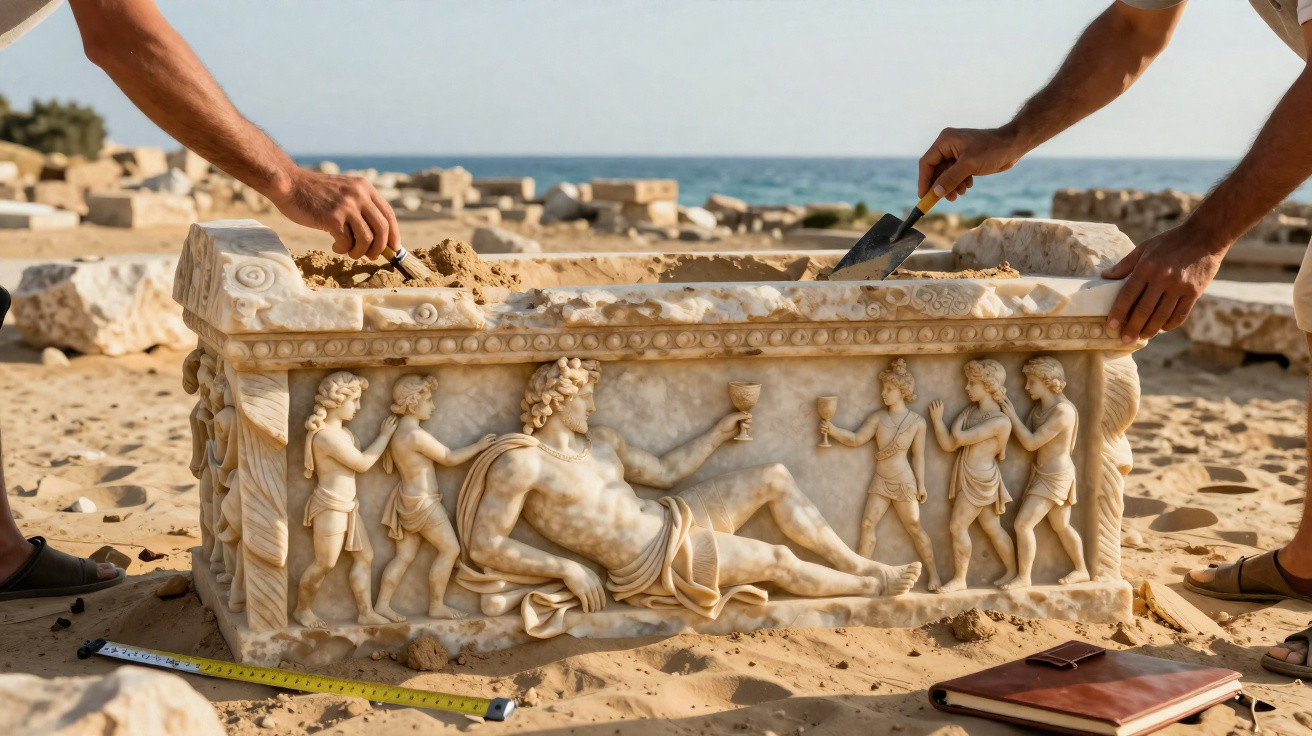
At the close of a day’s excavation in Caesarea, Israel, the tip of a marble object emerged from the sand. As archaeologists cleared the area, they uncovered an unexpected image: Hercules reclining on a lion skin, holding a cup and unable to stay upright. It formed part of a Roman sarcophagus dating back roughly 1,700 years.
How did the sarcophagus emerge in the final hour?
The discovery was made in 2025 during work by the Israel Antiquities Authority in Caesarea. Nohar Shahar and Shani Amit said the team was nearly ready to finish for the day when one end of the marble came into view. Once it had been cleaned, an almost intact panel showing Hercules was revealed first.
The find lay beyond the ancient city walls, in a burial area consistent with Roman customs. As further fragments were removed and sent for conservation, it became apparent that this was not a standalone panel. The pieces came from a large sarcophagus decorated with a continuous mythological narrative.
What was Hercules doing in the scene?
The hero is depicted after losing a drinking contest to Dionysus, the god linked with wine and ecstasy. Hercules lies on his familiar lion skin, holds a cup and appears unable to support himself. The visual joke lies in turning a figure celebrated for his strength into someone overcome by too much wine.
The scene was identified as conservators reassembled the monument. Other figures, including satyrs, maenads, Hermes and Pan, help place it within the Dionysian world. Animals and trees finish the composition, making the burial chest a lively procession rather than a solemn, silent image.
Why place a drinking contest on a tomb?
For Romans, depictions of Dionysus could evoke celebration, transformation and passage into another form of existence. Shahar explained that the carved procession may be seen as accompanying the deceased on their final journey, with drinking and dancing representing release from the restrictions of everyday life.
This does not mean that every Roman understood death in the same way. The sarcophagus most likely belonged to a wealthy pagan family, able to commission imported marble and elaborate ornamentation. Its choice of myth shows how one particular group wished to portray death, pleasure and continuity.
- The sarcophagus is around 1,700 years old and belongs to Roman-period Caesarea.
- Hercules is shown defeated in a drinking contest with Dionysus.
- Satyrs, maenads, Hermes, Pan and animals complete the carved procession.
- The funerary interpretation connects dancing and wine with the deceased’s transition into another existence.
Where did so much marble come from?
Early analysis suggests that the marble block was probably imported from north-western modern-day Turkey, an important area for quarrying and trading the stone in the Roman period. Moving such a heavy piece to Caesarea would have required substantial resources, reinforcing the idea that its owner held a high economic position.
Archaeologists believe that some of the final finishing work may have been carried out locally. This would fit a production chain in which blocks or partly prepared sarcophagi travelled by sea before receiving details near their destination, reducing risk and allowing the decoration to be tailored to the client.
What remains to be discovered about the deceased?
Conservation work may expose pigments, tool marks and details now concealed from view. The team must also examine the burial context to establish when the sarcophagus was placed there and whether other objects could help identify the person buried within it. Rich decoration does not automatically provide a name.
Even without knowing who occupied the chest, the scene preserves a striking decision. The drunken Hercules turned the final hour of an excavation into a window on Roman humour and funerary beliefs. The hero lost the contest, but his carved failure has endured for around seventeen centuries.




Comments
No comments yet. Be the first to comment!
Leave a Comment