
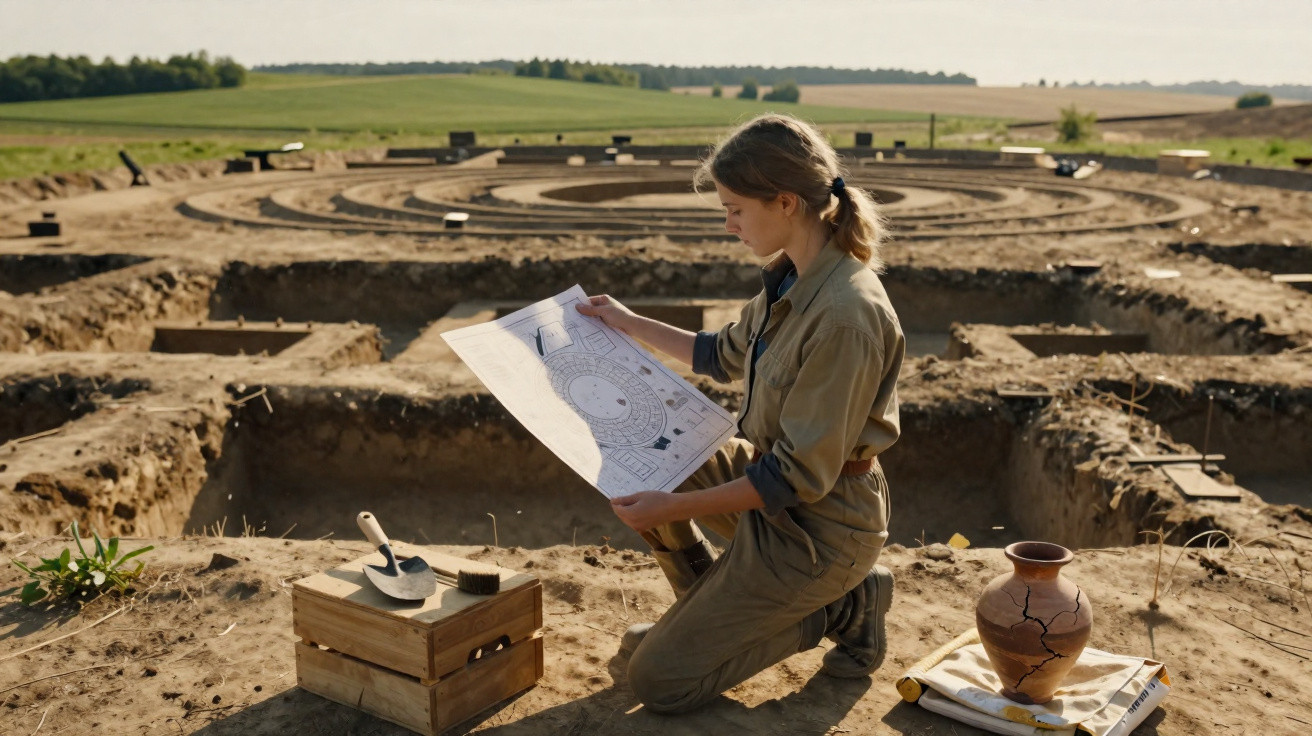
An unassuming mound on the Ukrainian steppe is causing a stir: new discoveries are calling one of history’s most firmly held assumptions into question.
For decades, the accepted view was that the first true cities arose in Mesopotamia, between the Euphrates and Tigris. Now an ancient settlement in eastern Ukraine has moved into the spotlight. Archaeologists there have identified signs of a complex, large-scale settlement that may have existed hundreds of years before the Mesopotamian metropolises, potentially shifting the familiar idea of the ‘cradle of cities’ considerably.
A site that is rewriting history after 50 years
The location itself has been known for a long time. More than half a century ago, researchers in eastern Ukraine uncovered unusual traces, including pottery fragments, remains of clay houses and dark discolourations in the soil. For years, however, the funding, techniques and wider interest needed to grasp the scale of the discovery were lacking.
That situation has changed in recent years. An international team of archaeologists is now examining the site systematically. Aerial photographs, drone surveys and modern ground-penetrating radar have produced a remarkably clear picture: this was not a small village, but an extensive settlement complex with a planned layout.
“New measurements point to an early urban settlement – large, densely built and clearly patterned, long before Babylon and Ur.”
This gives renewed force to an older hypothesis: perhaps the first cities did not emerge solely in Mesopotamia, but appeared at the same time, or even earlier, in another part of Europe.
The enigmatic Cucuteni-Trypillia culture
The settlement is attributed to the Cucuteni-Trypillia culture, which existed between around 5400 and 2700 BC across parts of present-day Romania, Moldova and Ukraine. Until recently, this cultural sphere was known mainly to specialists. That may now be changing.
These people are particularly associated with:
- elaborately painted pottery decorated with spiral motifs
- large longhouses made from timber and clay
- ordered settlements arranged in concentric rings or along clearly defined streets
- the repeated burning down and rebuilding of houses
The current investigation of the Ukrainian site indicates that the settlement covered many dozens of hectares. At its peak, it may have been home to thousands of people – far more than would normally be expected of a ‘village’.
City or not a city – what determines the difference?
The term ‘city’ tends to evoke stone walls, palaces, temples and writing. Those are features usually expected in southern Iraq or ancient Syria, rather than on the Ukrainian steppe. Even so, several criteria strongly support its city-like character:
| Criterion | Mesopotamian cities | Ukrainian site |
|---|---|---|
| Area | in some cases more than 100 hectares | probably several dozen hectares |
| Population | tens of thousands of inhabitants | at least several thousand residents |
| Settlement plan | distinct streets, districts and temple precincts | concentric arrangement of houses, regular structure |
| Writing | cuneiform, administrative tablets | no writing identified so far |
For this reason, many researchers describe such places as ‘mega-settlements’ or ‘proto-cities’ – early forms of the classical city. Whether or not the label ‘city’ is used is almost a matter of preference; the social and organisational achievement involved remains striking.
A challenge to the old idea of the cradle of civilisation
Countless schoolbooks state that the first urban revolution took place in the Near East. The plain between the Euphrates and Tigris is presented as the model for all later advanced civilisations. Temples, bureaucracy, trade and writing developed there.
The evidence from Ukraine now adds a major qualification to that account. It suggests that people in eastern Europe were planning settlements at the same time – or perhaps even earlier – that extended far beyond the scale of a village.
“The urban revolution suddenly seems less like a single event in one place – and more like a trend that reached different regions independently.”
This has consequences for historical scholarship. Research teams must ask:
- Were there several centres in which complex forms of settlement developed?
- Were ideas exchanged across vast distances, or did they emerge in parallel?
- How closely was Europe connected to wider networks before the Bronze Age?
How archaeologists interpret the Ukrainian ‘city plan’
The archaeologists working at the site are combining several modern approaches. Conventional excavations alone cannot explain an area of this size. Geophysics and remote sensing are therefore being used extensively.
Ground-penetrating radar detects minor differences in the conductivity of the subsoil. Computers then use this information to generate images of the ground plans of long-vanished houses. Drones provide orthophotos and elevation models, where former street lines appear like shadows.
In this way, a settlement plan is gradually taking shape: rows of houses separated by lanes, sometimes with a larger open space interpreted as an assembly area. The regular arrangement points to agreements, rules and shared planning – in short, an organised community with established structures.
What graves and refuse pits reveal
Burials and waste deposits provide further evidence. Grave goods can reflect differences in status. Those buried with more elaborate pottery, jewellery or weapons probably occupied a higher position in the social hierarchy during life.
In refuse pits, researchers find animal bones, plant seeds, tools and pottery. These remains make it possible to reconstruct what residents ate, which domestic animals they kept and how far their trading networks extended. Imported objects indicate contacts spanning hundreds of kilometres.
Why this debate is so emotionally charged
The question of whether a particular culture created ‘the first city in the world’ is not merely academic. It also carries considerable symbolism: being regarded as the point of origin secures a place in collective memory. States often draw on such interpretations to emphasise the exceptional age of their own traditions.
As a Ukrainian site is now discussed as a very early urban settlement, some specialists in ‘classical’ Mesopotamian research have responded cautiously. They warn against overturning established chronologies too quickly. Others see precisely this as the central appeal: archaeology depends on challenging old certainties.
“One thing is certain: every new excavation pushes the boundaries of what we thought possible a little further.”
How our view of prehistory is changing step by step
The story of early cities has been revised several times over recent decades. As recently as the middle of the 20th century, many historians believed development followed a strictly linear path: first the village, then the small town, then the large city, all neatly within one region before spreading to the rest of the world.
Today, the picture appears much more varied. Finds from China, Central America, the Indus Valley and now eastern Europe suggest that people in several places were experimenting with large settlement forms at the same time. Some of these efforts came to nothing, while others produced lasting urban traditions.
The Cucuteni-Trypillia culture disappeared long before the classical civilisations of the Mediterranean. Its mega-settlements also dissolved. The reason remains uncertain: climate fluctuations, overuse of the land, conflict or a deliberate return to smaller communities are all under discussion.
What non-specialists can learn from these discoveries
Even people who do not engage with archaeology every day can take several lessons from this debate. Three points stand out:
- History is not a fixed framework; it changes with every new excavation.
- Complex societies are not exclusive to the ‘Orient’ but emerge around the world.
- Large settlements are not guaranteed to endure – they can disappear again.
For many people, the term ‘mega-settlement’ remains abstract. It becomes more tangible when one imagines several modern villages merging into a ring-shaped belt of houses, built without modern roads or machinery and relying only on human labour and simple tools. That is apparently what happened in Ukraine more than 6000 years ago.
Anyone interested in archaeology can understand these developments through smaller examples: local museums displaying pottery fragments and models of early houses show just how much planning, craftsmanship and organisation went into early settlements. Finds from eastern Europe are likely to be given far greater prominence there in the coming years, because the Ukrainian site has created a new focal point in the debate over the ‘first cities’.






Comments
No comments yet. Be the first to comment!
Leave a Comment