
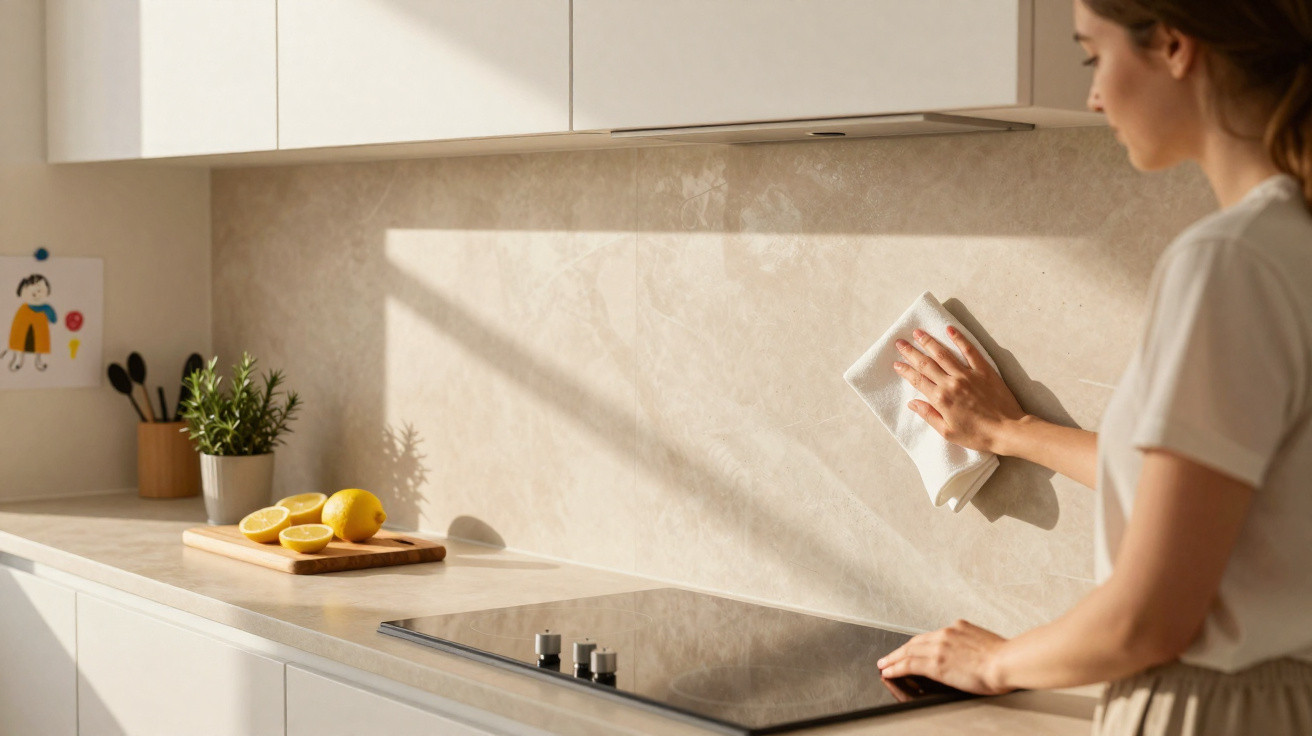
If you are planning to renovate your kitchen, you may be surprised by a clear shift in trends: tiled splashbacks with stubborn grout lines are being replaced by large-format, continuous wall panels. Running seamlessly from the worktop up the wall, they give kitchens a calm, luxurious-looking finish while requiring far less cleaning.
Why tiles are disappearing from kitchens
Grout lines: an everyday frustration
Many households know the issue well: grease, sauce splashes and limescale all tend to collect in the grout between kitchen tiles. Even specialist cleaners can quickly leave the surface looking uneven and dated. This appearance is increasingly at odds with modern kitchen designs.
“Seamless wall panels provide a smooth, continuous surface – dirt has hardly anywhere to cling to, and the kitchen immediately looks tidier.”
There is also the visual effect to consider. A tile grid breaks the wall into many small sections, making compact kitchens appear more cramped and busier. The latest generation of continuous wall cladding deliberately counters this with clean lines, minimal interruptions and a more spacious feel.
The “monolith effect”: worktop and wall as one
A key part of the trend is the so-called monolith look. Visually, the worktop simply continues up the wall, with no obvious break or change of material. This creates the impression that the entire run of kitchen units has been formed from one solid block.
- the room feels larger and more orderly
- light is reflected more evenly
- colours and veining are shown off more effectively
- cupboard fronts, handles and lighting stand out visually
Especially in open-plan kitchens that flow into the living area, this continuous wall covering creates a premium, homely impression. The kitchen looks less “technical” and more like a carefully designed piece of furniture.
Materials driving the seamless kitchen wall panel trend
Stone, high-tech surfaces and modern resins
Seamless wall cladding is not one single product, but a construction principle. A number of materials are particularly well suited to it:
- Quartz and engineered stone: highly durable, available in many understated solid shades and requiring very little maintenance.
- Dekton and other ultra-compact slabs: exceptionally hard, heat- and scratch-resistant, making them ideal behind a cooker or hob.
- Natural stone such as marble, granite or quartzite: distinctive veining and an elegant appearance, although it needs professional protection against staining.
- Solid-surface materials and resins (for example Corian and Hi-Macs): can be shaped with seamless joins, feel warm to the touch and offer a very uniform look.
- Newer composite materials made from ceramic and engineered stone: combine ceramic hardness with the stability of composite materials.
Natural, warm shades are particularly popular: sandy beige tones, pale stone greys, gentle brown graduations and muted greens. They work especially well with timber-fronted units, black taps and the currently fashionable matt metal finishes.
Surfaces: matt, satin and textured
Alongside material choice, texture also matters greatly. High-gloss finishes have fallen out of favour in many kitchens. In demand are:
- silk-matt surfaces that show hardly any fingerprints
- lightly textured finishes reminiscent of real stone
- soft, “powdery” finishes that diffuse light gently
Some manufacturers use micro-textured surfaces that create a subtle interplay of light and shadow. This is particularly striking on large-format slabs without becoming overpowering.
Seamless also means easier cleaning
Hygiene benefits in family life
Beyond appearance, the trend is convincing because of its practicality for everyday use. Where there is no grout line, nothing can become trapped. Smooth, continuous wall panels can generally be cleaned with a soft cloth and a little mild cleaner.
“Many users report: one wipe after cooking is enough – even tomato sauce and oil no longer splash into every grout line.”
Depending on the material, there may be further benefits. Some high-tech surfaces have a stain-resistant seal, while others are UV-stable and barely discolour even in rooms with plenty of daylight. This helps the kitchen retain its new appearance for longer.
Durability and long-term performance
Wall cladding behind a cooker has to withstand a great deal: heat, steam and grease splashes. High-quality slab materials are designed for these conditions. Dekton and similar products, for instance, are heat-resistant enough to come into brief direct contact with hot pans. Natural stone offers high compressive strength, but requires regular sealing.
One point remains important: there is no such thing as an “indestructible” material. Sharp objects and aggressive cleaning products can damage any surface. Understanding how the selected material responds helps to avoid costly damage.
Planning your move to seamless kitchen walls
Preparation and choosing materials
Careful planning is worthwhile before ordering a wall panel. The following steps will help:
- Define how the kitchen will be used: Will you cook frequently and at high temperatures? Are there children in the household? Is it more of a show kitchen or a working kitchen?
- Set a budget: Prices can vary considerably between materials.
- Choose a style: natural stone effect, concrete look, a calm solid colour or bold veining?
- Take precise measurements: including sockets, lighting rails and the extractor hood.
- Involve a specialist installer: particularly for natural stone and ultra-compact slabs.
Anyone with solid DIY skills may be able to work with easier-to-process resin or solid-surface panels. Heavy stone or ceramic slabs require suitable tools and experience, as a cutting mistake can quickly become expensive.
Costs, pitfalls and common mistakes
Seamless walls look sophisticated, but they cost significantly more than standard tiles once premium materials are involved. Premium slabs can cost roughly €350 to €800 per linear metre, depending on thickness, cut-outs and edge finishing.
Designers and installers pay particular attention to:
- Slab thickness: a panel that is too thin can appear unstable, while one that is too thick makes connections and finishing details more difficult.
- The substrate: it must be level, dry and load-bearing, otherwise stress and cracks may occur.
- Electrical installations: cables and sockets should be fully planned before installation.
- Coordination with the worktop: inexpensive laminate paired with a luxury wall panel can soon look mismatched.
Those intending to use their kitchen for the long term and who do not want to renovate every five years benefit most from this investment. In rented homes with limited budgets, thinner composite panels or specialist coatings can be an alternative.
How professionals incorporate new wall cladding into the overall scheme
Colour schemes and combinations
Interior designers rarely consider seamless wall cladding in isolation. It forms the backdrop against which unit fronts, appliances and decorative details are displayed. Popular combinations include:
- light stone effect + natural oak + black taps
- sandy quartz + white unit fronts + warm indirect LED lighting
- dark resin surface + handleless unit fronts + stainless-steel appliances
If you are unsure, view sample panels in the actual light of your own kitchen. Artificial lighting, daylight and reflections can alter the effect dramatically.
Practical examples from kitchen planning
In compact city flats, designers often choose light, understated wall panels without prominent veining. They make the room feel larger and do not distract from storage solutions. In spacious country-style kitchens, by contrast, a striking natural stone can become an intentional focal point.
A frequent recommendation from professionals is to extend the wall cladding not only behind the sink, but across the full length of the kitchen run. This creates a coherent frame that structures the room and makes it look noticeably more premium.
What buyers should know before signing
Certain terms come up repeatedly during consultations: “ultra-compact”, “solid surface”, “sealing”, “UV-stable”. A basic understanding of them makes decisions easier. Ultra-compact materials, for example, are pressed mixtures of minerals fired at extremely high temperatures, which is why they are so hard. Solid-surface materials, on the other hand, are cast material blends that can be joined seamlessly and sanded again.
The options for later adjustments are also worth considering. Resin and solid-surface materials can sometimes be re-sanded or repaired, whereas natural stone generally cannot. In return, every stone has its own individual veining, which is the deciding factor for many buyers.
Anyone now considering a new kitchen should at least include seamless wall cladding on their shortlist. It changes not only the appearance but also everyday work in the kitchen: less scrubbing, cleaner lines and a calmer overall impression. For many people, that becomes the decisive reason to finally leave the classic tiled look behind.





Comments
No comments yet. Be the first to comment!
Leave a Comment