
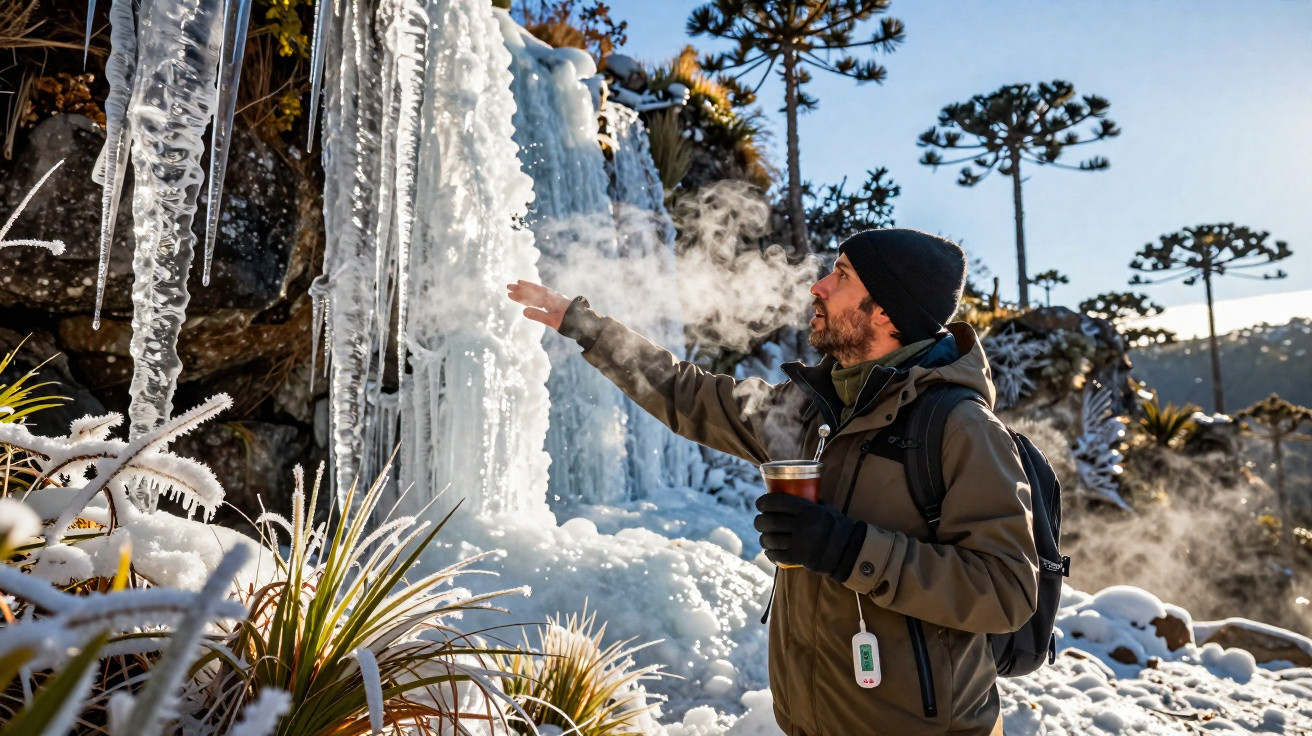
Urupema, in the Santa Catarina Highlands, is renowned for severe cold, regular frosts and an unusual Brazilian phenomenon: a waterfall that can freeze during the strongest cold spells. The municipality was officially named the National Capital of Cold in 2021 and includes some of Santa Catarina’s highest and coldest locations.
Why can Urupema record such low temperatures?
Elevation is one of the key reasons. The municipality’s higher areas rise above 1,300 metres, while Morro das Torres reaches roughly 1,500 metres, providing favourable conditions for sub-zero temperatures when polar air masses move across southern Brazil.
The mountainous landscape also encourages cooling on clear, calm nights. In June 2026, for instance, weather stations recorded -8.17 °C in Urupema; during the same event, Bom Jardim da Serra reached -8.7 °C. This shows that the National Capital of Cold title does not mean Urupema records the country’s lowest temperature in every cold spell.
- High elevation compared with much of Brazil;
- Frequent arrival of polar-origin cold air masses;
- Mountain terrain that promotes the pooling of cold air;
- Heavy frost on certain winter mornings;
- Recurrent sub-zero temperatures during the strongest events.
Watch the video from the Gi, Explore It! channel below to see what life is like in Urupema:
How does the famous Freezing Waterfall work?
The Freezing Waterfall is around 7 kilometres from the town centre and has a drop of approximately 13 metres. During prolonged periods of intense cold, some of its water freezes over the rocks and vegetation, creating sheets, icicles and curtains of ice that completely alter the waterfall’s appearance.
Why is a frozen waterfall so rare in Brazil?
Most of Brazil lies in tropical regions, where lengthy spells of sub-zero temperatures are unusual. In Urupema, the combination of elevation, terrain and polar air masses enables water to remain exposed to sufficient cold to freeze partially when atmospheric conditions coincide.
The phenomenon does not occur every winter day and cannot be guaranteed for a trip planned in advance. A run of sufficiently low temperatures is required; in severe events, water collected on the rocks freezes, forming shapes that resemble small natural ice sculptures.
- Freezing depends on the strength of the cold air mass;
- Sub-zero temperatures must last long enough;
- Shaded areas retain ice for longer;
- The formations may differ from one cold spell to another;
- A winter visit does not guarantee that the waterfall will be frozen.
When is the best time to visit Urupema?
June, July and August offer the best prospects of frost and sub-zero temperatures, although every winter has its own characteristics. The town is roughly 200 kilometres from Florianópolis and can form part of an itinerary through the Santa Catarina Highlands, alongside other Brazilian destinations sought out by people who enjoy cold weather.
Why was Urupema given the National Capital of Cold title?
The status ceased to be merely a tourism nickname on 30 November 2021, when Law No. 14,255 officially granted Urupema the title of National Capital of Cold. Its reputation stems from the combination of altitude, frost, frequent below-zero readings and winter scenery that is uncommon in a predominantly tropical country.
Urupema has therefore developed an identity closely linked to winter in the Santa Catarina Highlands. When a sufficiently powerful polar air mass reaches the municipality’s highest areas, fields turn white with frost and the Freezing Waterfall can turn flowing water into ice, producing scenery that seems far removed from the climate normally associated with Brazil.




Comments
No comments yet. Be the first to comment!
Leave a Comment