
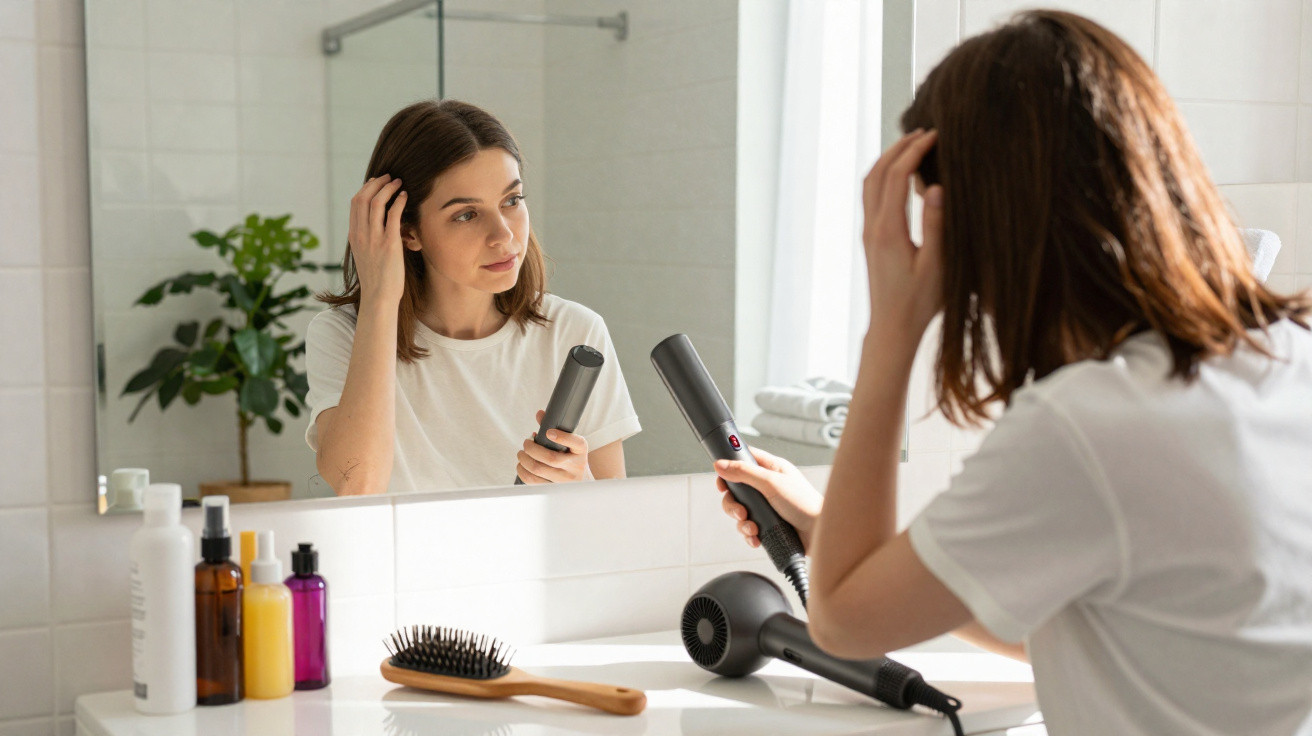
During a haircare routine, certain habits may seem harmless, yet they can undermine hair health over time. Repeated regularly, some behaviours can leave hair drier, more fragile and more likely to break.
As well as its appearance, it is important to watch for changes to the scalp, the amount of shedding and hair thickness. According to dermatologist and trichologist Dr Bianca Almeida, recognising persistent changes is essential for distinguishing damage to the hair shaft from a condition that may require investigation.
Below are common habits that can harm hair health.
1. Overusing hairdryers, straighteners and styling tools
Regular exposure to high temperatures can damage the structure of the hair. “Frequent use of heat sources, particularly at high temperatures, can contribute to dryness and breakage. There is no need to stop using a hairdryer or straighteners, but it is important to avoid very high heat and leaving the appliance on the same area for too long. Using heat protection can also help minimise damage,” explains Dr Bianca Almeida.
2. Detangling hair by pulling or using too much force
Another frequent mistake occurs when brushing or combing hair. “When hair is already sensitised, excessive pulling can increase breakage. It is important to detangle hair gently, especially when it is wet or has undergone a chemical treatment. Small adjustments to the way hair is handled can help preserve its structure,” advises the specialist. The recommendation is to detangle carefully, starting at the ends and gradually working upwards towards the roots.
3. Having chemical treatments too close together
Chemical procedures, including colouring, bleaching and straightening, should be approached with care. “Chemical treatments can significantly alter the hair’s structure, especially when they involve processes such as bleaching. If the hair is already sensitised, carrying out further procedures at very short intervals raises the risk of damage and breakage. It is important to allow enough time between treatments and assess the condition of the hair before having another chemical procedure,” highlights Dr Bianca Almeida.
Do not overlook changes in volume and thickness
Breakage is not always the main issue. Progressive thinning also warrants attention and may be linked to conditions such as androgenetic alopecia, commonly known as male- or female-pattern hair loss. For women, this change can develop gradually: the centre parting may widen, the scalp may become more visible, or a ponytail may lose volume.
“It is common for a woman to notice that her hair is finer or has lost volume without necessarily seeing very heavy shedding. Progressive thinning may be a sign of androgenetic alopecia and needs to be distinguished from breakage. The earlier we identify the cause, the greater the possibilities of establishing an appropriate monitoring and treatment strategy,” explains the dermatologist.
Do not try to treat hair loss with vitamins and products alone
When hair starts shedding more heavily, people often turn to vitamins, supplements or specific products without professional guidance. However, hair loss can have several causes, and supplementation without recommendation will not necessarily solve the issue. Hormonal changes, stress, illnesses, nutritional deficiencies and significant weight loss are among the factors that may be associated with hair changes.
“Indiscriminate use of vitamins and supplements is not recommended. When a nutritional deficiency is suspected, an individual assessment is needed to establish whether a deficiency actually exists. Hair loss can have different causes, and treatment must be directed at the problem responsible for the change,” stresses Dr Bianca Almeida.
How rapid weight loss can affect hair
Significant weight loss may also be followed by a temporary increase in hair shedding. This condition, called telogen effluvium, can appear a few months after substantial weight loss. Beyond weight loss itself, highly restrictive diets may reduce the intake of protein and other nutrients needed for the body to function properly.
“It is relatively common for patients to notice increased hair shedding after substantial weight loss. In these cases, we need to assess whether we are dealing with telogen effluvium related to weight loss or whether another condition is also present, such as androgenetic alopecia, which can cause progressive thinning of the hair,” explains the specialist.
When should you see a dermatologist?
Heavy or persistent hair loss, the appearance of bald patches, a progressive reduction in volume, thinning hair, itching, flaking or other scalp changes should be assessed by a dermatologist. It is also important to distinguish shedding from the roots from breakage along the lengths, as the two issues may have different causes and treatments.
“There is no universal routine for every hair type. Care needs to take account of the characteristics of the hair, the scalp and each person’s stage of life. When there is a persistent change, the ideal approach is to investigate the cause rather than simply trying to mask the problem with products,” concludes Dr Bianca Almeida.
By Sarah Carvalho





Comments
No comments yet. Be the first to comment!
Leave a Comment