
You buy a plant, proudly place it on the windowsill and see it as a promise of life. For the first few days, its leaves shine and the pot looks perfectly positioned. Then, without quite knowing when it began, something goes wrong. The stems grow oddly long, the leaves turn pale, and the pot stays stubbornly dry… or soaking wet. You water it, talk to it and search TikTok for advice. Nothing works.
One small detail has been overlooked. A tiny detail that changes everything.
The tiny mistake that quietly suffocates your houseplants
The same scene plays out in millions of flats: potted plants, sometimes beautiful ones, sitting in decorative outer pots with no visible hole in the base. It looks neat, stylish and Instagram-friendly. Yet the roots are slowly suffocating.
The small habit that genuinely stops plants from growing is not watering or fertiliser. It is leaving them in a container from which water cannot escape. No drainage means no proper growth.
A reader sent me a photograph of her fiddle-leaf fig. She had owned it for three years, and for three years it had never grown beyond the same 40 centimetres. She watered it “when the soil looked dry” and had repotted it into a beautiful ceramic pot… without a hole in the bottom.
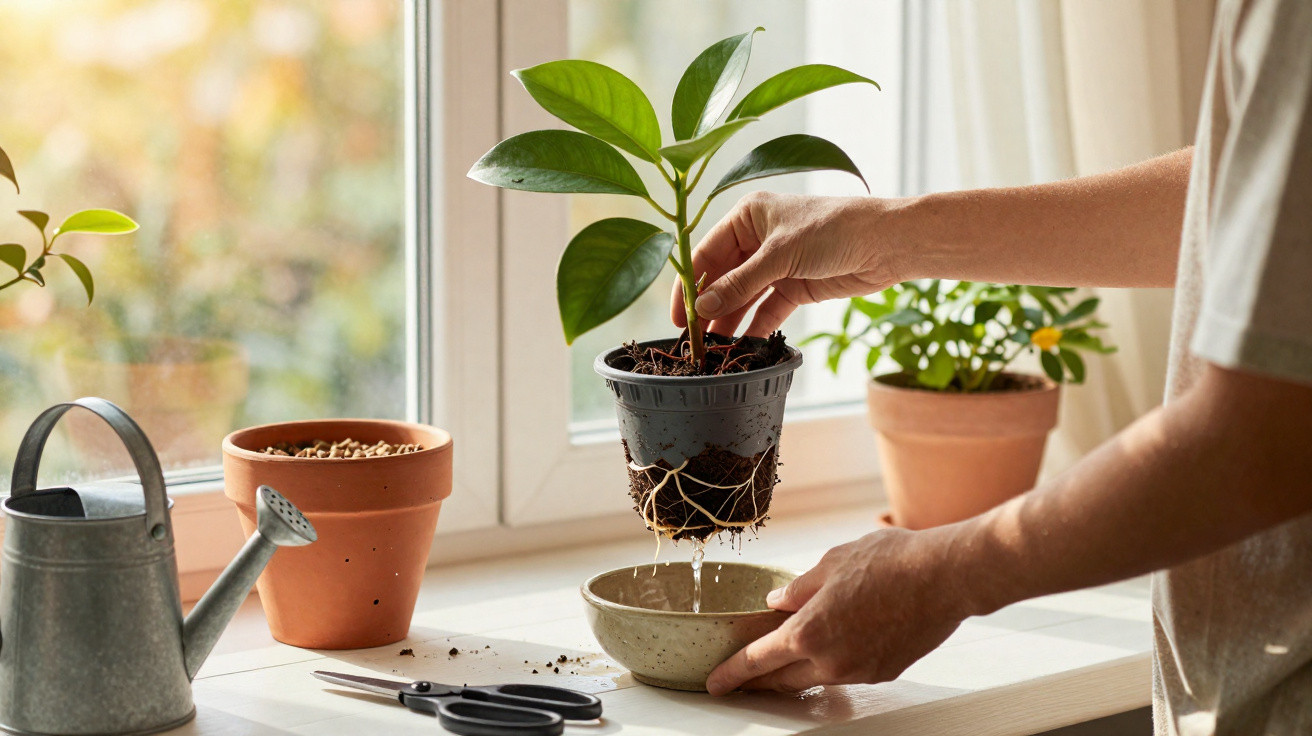
When she finally dared to take it out, its roots were a tightly packed brown mass, with a slightly sour earthy smell. New white roots were searching towards the surface, as though they were trying to escape. The fiddle-leaf fig was not short of affection. It simply lacked an emergency exit for the water.
Without a drainage hole, water collects at the base of the pot even when the surface looks dry. The roots sit in an unseen area that is waterlogged and short of oxygen. Eventually, they rot, including when you believe you are “not watering too much”.
When the roots are struggling, the plant switches into survival mode. It barely grows, turns yellow and drops leaves. We assume it needs feeding, when in fact it can neither breathe nor drink properly. The plant slowly dies in silence because one hole is missing.
How to fix it: the simple drainage routine that changes everything
The essential rule can be summed up in one sentence: always give roots real drainage. In practice, this means using a pot with at least one outlet hole, placed on a saucer or slipped inside a decorative outer pot.
Repot the plant in a pierced plastic or terracotta container, using a suitable potting mix rather than dense garden mud. Then water it over the sink until water flows freely from the base. Let it drain, and only then return the pot to its attractive outer container.
A common mistake is trying to “protect” the floor or furniture by adding a layer of clay pebbles or gravel to the bottom of a pot with no hole. It may seem like a solution. In reality, the water still stagnates. It settles beneath the root zone, creating a permanent water table, and the problem remains exactly the same.
Another trap is leaving a plant to soak for hours in a saucer full of water. Roots do not need a continuous bath; they need a cycle of moisture → partial drying → watering again.
We have all had that moment of looking at a dying plant and wondering what we did wrong. The truth is that it is not neglect; it is often a lack of understanding of what happens below the surface.
“Drainage is like the ventilation in a house: you cannot see it, but if you remove it, everything else deteriorates,” an urban horticulturist who looks after plants in Paris offices told me.
- Always choose a pot with a hole
- Allow all excess water to drain away after watering
- Empty saucers and decorative outer pots after 15–20 minutes
- Use an airy potting mix, not a compact one
- Check the condition of the roots whenever you repot
Let your houseplants breathe: changing your mindset, not just the pot
That small hole in the base of the pot also changes how we think about plants. We stop reducing every issue to “more water” or “more fertiliser” and begin thinking like a root. Can it breathe? Does excess water have somewhere to escape?
Often, the biggest transformation does not come from fresh potting compost or a grow light, but from the day you finally give trapped water a way out.
When a plant has stalled for months, the first instinct should be simple: inspect the bottom. Is there a hole? Is there a layer of brown roots with a rather strong smell? In many cases, simply repotting into a pierced pot with a lighter growing medium gets things moving again.
Let us be honest: nobody really does this every day. We are not going to inspect roots like surgeons. But we can set aside an hour twice a year to give a fresh start to plants that are suffering silently.
This small drainage detail points to something bigger: our desire to control everything on the surface while forgetting what is happening deeper down. We tend yellowing leaves, wipe away dust and turn the pot by a few degrees… while the real battle is taking place beneath the soil.
A plant that grows well is one whose need for air is respected as much as its need for water. It starts with a hole in the bottom of the pot: discreet, almost ordinary, but decisive.
In your living room, on your desk or in a bedroom that is sometimes too dark, your plants already show how they feel. Some stretch towards the light, others tense up, while others simply stop growing. Watching them, talking about them, sharing photographs and asking questions creates something close to a small underground community between people… and roots.
| Key point | Detail | Benefit for the reader |
|---|---|---|
| Essential drainage | A pot with a hole and an exit route for water are non-negotiable | Understand why plants stop growing or rot for no apparent reason |
| Wet/dry cycle | Allow the growing medium to dry partially between waterings | Reduce root rot and encourage more vigorous growth |
| Thoughtful repotting | Check the roots and soil type whenever changing pots | Give plants a genuine second chance instead of constantly replacing them |
FAQ:
- How do I know if my pot has good drainage? There should be at least one hole in the bottom, water should run out within a few seconds when you water, and the saucer should not remain permanently full.
- Can I drill a hole in a decorative pot? Yes, you can do this with many ceramic or plastic pots by using a suitable drill bit and working very slowly, although some very hard or glazed materials may crack.
- Are rocks at the bottom enough for drainage? No, rocks merely move the saturated zone higher up in the pot; they never replace a genuine outlet hole for water.
- How often should I repot houseplants? Every 1–2 years on average, or when roots circle around the bottom, the plant dries out too quickly or it stops growing altogether.
- What soil mix helps drainage the most? Use a light mix containing perlite, bark or sand, suited to the plant type: more open for tropical plants and succulents, and slightly denser for some shade-loving plants.

Comments
No comments yet. Be the first to comment!
Leave a Comment