
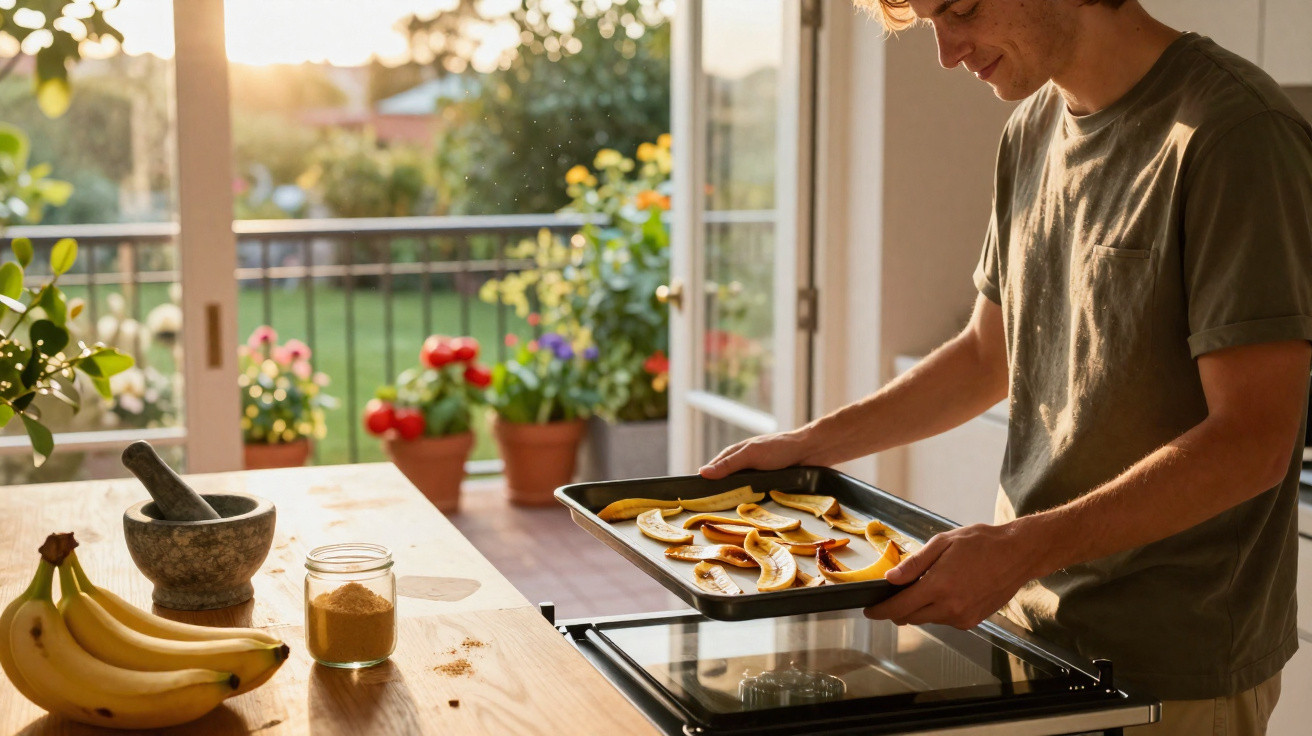
What began as a specialist suggestion on gardening forums has grown into a modest household trend: turning baked banana peels into homemade fertiliser. Households that previously put peels directly into the rubbish or food-waste bin are now treating them as an inexpensive, nearly effortless way to restore depleted soil and perk up unhealthy-looking plants.
From bin to balcony: how banana peels got a second life
Bananas are among the most commonly bought fruits in Western homes, yet their skins generally go straight into the bin or food-waste caddy. Environmental agencies in Italy estimate that the country alone discards over 250,000 tonnes of banana peels each year. Increasingly, households are viewing this waste as a free resource instead.
Laboratory testing by regional bodies in northern Italy indicates that dried banana peel may contain as much as 40% potassium by dry weight, as well as calcium, magnesium, and small quantities of phosphorus and nitrogen. These nutrients help with flowering, fruit development and overall plant hardiness, particularly in containers, where soil nutrients are quickly depleted.
Banana peels, once seen purely as trash, now sit at the crossroads of home gardening, frugality and circular economy habits.
The change has not been driven by major brands or polished advertising campaigns. Instead, it emerged organically through online gardening groups, zero-waste communities and balcony-growing forums, where people began posting before-and-after images of their plants. Many users reported greener leaves and earlier flowering after several weeks of regular application.
The 30-minute oven trick everyone is talking about
The growing popularity of this approach largely comes down to its simplicity. It requires neither specialist equipment nor a compost bin: just an oven and a little time.
Step-by-step: turning peels into plant food
- Gather clean banana peels, preferably from fruit that is ripe but not rotten.
- Arrange the peels in one layer on a baking tray, ensuring they do not overlap.
- Put them into an oven preheated to around 180°C (350°F) for approximately 30 minutes.
- Take out the tray when the peels appear dry and lightly crisp rather than burnt.
- Allow them to cool fully, then use a blender, food processor, or mortar and pestle to make a coarse powder.
- Keep the powder in an airtight jar somewhere cool and dry.
Garden centres that have trialled the technique describe the finished powder as a slow-release addition rather than an instant plant booster. When stirred into potting mix or applied as a light ring around a plant's base, it releases potassium and minerals gradually as it decomposes.
Most balcony gardeners use banana peel powder as a gentle top-up, not as a full replacement for balanced fertiliser, to avoid nutrient imbalances.
Some Italian plant nurseries say that balcony growers of tomatoes, chillies and Mediterranean herbs value this method. The powder makes a small improvement to soil structure without dramatically altering pH levels, while helping plants during flowering, a demanding stage for small container-grown specimens.
Practical benefits that keep users hooked
Those who use the technique point to several straightforward benefits:
- It produces no strong smell while being prepared or used, unlike certain liquid organic fertilisers.
- It is virtually free because it uses part of the fruit that has already been bought.
- Once dried and protected from damp, it keeps for a long time.
- It reduces the amount of organic material going into the household bin.
- It offers children a simple, practical way to understand resources and waste.
The numbers: how much money can families actually save?
Italian consumer organisations calculate that an average family spends roughly €80 annually on garden fertilisers and soil-improving products. Households that replace some of these items with homemade alternatives such as banana peel powder report saving between 50% and 80%, depending on the amount of gardening they do.
Retail businesses have noticed the shift. A number of supermarket chains now publish brief advice on repurposing vegetable scraps in customer magazines and promotional leaflets. Certain local councils also run workshops on balcony composting and DIY plant care, connecting the reduction of food waste with urban-greening policies.
The banana peel trick shows how a tiny habit shift can link household budgets, food waste reduction and greener cities.
Homemade peels vs. industrial fertilisers
This grassroots practice has prompted questions for the fertiliser sector, which puts substantial investment into standardised NPK products containing nitrogen, phosphorus and potassium. Producers maintain that laboratory-made fertilisers provide accurate, dependable nutrient proportions, which banana peels on their own cannot ensure.
A comparison between dried banana peel and an average NPK fertiliser reveals notable differences:
| Component | Dried banana peel (g/kg) | Typical NPK fertiliser (g/kg) |
|---|---|---|
| Potassium (K) | 78 | 90 |
| Phosphorus (P) | 3.1 | 10 |
| Nitrogen (N) | 5.6 | 15 |
The lower nitrogen and phosphorus content is why horticultural specialists regard banana peel powder as a supplement, not a complete fertiliser. It can support flowering and fruiting, but it cannot entirely meet the demands of heavily productive vegetables or lawns.
Consistency is another issue. Peel nutrient concentrations differ according to banana variety, cultivation conditions and ripeness. The eventual composition is also affected by drying time and temperature. Such variation is a concern for growers who need predictable large-scale outcomes, although it is less significant for casual gardeners monitoring their plants from week to week.
Safety, pesticides and the bio question
Public environmental organisations throughout Europe offer broadly similar guidance: consider how the bananas were produced. Many imported bananas have wax coatings or traces of post-harvest treatments designed to extend shelf life during lengthy transport. Although these substances are safe for people within regulated limits, they may build up in small pots or raised beds when peels are used frequently.
For regular use in soil, experts tend to recommend peels from certified organic or Fairtrade bananas, where pesticide protocols are more tightly controlled.
There are currently no specific rules covering domestic use of banana peels as fertiliser. Environmental NGOs in Italy and Spain have started calling for public-information campaigns rather than strict regulation, including leaflets, school initiatives and online guidance on hygiene, moderation and avoiding treated peels where feasible.
Professionals recommend several basic household precautions:
- Briefly wash peels under running water before drying them.
- Do not use rotten or mouldy peels, as they can introduce undesirable fungi.
- Begin with small quantities around plants and monitor their response over several weeks.
- Use banana peel powder alongside other organic matter, including compost or well-rotted manure, to create a more balanced nutrient supply.
More than gardening: a lesson in circular habits
The appeal of banana peel fertiliser extends beyond leaf colour and earlier flowers, touching on wider cultural attitudes. Parents say that children involved at every stage - eating the banana, drying its peel and feeding the plants - start reconsidering what “waste” actually is. The kitchen becomes more than a place of consumption: it turns into a small space for transformation.
In several Italian towns, schools have even made banana peel fertiliser part of classroom projects. Children bring peels in from home, dry them using small dehydrators, and apply the resulting powder to raised beds in school grounds. Teachers use the activity to begin discussions about soil health, climate change and the economics surrounding imported food.
Who benefits most from the banana peel method?
The method is not equally suited to every type of gardener. Balcony gardeners and houseplant enthusiasts often see benefits sooner because they work with small amounts of soil and comparatively few pots. For them, one jar of peel powder may last for months, supplying regular small doses of potassium with little cost or labour.
Smallholders and allotment gardeners tend to take a different view. They may apply banana peel powder as a focused supplement for tomatoes, roses, peppers or citrus plants in pots, but generally continue to rely on compost, manure or balanced organic fertilisers for most of their nutrient requirements. Where large volumes are needed, the oven-drying stage may also be impractical.
Going further: other ways to use banana peels at home
The popularity of baked peels has renewed attention on older, more traditional uses for the same waste material. Some gardeners favour cold maceration, placing fresh peels in a jar of water for several days before diluting the liquid to create a mild feed. This approach works more quickly, but it can develop an unpleasant odour and creates a greater risk of mosquito larvae outdoors.
Experiments also extend beyond gardening. Frugal-living blogs suggest banana peel infusions as a cleaner for stainless steel, while others propose adding tiny amounts of dried peel powder to composting toilets to help balance odours. Strong evidence for these additional uses is still lacking, but they illustrate how one waste material can inspire dozens of small household experiments.
What looks like a simple trick with a fruit skin actually serves as a gateway into broader conversations about resource limits and household autonomy.
For city residents without a garden or compost heap, the banana peel trend forms part of a broader range of low-tech habits: drying orange peel to deter certain insects, applying coffee grounds in controlled quantities to acid-loving plants, or fermenting kitchen scraps into small-batch fertilisers. Every method has its limitations and risks, but they all rest on one central principle: a home can operate as a micro-cycle, with the output of one activity modestly nourishing another.
As energy costs fluctuate and environmental concerns increase, these humble, almost traditional skills are attracting fresh attention. Baking banana peels for 30 minutes will not solve food waste on a large scale, but it gives households a practical, repeatable action linking the fruit bowl to the flower pots - and, indirectly, to wider debates about how modern societies treat waste, value and soil.






Comments
No comments yet. Be the first to comment!
Leave a Comment