
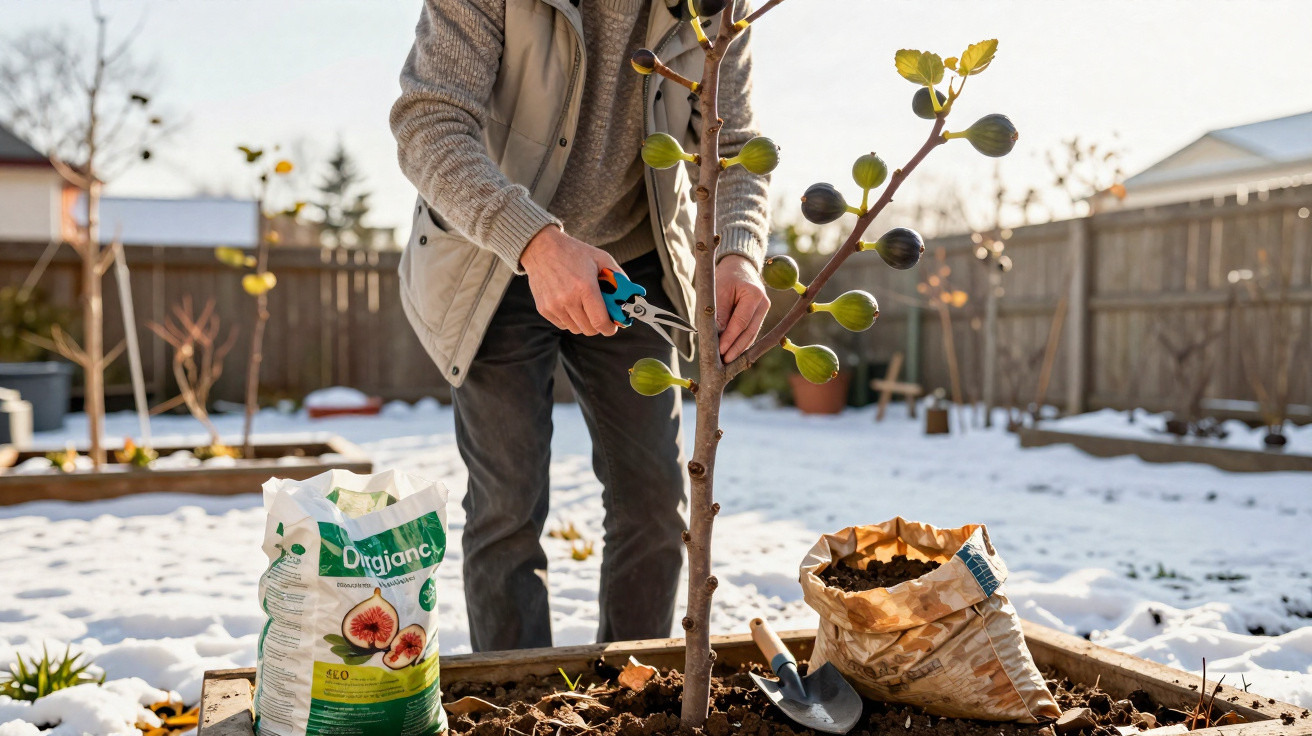
In the neighbouring garden, branches are laden with sweet figs, while your own harvest remains frustratingly sparse. Rather than blaming only the variety or the weather, it is worth looking closely at one factor many people simply overlook: correct pruning at the end of winter – along with the right care around it.
Why winter pruning determines whether branches are full or bare
A fig tree left entirely to its own devices will, over the years, develop into a real tangle of branches. They cross over, grow back towards the centre and almost completely close off the canopy.
“A dark, dense canopy is poison for fruit buds – without light and air, diseases have an easy time.”
In this stuffy central area, fruit buds remain weak. Fungal diseases spread more readily, while the plant wastes its energy on unnecessary wood and huge leaves instead of producing plump figs.
The opposite extreme is equally unfavourable: pruning a fig tree too severely can easily remove a large proportion of its fruit buds. In particular, the so-called “breba figs” – the very early first crop – are then lost. The tree may look healthy and vigorous, yet bear very little fruit.
The best time to prune is from late winter into very early spring, roughly between February and March, on frost-free days. At this point, sap flow is already beginning slowly and the buds are close to breaking. This is exactly when the tree’s energy can be directed deliberately towards the fruit-bearing parts without weakening it.
The ideal framework: four to six strong scaffold branches
Experts advise training a fig tree into a manageable, airy basic structure. The aim is four to six sturdy scaffold branches arranged around the trunk like an open goblet.
- Select only the strongest and healthiest branches
- Space them evenly around the trunk
- Choose branches that angle slightly outwards rather than back into the centre
- Avoid any with cracks, damage or signs of disease
These scaffold branches create a stable framework that allows light to reach deep into the canopy. Dead wood, crossing shoots and branches growing back towards the middle should be removed decisively at their point of origin. This keeps the centre of the tree bright and well ventilated.
It is also important to look downwards: figs readily produce so-called water shoots or suckers from the root area or directly from the base of the trunk. They may look vigorous, but they draw off a large share of the tree’s energy and rarely produce high-quality fruit.
These shoots are best removed as low down at their base as possible, rather than simply cut halfway along. A clean, smooth cut heals more quickly and lowers the risk of rot.
How hard should you prune – and where should you cut?
Once the scaffold branches have been chosen, the detailed pruning follows. Each main branch carries several side extensions that grow strongly over the year. A simple rule of thumb applies here: shorten each extension by around one third.
“Cutting back by one third awakens dormant buds further down the branch – this is where the new shoots that will later carry figs develop.”
If you remove only a very small amount, growth remains at the outer edges and the canopy becomes bare from the inside. If you cut back too hard, a great deal of fruiting wood is lost. The middle approach keeps the tree both well shaped and productive.
The crucial outward-facing bud
The cut should not be made just anywhere on the branch, but just above a bud that faces outwards. This small detail has a major effect: the new shoot will grow outwards and further open the canopy instead of closing it again.
Over several years, this creates a stable, “bowl-shaped” canopy: bright within, dense around the outside, and with plenty of fruiting branches in the well-lit outer area. Diseases spread more slowly, and chemical treatments become unnecessary in many cases.
Location, soil and fertiliser: without these basics, the canopy stays empty
Even perfect pruning cannot fully compensate for an unsuitable location. Figs need one thing above all else: sunshine. At least six hours of direct sunlight each day is a useful guideline.
A spot in front of a south- or south-west-facing wall is ideal, as it stores warmth and provides shelter from wind. Exposed sites, especially those affected by cold easterly winds, slow growth and can damage young shoots.
The soil should be relatively light and free-draining. Waterlogging around the roots quickly causes problems. A slightly acidic to neutral pH of around 6 to 6.5 is ideal.
A mulch layer around the trunk is particularly helpful:
- A depth of between 5 and 20 centimetres
- Materials such as leaves, chipped branches, straw or bark mulch
- Do not press it directly against the trunk; leave a little space
Mulch keeps the soil more evenly moist, shields the roots from temperature extremes and supports soil life. It helps the tree maintain steadier growth, particularly during dry summers.
Fertilising correctly: fewer leaves, more fruit
Many gardeners want to “do something good” for their fig tree and use fertiliser that is too high in nitrogen. The result is huge leaves and long shoots – but disappointingly few figs.
“Too much nitrogen promotes leaf growth, not fruit. Potassium and phosphorus are far more important for figs.”
A balanced fertiliser for fruit trees or soft fruit, with a high potassium and phosphorus content, is a sensible choice. Well-rotted compost also works well when lightly worked into the topsoil in late winter or early spring.
Applying it once a year is usually entirely sufficient. In nutrient-rich soils, mulching alone and adding a little compost from time to time will often be enough. Over-fertilising makes the tree more susceptible to frost and pests, while shifting the balance in favour of leaves.
Unifere or bifere figs – and why the variety matters in northern areas
Fig trees differ in how often they fruit each year:
- Unifere figs: one main crop in late summer
- Bifere figs: a first crop in early summer (breba figs), followed by a second in late summer
In cooler regions with late frosts, bifere varieties have a harder time. Their early fruitlets can easily freeze before they ripen. Gardeners in northern areas with a harsher climate are often better served by unifere varieties, which put all their energy into one more reliable late crop.
There is another point that hardly anyone considers: some traditional fig varieties require a particular small wasp for pollination. This insect is completely absent in many areas. Such varieties may form flower buds, but without a pollinator they produce hardly any usable fruit – no matter how carefully they have been pruned.
Practical advice on pruning time and common mistakes
Anyone attempting their first winter pruning should take their time and inspect the tree from every angle beforehand. A sensible order is:
- Remove dead and clearly diseased wood
- Cut away suckers and water shoots at the base
- Identify four to six scaffold branches and remove competing branches
- Shorten the remaining shoots by about one third, always cutting to an outward-facing bud
Common mistakes include:
- Pruning during a hard frost or immediately before a forecast cold snap
- Cutting back to “stubs” that later heal poorly
- Having no clear framework, with too many scaffold branches shading one another
- Applying fertiliser that is too high in nitrogen after pruning, causing excessive leaf growth
Why patience with a fig tree is rewarded
Many fig trees need three to five years before they truly get going. Those who consistently maintain an airy canopy, prune regularly but moderately, and provide a suitable site during these years create the basis for abundant harvests over decades.
Figs respond far more strongly to light conditions and air circulation than traditional pome fruit trees. A tree with a well-formed “open goblet” will generally produce more and better fruit than a wild, bushy specimen, even when both are the same age.
If space is limited, a fig tree can even be trained as an espalier against a warm house wall. The basic principles remain unchanged: a few strong main axes, a clear structure, cuts made to outward- or sideways-facing buds, and close attention to dead or diseased wood.
Experience builds with every winter pruning session. After two to three years, the change is usually clear: where only a few sad figs once hung, the branches now bend noticeably under the weight of the fruit – and the previously inconspicuous tree becomes the garden’s secret star.






Comments
No comments yet. Be the first to comment!
Leave a Comment