
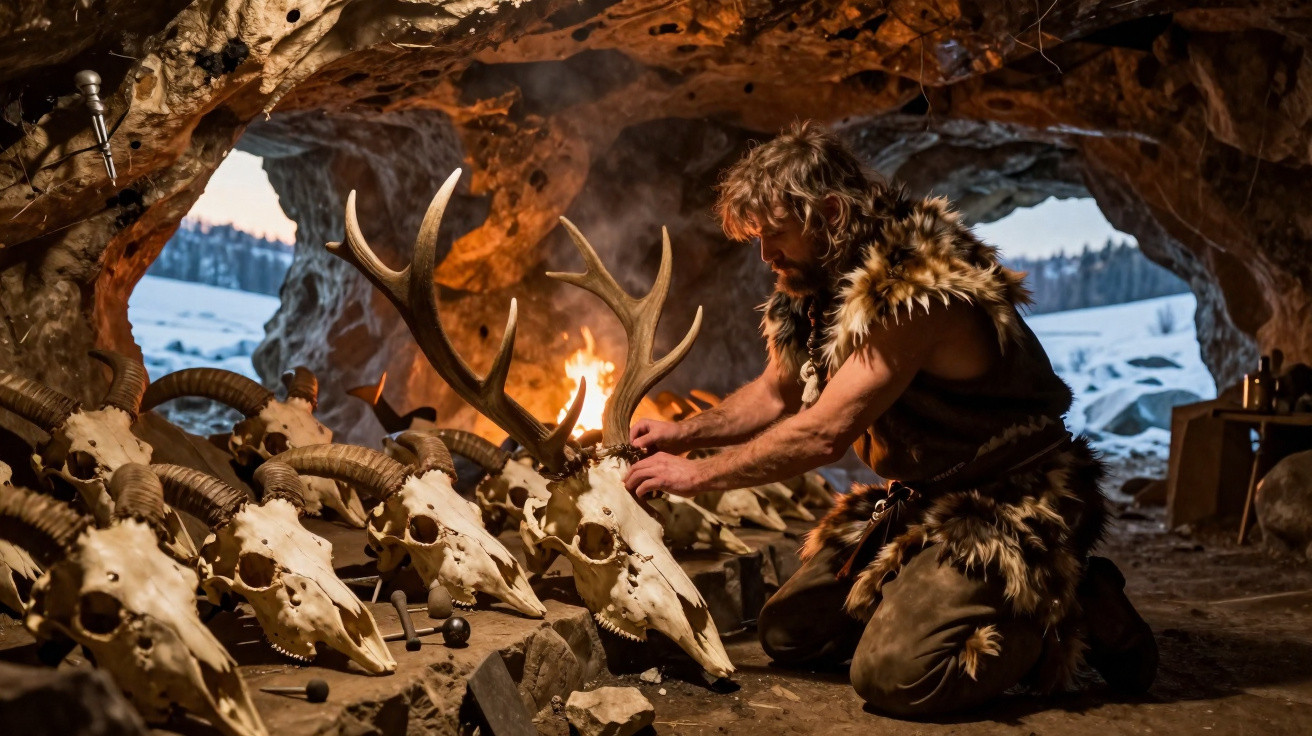
The skulls came from enormous Ice Age animals, and Neanderthals placed them in the cave more than 43,000 years ago. Archaeologists now believe this unusual activity continued for centuries, perhaps much longer, and was scarcely connected with hunting or eating. What these people were doing inside the cave remains unknown - yet the site is making researchers reconsider just how elaborate and nuanced Neanderthal culture may have been.
A cave filled with heads and horns
The account focuses on Des-Cubierta cave in central Spain’s Lozoya Valley, which was first identified in 2009. Researchers found an extraordinary collection inside: 35 skulls of large mammals, many still topped with horns or antlers. The assemblage contained steppe bison, aurochs (wild cattle), woolly rhinoceros and red deer.
Every skull in the cave belonged to a horned or antlered species, and jaws were almost always missing.
This deliberate-looking choice was striking. Few other bones from the same creatures - such as limbs, ribs and vertebrae - were present. However, deposits nearby contained more than 1,400 stone tools made in the Mousterian tradition, securely linking the cave with Neanderthals rather than modern humans.
The cave does not appear to have been a dwelling. It contains no unambiguous evidence of hearths, bedding or the discarded waste normally associated with a living area. Instead, Des-Cubierta seems to have been somewhere Neanderthals returned to repeatedly in order to deposit particular objects.
Separating rockfalls from rituals
Des-Cubierta was not left untouched. Across many millennia, falls from its ceiling and walls scattered rock and bone throughout the space. To establish what Neanderthals had genuinely done, the researchers needed to distinguish the consequences of gravity and passing time from intentional human actions.
Archaeologist Lucía Villaescusa Fernández and her colleagues plotted every bone, stone and piece of fallen rock. They then compared the arrangements, examining skull locations, accumulations of rock and clusters of tools.
The distribution of skulls and tools did not match the pattern expected from natural rockfall, pointing to purposeful placement.
The research, published in Archaeological and Anthropological Sciences, finds that Neanderthals carried the skulls into the cave and positioned them in selected places. They returned to the same areas repeatedly over long periods, between 135,000 and 43,000 years ago, including some of the Ice Age’s coldest intervals.
If it was not dinner, what was it?
One of the most notable aspects is what the skulls lack. They do not resemble debris from butchery. Jaws, which contain substantial meat and marrow, are generally absent. There are few cut marks. Many crania retain the bony horn or antler bases, despite these robust materials being potentially useful as raw resources.
This evidence makes a straightforward practical explanation less convincing. The skulls were not merely the remains of meals piled conveniently in one part of the cave.
The evidence suggests a practice that was not directly tied to survival needs such as food or toolmaking.
What, then, was happening? Archaeologists are careful not to claim outright that this was “religion” or “ritual”, as such labels bring modern assumptions with them. Nevertheless, researchers are considering several explanations:
- Symbolic displays: Horned skulls may have acted as visual signs connected with group identity, stories or beliefs.
- Hunting trophies: The heads of formidable prey may have recognised skill or bravery, rather like modern trophy rooms.
- Territory markers: The cave could have functioned as a distinctive place known across a valley-wide Neanderthal network.
- Teaching spaces: Older people may have used the skulls to instruct younger hunters about animals and hunting methods.
Bones alone cannot prove any of these possibilities, but the continuation of this behaviour across many generations suggests a common tradition. It was transmitted, repeated and seemingly treated with respect.
What Des-Cubierta reveals about Neanderthal minds
For many decades, Neanderthals were portrayed as dull, unimaginative brutes. That view has increasingly eroded. Evidence has accumulated for intentional burials, personal ornaments fashioned from eagle claws and shells, and pigment use.
Des-Cubierta contributes another element to this picture. Rather than body-worn ornaments, the site shows a landscape altered to convey meaning. The cave itself became a type of symbolic container.
The site suggests Neanderthals created traditions with their own logic, not simply copying what later Homo sapiens did.
French archaeologist Ludovic Slimak characterises this development as a shift in the question being asked. Rather than questioning whether Neanderthals were “like us”, researchers are exploring the kinds of meaningful behaviour they created on their own terms. Des-Cubierta provides a restrained but persuasive answer: something complex was taking place.
| Evidence from Des-Cubierta | What it hints at |
|---|---|
| Only horned or antlered species | Selective, possibly symbolic choice of animals |
| Skulls without jaws or most other bones | Not simple food waste or random discard |
| Repeated use of the same cave areas | Long-term tradition within a group or region |
| Cave not used as a dwelling | Space reserved for special, non-domestic activity |
A cold setting: life in Ice Age Iberia
These Neanderthals lived during a severe climatic period. From 135,000 to 43,000 years ago, central Iberia experienced repeated changes between cold, dry conditions and somewhat milder phases. Steppe bison and woolly rhinoceros crossed open plains, while forests contracted and spread again with every climatic shift.
Keeping a shared tradition alive through such unstable conditions points to strong social bonds. Groups followed herds, endured harsh winters and nevertheless continued returning to one particular cave to carry out the same, still enigmatic action.
Such repetition suggests stories that have since vanished: accounts of powerful animals, perilous hunts, ancestors or spirits associated with horns and antlers. Their words are lost to us, but their actions preserve a faint trace of their narrative world.
What “symbolic behaviour” means in this context
Archaeologists use the term “symbolic behaviour” when objects represent ideas. A painted symbol might represent a clan, while a shell necklace could indicate status or belonging. At Des-Cubierta, the proposal is that the skulls represented something more than meat or bone.
For readers, the concept can be separated into more straightforward points:
- Someone selected the objects that would be brought in.
- They put them in locations that held significance for them.
- Other people understood that significance sufficiently to repeat the act.
Together, these three stages show abstract thought, mutual understanding and memory maintained across generations - all essential components of culture.
How scientists distinguish natural and human patterns
At first sight, mixed bone and rock inside a cave may seem entirely chaotic. To determine whether people were involved, researchers now use methods that would have astonished a Victorian fossil hunter.
At Des-Cubierta, the team carried out detailed spatial analysis. They logged the exact three-dimensional location of every object. Software then assessed whether the resulting distributions matched patterns expected from gravity, flowing water or a collapsed ceiling.
When the pattern of skulls and tools breaks the rules of natural forces, human agency becomes the most likely explanation.
This kind of modelling is now becoming routine in cave archaeology. It enables research teams to identify subtle activities that may not be visible by eye, including routes through a site, favoured corners and separate “zones” serving different purposes.
Why Des-Cubierta changes how we see Neanderthals
Discoveries of this kind have significant wider implications. School books and documentaries still frequently present Neanderthals as supporting figures in the story of Homo sapiens. A cave containing carefully positioned skulls instead points towards something like a parallel history, with separate rituals and values.
For teachers, museum guides and parents speaking with inquisitive children, Des-Cubierta provides a clear example:
- Neanderthals hunted large, dangerous animals.
- They took selected parts into a special cave.
- They revisited that cave over thousands of years.
- They followed a practice that extended beyond basic survival.
This sequence is more readily imagined than broad statements about “complex cognition”. It makes a distant human species appear more recognisably human, without suggesting that Neanderthals thought in precisely the same way as people today.
The next stage will be to compare Des-Cubierta with other sites containing unusual accumulations of animal parts, ranging from piles of antlers to deer-skull headdresses among later hunter-gatherer groups. By assessing both similarities and differences, researchers hope to determine whether Neanderthal practices represented a distinctive cultural tradition or reflected patterns that emerged repeatedly throughout human history.





Comments
No comments yet. Be the first to comment!
Leave a Comment