
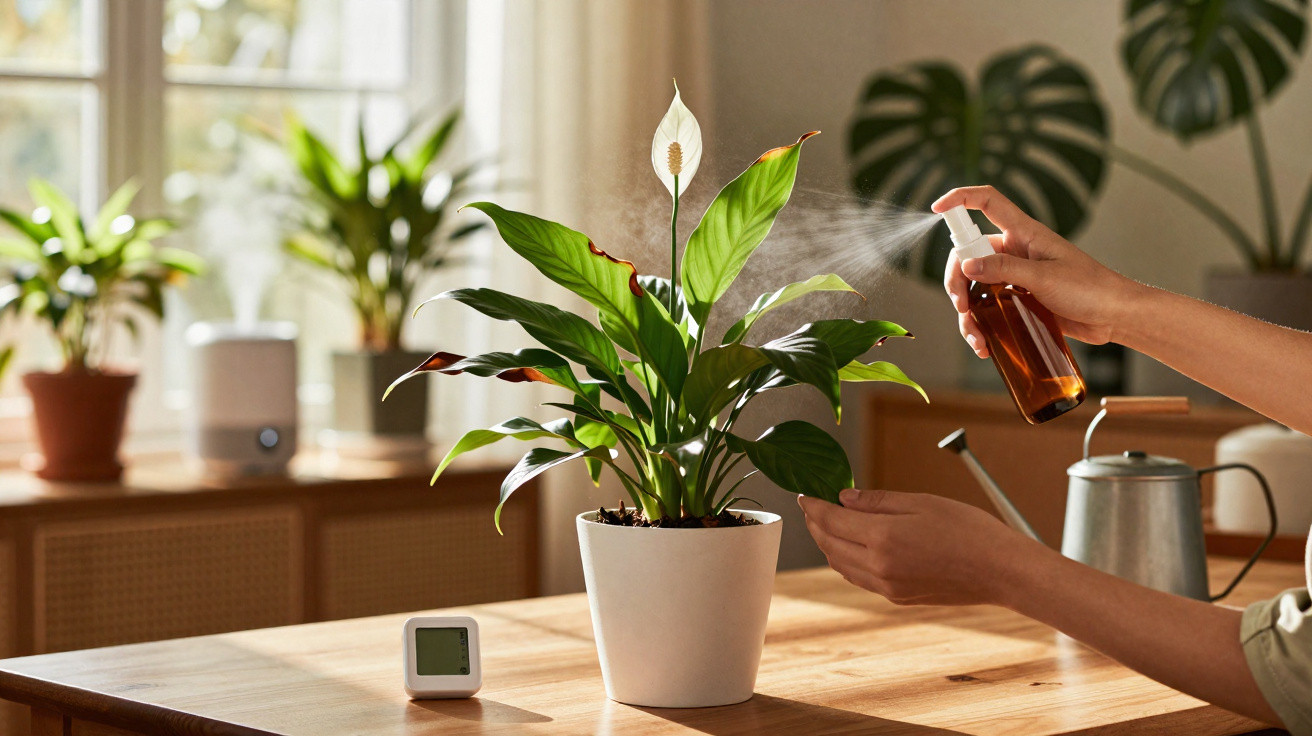
It is not happening at random.
The peace lily (Spathiphyllum) is accommodating, yet it shows signs of stress quickly. Brown areas and crisp leaf tips are the plant’s way of flagging an issue with humidity, watering or light. Here is how experts interpret these clues and the minor changes that can restore rich green foliage.
What brown tips on a peace lily are telling you
Brown marks on a peace lily generally point to unsuitable care rather than a terminal disease. Dry air, inconsistent watering, mineral-heavy tap water and intense sunlight can all prompt this response. Because each problem affects the foliage in a slightly different way, you can narrow down the right remedy.
Most peace lilies want consistently moist soil, bright but indirect light, soft water, and humid air. Miss one, and the leaf edges speak up.
The five usual suspects
Low humidity
Dry air indoors draws water from the peace lily’s delicate leaves. The margins usually become tan before larger portions turn brown. The issue becomes more pronounced close to radiators, heating vents and rooms exposed to continual air movement.
- Aim for 45–60% relative humidity around the plant; in winter, many homes are at roughly 30%.
- Use a compact humidifier nearby during the heating season; a timer can help maintain stable levels.
- Position plants together to make a shared microclimate, or stand the pot on a pebble tray containing water below the base of the pot.
- Misting provides only brief relief and may leave marks on foliage when the water is hard.
Underwatering
If the root ball becomes dry, the leaves can wilt dramatically before their tips become crisp. Watering revives the plant, but any brown areas will not return to green.
- Test the compost twice a week; water once the top 2.5 cm feels lightly dry rather than dusty and completely dry.
- Water generously until surplus runs out, then tip out the saucer. Small amounts of water can leave the centre of the root ball dry.
- Where compost has shrunk away from the pot, immerse the pot up to its rim for 10–15 minutes to re-wet the growing medium.
Overwatering
Soil that remains saturated deprives roots of oxygen, causing stress and making rot more likely. Leaves start to yellow from the bottom before brown patches develop. Growth becomes slower, while the pot remains heavy for several days.
- Choose a pot with a drainage hole, and do not use a decorative cachepot unless it contains an inner nursery pot.
- During lower-light months, allow the top 2.5 cm of compost to dry before watering again.
- If the roots smell sour or feel soft, repot the peace lily in fresh, free-draining compost and cut away damaged roots.
Chemicals in tap water
Peace lilies may be sensitive to fluoride and high levels of dissolved minerals in mains water. Leaf tips can turn brown, sometimes with a fine pale border around the edge. A white deposit may also appear on the compost surface or pot rim.
- Change to rainwater, distilled water or filtered water. Leaving tap water overnight allows chlorine to disperse, but it will not remove fluoride.
- Every two to three months, flush the pot with clean water to clear accumulated salts.
Too much sun
Direct sunlight can scorch the plant’s thin leaves. Look for pale, crisp patches on the side facing a window or grow light.
- Set the plant a few feet from a bright window, or filter the light with a sheer curtain.
- Provide bright, indirect light; north- or east-facing positions commonly suit it, as does a mid-room spot near a south-facing window.
Quick diagnostic snapshot
| Symptom | What to check | Likely cause | First fix |
|---|---|---|---|
| Crisp brown tips on an otherwise green plant | Humidity in the room, nearby heater | Low humidity | Add a humidifier and move it away from the heat source |
| Sudden wilting, followed by brown tips after recovery | Completely dry compost, lightweight pot | Underwatering | Soak deeply, then follow a regular routine |
| Yellow leaves alongside brown patches | Compost wet for days, heavy pot | Overwatering | Extend the gap between watering; improve drainage |
| Brown margins with a pale halo, crust on compost | Signs of hard tap water | Fluoride/salt sensitivity | Use rainwater or filtered water; flush the compost |
| Pale, crisp patches facing a window | The room’s light pattern | Sun scorch | Move to bright, indirect light |
Should you cut brown leaves?
Yes. Remove completely brown leaves at the base with clean scissors or secateurs. On leaves with brown tips only, cut off the affected section while following the natural outline of the leaf for a neat finish. Taking away damaged material lets the plant direct energy towards healthy growth and stops dead tissue from harbouring fungal spores.
Keep the soil evenly moist, never soggy. When in doubt, check with your finger before you water, not after.
A peace lily watering, light and potting routine that works
- Water: Soak thoroughly, then wait until the top 2.5 cm is just dry. Expect the plant to use water more slowly in winter.
- Water quality: Choose rainwater, distilled water or filtered water to prevent fluoride stress. Flushing monthly helps prevent salt accumulation.
- Light: Bright, indirect light is best. Turn the pot each week to promote balanced growth.
- Humidity: Keep humidity at 45–60%. Pebble trays and small humidifiers are straightforward, low-effort choices.
- Soil: A peat-free indoor compost with added perlite or bark gives roots better airflow.
- Fertiliser: Feed sparingly in spring and summer with a diluted balanced fertiliser. Do not feed in winter.
- Pot: Select a container with a drainage hole, moving up a size only once roots circle the pot.
Extra pitfalls to watch for
Cold draughts may leave brown spotting on leaves overnight. In winter, keep the plant away from external doors, and in summer avoid air-conditioning currents. Leaf-shine products clog pores and may make browning worse; use a damp cloth to remove dust instead.
Pests seldom produce brown tips, although spider mites flourish in dry air and may create stippling on leaves. If you notice webbing, rinse the foliage under the shower and increase humidity. For mites that persist, apply a mild, plant-safe soap solution to both leaf surfaces.
If you need to reset a troubled plant
If several leaves have turned brown and the compost smells sour, take the plant out of its pot. Use sterile scissors to remove soft roots. Repot it in fresh, airy compost, water with filtered water and place it in bright, indirect light. Avoid fertiliser for four weeks while the roots become established again.
A realistic weekly schedule
Choose one day for plant care. Check the compost with your finger rather than relying on the calendar. Turn the pot by a quarter turn. Refill the humidifier and replenish the pebble tray. Wipe down one or two leaves. This five-minute habit prevents most browning problems before they develop.
Good-to-know extras for long-term success
Peace lilies favour slightly snug pots, since excess compost stays wet and increases the risk of rot. Use room-temperature water so that the roots are not shocked. Where tap water is especially hard, a small countertop filter may prove worthwhile through healthier foliage.
For flowers, bear in mind that strong indirect light supports blooming more effectively than heavy feeding. Older flower stems may turn brown as blooms fade; cut them at the base to keep the plant tidy and promote fresh growth.





Comments
No comments yet. Be the first to comment!
Leave a Comment