
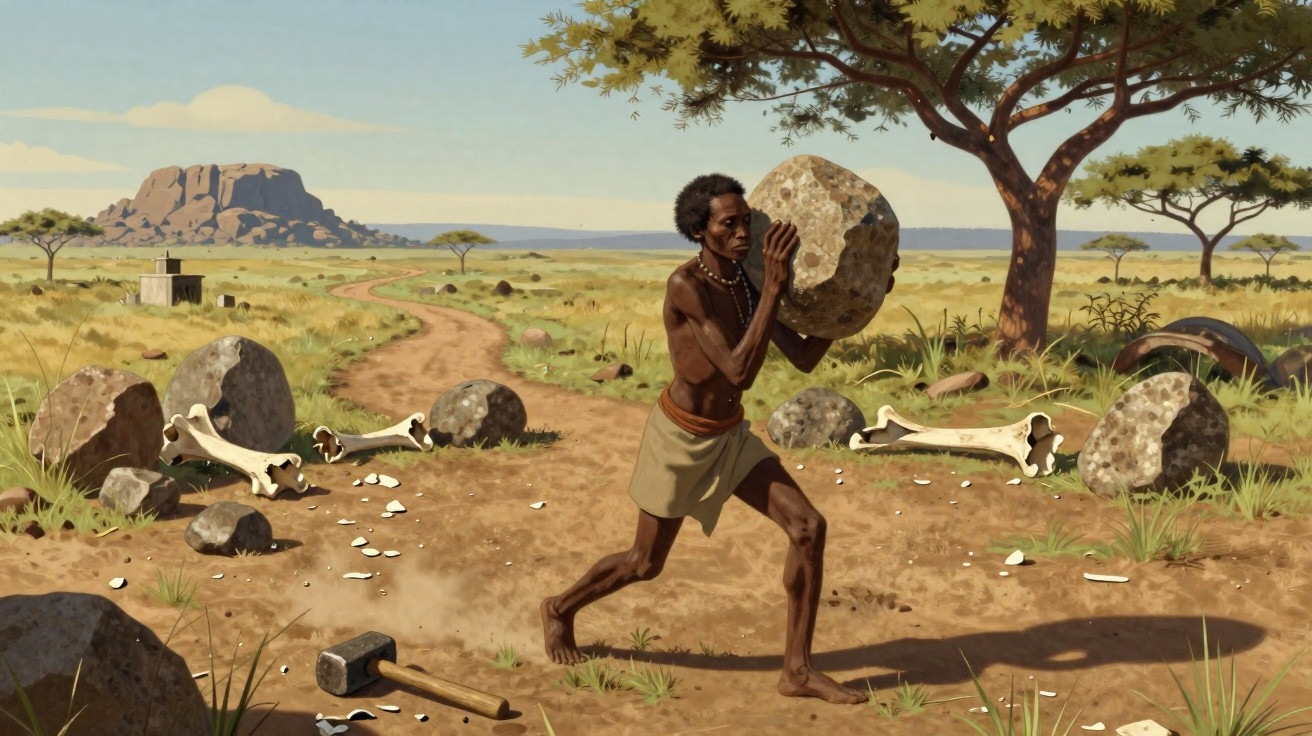
Ancient human relatives intentionally moved enormous stones 2.6 million years ago. This is no snappy museum caption, but a physical, exhausting undertaking that points to planning, cooperation and an internal understanding of the terrain long before maps. If the case holds, it pushes back the origins of human-like behaviour.
Its surface is dimpled and battered, with cortex chipped away where a dozen forceful strikes fell. He lifts it, feels its heft, and gestures over a scrub-covered skyline towards an otherwise ordinary ridge. Its significance becomes clear only when you learn that this exact stone occurs there-and not anywhere nearby.
Geologists can reconstruct a faint corridor linking that ridge to the camp: a trail of wandering cobbles alien to the local geology. Suddenly, a picture emerges of ancient people taking heavy cores towards water, carcasses and shelter. Most of us have dragged an unwieldy object over an inconvenient distance simply because we knew it would be useful later.
Now picture the same task 2.6 million years ago: no roads, no rucksacks and vultures circling in a hostile sky. Consider what would have made it worthwhile.
Stones on the move, minds in motion
At a series of early sites in Kenya, Ethiopia and Tanzania, archaeologists are uncovering stones with a compelling message. Large, heavy cobbles and cores that correspond with faraway outcrops appear where the underlying bedrock says they have no business being. They may have travelled several kilometres, and occasionally farther. No one simply happens to wake beside stones like these.
At one location, a field team plotted quartzite cobbles beside an ancient river channel, then traced their mineral “fingerprint” to a ridge many kilometres distant. Elsewhere, researchers recorded dozens of cores gathered at a prehistoric lakeshore, although the closest natural source lay beyond difficult terrain and a steep escarpment. These were meaningful loads: five, eight or ten kilos pressing hard into the forearms. Together, the evidence resembles intention sewn across the landscape.
What would such transport demand? Anticipation, knowledge of places, and remembered routes and water sources. It also requires a motive for carrying a burden, with the benefit still hours away. Our early relatives might have stored stones near places where carcasses were likely, positioned raw material in advance for butchery, or divided loads among members of small groups. Energy was an unforgiving calculation in such environments. If they transported these stones, the reward had to justify the effort.
How they might have moved the heavy stuff
Imagine a small group stopping beneath an acacia, with two people slipping a branch beneath a cobble to form a basic stretcher. Plant fibres could be twisted into a sling, while the stone was supported and shifted from hip to hip during the walk. They might drag it briefly across wet sand near water to ease their arms, before lifting it again to protect their fingers from crushing.
Today’s hikers understand the principle: regularly alter your grip, distribute the weight and divide a journey into manageable stages. Those same principles would help with a five-kilo core beneath a fierce sun. Realistically, no one carries such loads every day. On some days, a stone could be hidden in scrub and collected later. On others, it might be rolled down a slope and directed with a stick. Straight routes belong on maps rather than in thorn-filled savannah.
One researcher described it simply:
“When non-local stone shows up in clusters, near butchered bones and hearth traces, you’re not looking at a fluke of geology. You’re looking at a plan carried in human bodies.”
The field evidence often follows a familiar pattern:
- Rock types from elsewhere resting on unsuitable bedrock.
- Reassembled flakes scattered along a route like breadcrumbs.
- Bruised cortex suggesting extended handling rather than knapping alone.
- Stone stores near water, animal remains or shelter from the wind.
What this shifts in our origin story
If heavy stones were carried through the landscape 2.6 million years ago, several assumptions need revisiting. It places deeper planning earlier in a period frequently portrayed as short-term and opportunistic. It narrows the distance between them and us-not by treating them as modern humans, but by showing that they used a familiar exchange: giving time in return for an advantage.
It changes how tools are understood, too. A stone core is more than a source of flakes; it is a portable assurance. Taking one along means that an unexpected opportunity-a hippopotamus stuck in mud or a marrow-filled bone-can become food and protection. Transport is a subtle technology. It is difficult to identify in the archaeological record and easy to overlook in the wider narrative.
Behind the evidence, a practical lens
Begin with the terrain. Survey the geology around a site and identify what does not fit. When cobbles on a terrace differ from the bedrock below, investigate further through chemical signatures, grain structure and enclosed minerals. Once a source ridge has been identified, walk probable passages-river margins, saddles and gradual spurs-and search for a chain of misplaced stones that waxes and wanes along the way.
Chart behaviour rather than artefacts alone. Create zones around water, shade and viewing points, then examine where non-local stones gather. Determine whether flakes become smaller along a route: substantial removals close to the source and finer work near food or fire. Minor features can add depth, including edge wear from carrying rather than striking, marks from abrasive slings and sheen produced by repeated use. These are not boxes to tick, but clues that accumulate into a broader image.
Then consider the ordinary questions too often omitted from deep time: where would you stop? Where is the wind calmer? Which slope would you refuse to tackle with a ten-kilo stone and a toddler on your hip? Let’s be honest: nobody really does this every day. Risk also enters our interpretations when we impose neat logic on untidy terrain. Behaviour is found in the diversions.
The human echo in a heavy stone
This proposition does not strike like a thunderbolt. Instead, it arrives as a steady weight in the hands, with a route reconstructed from minerals and scars. If ancient relatives transported massive stones, they moved more than weight-they moved purpose. That is a short statement with a far-reaching implication.
It calls for further fieldwork: improved source mapping, experiments in carrying methods and renewed examination of older collections. It also offers a more modest reflection of ourselves: the instinct to prepare, improve the odds and bring useful items nearer to where life unfolds. That instinct is recognisable. Send this to the person who always carries the picnic cool box a little farther than seems necessary. They will understand.
| Key point | Detail | Why it matters to readers |
|---|---|---|
| Early transport | Heavy non-local stones at sites dating to 2.6 Ma | Moves planning and cooperation further back in time |
| Evidence trail | Source matching, refits and grouped caches | Shows how scientists build the argument |
| Practical model | Shared loads, staged routes and resting points | Makes deep-time behaviour feel tangible |
FAQ:
- Did ancient hominins really carry massive stones? Several sites contain heavy, non-local cobbles and cores that cannot be accounted for by the surrounding geology. Alongside clusters near butchered bones and traces of hearths, this pattern supports deliberate transport rather than random deposition by rivers.
- How far were these stones moved? Distances range from several kilometres to possibly more than ten, depending on the terrain and routes along water. Even a short journey matters when a load weighs five to ten kilos and the ground brings thorns, heat and predators.
- Which species could have done this? Around 2.6 million years ago, possible candidates include early members of the Homo lineage and robust relatives such as Paranthropus. As tool traditions overlap between species, more than one branch may have shared this behaviour.
- Why carry stones instead of just using what’s there? Material quality matters. Suitable stone is unevenly spread across the landscape. Carrying a dependable core ensures flakes are available when an opportunity arises-at a carcass, beside water or at a shelter-turning chance into success.
- What does this change in the big picture? It makes behaviours associated with “modern” planning and teamwork older than previously thought. It also indicates that understated technologies-transport, caching and route memory-belonged to the toolkit long before spears and fireside stories.





Comments
No comments yet. Be the first to comment!
Leave a Comment