
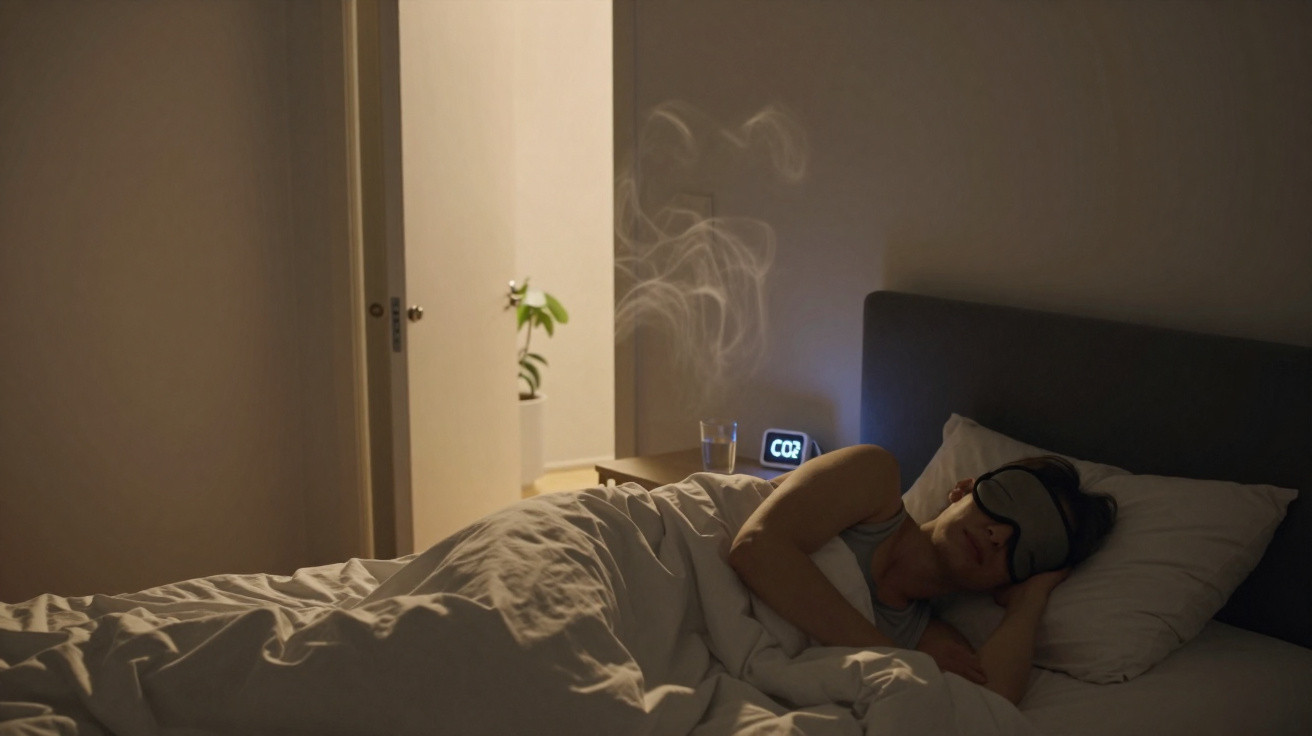
A phone screen goes dark on the bedside table, its glow contracting as the day finally ends. Along the hallway, a narrow band of yellow light falls across the floor from a door left ajar. Most of us shut it automatically, an instinctive gesture of privacy. But through that small opening, air is circulating. Gradually. Silently. More than your skin can detect.
By morning, one person wakes feeling sluggish, with the familiar sensation of a head made heavy by the night. Someone else in the same home, keeping the same routine, rises feeling surprisingly refreshed. The difference? One slept behind a firmly closed door, while the other allowed corridor air into the room. The science behind that narrow gap is more surprising than it first appears.
When a closed bedroom door creates a CO₂ bubble
Step into a bedroom that has been shut all night and the atmosphere is almost tangible. The air feels still: slightly warm and somewhat stale. It is not necessarily unclean, simply… breathed in. We often put poor sleep down to stress, screens or a late evening meal, rather than the invisible carbon dioxide build-up that increases with every breath in a tightly closed room.
Researchers are now tracking this in ordinary homes with CO₂ monitors. In closed bedrooms, measurements commonly rise above 1,500 parts per million by the early morning, and can sometimes climb higher. That level is not toxic, but it is a long way from the fresh outdoor air in which the body developed. Your brain registers the change quietly, before you consciously notice it.
At a small Dutch university campus, students took part in sleep research while discreet sensors monitored their bedrooms. One group slept with both doors and windows completely closed. The other left either a window or a door slightly open. On paper, the findings seemed unremarkable: a few hundred ppm less CO₂ here, a few fewer micro-awakenings there. In practice, those modest differences were linked to deeper sleep stages, less tossing and turning, and better focus the following day.
The students did not always notice a dramatic immediate change. That is the difficult thing about air: it does not announce itself, it merely influences you. Across a week, however, those with greater airflow described less morning brain fog and fewer “why am I so tired?” complaints. Nothing else in their lives had altered. Only the way air moved in and out of their rooms overnight.
The explanation is basic physics combined with a very human body. Every exhalation releases CO₂. In a closed, well-insulated bedroom, it slowly becomes more concentrated, particularly when two people share a bed or a pet sleeps at the foot of it. Elevated CO₂ does not suffocate you, but it can subtly affect breathing patterns and may make oxygen exchange less efficient. To maintain balance, your brain creates tiny arousals. You do not wake fully, but your deep sleep becomes fragmented.
Leave the door open and that CO₂ has a route out. The difference in concentration between the bedroom and hallway allows the air to blend and balance out. A strong draught is unnecessary; even a change of a few hundred ppm can be meaningful. Improved airflow supports steadier breathing, a calmer heart rate and an easier transition into restorative slow-wave sleep. You may not recall any of it when you wake. Your body will.
How to use your bedroom door as a quiet sleep aid
The easiest adjustment is almost ridiculously minor: rather than pushing the door shut until the latch catches, leave an opening around the width of your thumb. It need not be wide enough to make you feel exposed, only sufficient for air to exchange with the rest of the home. From the outside, the gap looks tiny, but it can increase airflow far more than expected.
If complete darkness matters to you, manage the light with the door rather than blocking the air. A rolled-up towel along the bottom of the door frame can stop the hallway glow while leaving the upper part of the doorway open to circulation. Some people hang a lightweight curtain or beaded screen inside the doorway, preserving a sense of privacy while allowing some air and sound through.
You can go one step further by combining the open door with a mild pressure difference. Positioning a quiet fan in the hallway, rather than the bedroom, can draw fresher air through the gap without blowing a draught on your face. It does not need a powerful setting; low speed overnight is enough to move corridor air and stop the bedroom becoming a sealed bubble. In older homes, even a slightly draughty window elsewhere can help sustain that airflow.
During a hot summer night or in a compact flat, it can seem as though the only choices are sealing everything and turning up the air conditioning, or opening every window and hoping for the best. There is another option. Keep the window largely closed for security or noise control, and let the bedroom door act as the main “lung”. In winter, people often close doors tightly to retain heat, but an open-door night under thick bedding can feel more restorative than sleeping in an airless, overheated room.
A frequent error is assuming that five minutes of ventilation before bed will do the job. The research is fairly clear: CO₂ begins increasing again the moment you fall asleep and continue breathing. Fresh air at 10 p.m. has limited value at 4 a.m. if the room has been sealed ever since. Another mistake is judging air quality by smell alone. If a room smells normal, we tend to assume it is healthy. CO₂ has no smell, so your nose cannot alert you.
Let’s be honest: nobody wants to bring out an air-quality monitor every evening. Most people simply want good sleep without turning their bedroom into a DIY laboratory. That is why this door trick is useful. It requires very little effort, seems almost too straightforward, and quietly reduces the overnight rise in CO₂ while you do absolutely nothing. Consistency matters more than perfection.
Some sleep doctors describe airflow as an overlooked background influence on our nights. As one put it:
“We obsess over mattresses and blue light, yet the very air in the room is what your brain negotiates with all night long.”
That thought stays with you after a night that genuinely feels fresh. You begin to recognise the mornings when the air seems heavy before you have even lifted the duvet.
To keep it practical, try a few straightforward approaches:
- Spend one week sleeping with the door closed, then one week with a thumb-width gap, and compare how you feel when you wake.
- If you share a bed, regard airflow as essential, much like choosing the right mattress firmness.
- If somebody is ill, favour open doors and cross-ventilation to dilute both CO₂ and airborne particles.
This does not need to become a strict nightly routine. The goal is not laboratory-perfect conditions, only a bedroom that is a little more considered. Once you have experienced the difference of a room where breathing feels easy, closing the door like a vault can start to seem oddly old-fashioned.
A small crack of light and a bigger conversation about sleep
There is something unexpectedly personal about the bedtime choice between an open and closed door. It is not solely about privacy or childhood anxiety about the dark. It also reflects how much of the outside world you allow in when you are at your most vulnerable. That slender, almost invisible line of air can become a quiet expression of trust in your home.
We have made sleep into a competitive pursuit, full of wearables, charts and hacks. Yet one of the most helpful changes may be an old-fashioned, almost dull habit: allowing rooms to breathe again. No app will praise you for leaving the door slightly open. Your brain, however, may appreciate it at 3 a.m. in its own unspoken way.
On a difficult night, when your heart is pounding or your thoughts refuse to settle, every corridor sound becomes noticeable: each creak, each murmur and every faint movement of air. On a good night, it all merges into a gentle background hum, and time seems to leap from midnight to morning in one instant. That leap is what we are quietly trying to find.
We have all woken somewhere unfamiliar - a holiday cottage or a friend’s spare bedroom - after sleeping deeply for no obvious reason. The same body, the same worries, but different air. You may not be able to relocate to the countryside or redesign your entire home. What you can do is experiment each night with one small variable: the boundary where your bedroom meets the rest of your world.
Perhaps tonight, instead of shutting the latch completely, pause for a moment. Leave the door only just open. Let the air make the first move, then see how your body responds. It is a small experiment that no one else needs to know about, beginning as soon as you switch off the light.
| Key point | Detail | Why it matters to the reader |
|---|---|---|
| An open door lowers CO₂ | Even a thumb-width opening lets carbon dioxide diffuse into the hallway overnight. | It can support deeper sleep and reduce that heavy-headed feeling in the morning. |
| Small changes beat gadgets | Pairing a slightly open door with a quiet hallway fan can stabilise bedroom air. | It provides a low-cost, low-effort alternative to expensive sleep technology. |
| Consistency matters | Steady airflow throughout the night is more effective than a short airing session before bed. | It makes a simple, sustainable sleep habit easier to establish. |
FAQ
- Should I always sleep with my bedroom door open? Not necessarily. If privacy or safety is a concern, begin with a small gap and adapt it until it feels both secure and breathable.
- Does an open door really change carbon dioxide levels that much? Research in real homes and halls of residence shows that open doors or windows can lower CO₂ by several hundred ppm, enough to measurably improve sleep quality for many people.
- What if I live in a noisy or polluted area? You can depend more on an open door and internal airflow, using filtered or conditioned air within the home instead of opening windows facing the street at night.
- Is a window better than a door for airflow? A window opening to the outdoors generally supplies fresher air, but a door still helps by stopping your bedroom from becoming a sealed box where CO₂ builds up.
- How can I tell if my bedroom air is a problem? Morning headaches, dry mouth and a “stuffy” feeling on waking are common signs; an inexpensive CO₂ monitor can confirm whether levels rise too high overnight.




Comments
No comments yet. Be the first to comment!
Leave a Comment