
The first sensation is the quiet. It is not the quiet of a deserted harbour, but the dense, charged stillness created when hundreds of people draw breath together. Along Toulon’s quay, families, veterans, schoolchildren and camera-carrying visitors all watch the same spot beyond the breakwater. On the horizon, a dark, level shape begins to emerge from the haze: extraordinarily long and oddly angular in the morning light. Somebody close by murmurs, “She’s coming.”
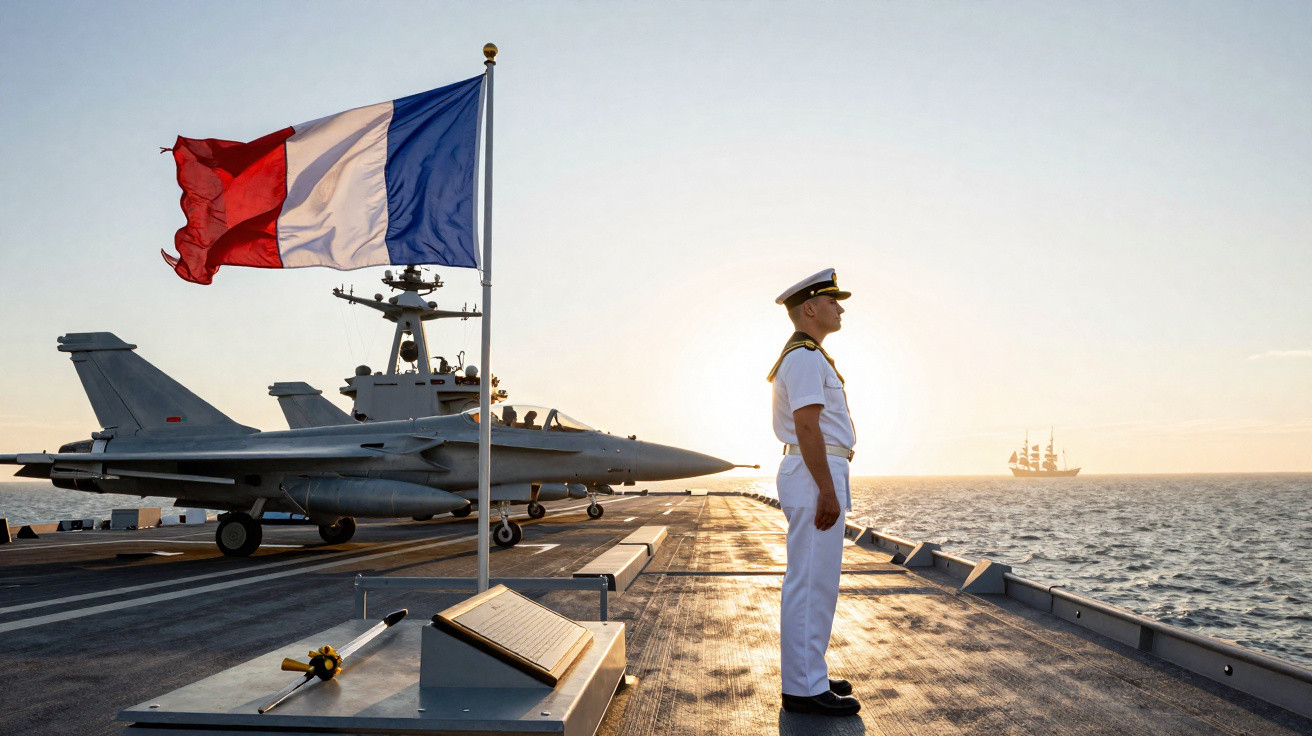
Gradually, the Charles de Gaulle comes into sight, with escort vessels spread around her like a guard of honour. She is France’s sole nuclear-powered aircraft carrier and one of the crown jewels of its naval forces. This time, however, she is travelling not towards a conflict zone but towards a commemoration rooted in four centuries of history.
It is less like observing a vessel arrive than watching a narrative rise to the surface.
The day France marked 400 years with steel, reactors and Rafales
In official terms, the deployment is simply described as a commemorative mission for the 400th anniversary of the French Navy’s foundation. At the quayside, it has a very different appearance and atmosphere. Sailors press their ceremonial uniforms for a second time. Pilots buff their flight helmets as though they were inherited treasures. Technicians photograph the ship from perspectives they have passed countless times before.
On the pier, an officer in his forties tells a group of teenagers that the French Navy, as an organised royal force, traces its origins to Cardinal Richelieu in 1626. Their phones remain poised and their interest seems tentative. He then gestures towards the enormous grey steel structure before them and quietly says: “Four centuries later, that story floats.” Their phones immediately rise much higher.
In the days leading up to departure, life aboard the Charles de Gaulle resembles both a military exercise and a national celebration. In one hangar, engineers move beneath the wings of Rafale Marine fighters, inspecting panels and sensors for a third time. Elsewhere, another team practises the protocol for formal ceremonies due to take place at sea and in overseas ports.
The route will follow symbolic passages: historic maritime bottlenecks will be crossed, allied harbours that once faced French cannon fire will receive French escorts, and flypasts will take place above waters where wooden frigates once exchanged broadsides. A young ensign calls it “the most expensive history class ever organized by the Republic.” The remark draws an easy laugh, although the pride behind it is unmistakable.
For Paris, deploying the nuclear carrier for the anniversary was far from a minor gesture. France could have sent a frigate or a tall ship and still fulfilled the commemorative purpose. Selecting the Charles de Gaulle delivers a more pointed statement: the nation that once launched royal galleons and ships of the line now projects force through an autonomous floating airbase powered by a nuclear reactor.
There is a strategic undertone too. At a time when maritime tensions are rising from the Red Sea to the Indo-Pacific, using the country’s most recognisable naval asset for a heritage mission reminds observers that this history is not nostalgic; it’s living doctrine. In this context, the past is not a museum exhibit but a set of tools.
Inside the Charles de Gaulle mission: ritual, risk and French statehood afloat
Aboard ship, the 400-year mission is delivered through thousands of exacting, small-scale actions. A quartermaster who normally directs helicopters onto their landing positions devotes part of the day to practising ceremonial flag-raising. A logistics officer revises supply calculations to account for additional receptions, distinguished visitors and cameras in areas that are normally unseen.
The captain’s diary becomes crowded with official addresses and memorial services alongside the standard operational briefings. From the outside, the vessel is in “celebration mode”. Beneath the surface, none of the normal discipline is relaxed: damage-control exercises continue to echo through the passageways, nuclear safety inspections maintain their unforgiving cycle, and aircraft must remain prepared for rapid launch. A commemorative mission at sea is still a mission at sea.
The emotional significance is genuine for the sailors. Many enlisted after hearing a grandfather speak of Atlantic convoys or a great-uncle recall a destroyer in Indochina. Now they are the people in uniform during a landmark year, serving aboard the flagship that dominates every news bulletin. One petty officer admits with a half-laugh that her parents have already alerted the entire village: “Our daughter is on the aircraft carrier for the 400 years!”
Most people know the feeling: work that is generally technical and routine suddenly connects to a larger story, and relatives look at it with renewed pride. For these sailors, that feeling endures for months and over thousands of nautical miles. It can be exhilarating, but also somewhat draining.
There is another concern, acknowledged quietly both aboard ship and at the Ministry of Armed Forces: that four centuries of occasionally brutal naval history could be reduced to a polished postcard. French vessels helped create an empire and secure trade routes, but they also imposed blockades, carried out bombardments and took part in colonial domination. Frankly, nobody is likely to explore all of that fully on a sunny deck in front of television cameras.
For this reason, some officers argue for a more nuanced account throughout the mission. They seek to address 19th-century anti-slave-trade patrols, rescue missions and the grey areas in which national interest conflicts with moral unease. A modern navy that celebrates itself without looking itself in the mirror would ring hollow. The deployment therefore poses a test: can power and pride be projected without closing off difficult chapters?
How France uses the anniversary as soft power at sea
Beyond its commemorative description, the mission is a precisely measured exercise in soft power. Each port visit is organised as carefully as a performance. Open days will allow local families to walk beneath fighter aircraft and look into radar rooms. Deck receptions will bring together foreign officers, diplomats and business leaders. Wines are chosen, cheeses labelled and speeches redrafted three times to strike a balance between modesty and grandeur.
One communications officer describes the approach by saying every stop has a “narrative spine”. In one country, attention will centre on joint anti-piracy operations; in another, on shared memories of world wars; elsewhere, on technological collaboration. Anchored against a city skyline, the Charles de Gaulle becomes an exceptionally large and expensive way to begin a conversation.
Naturally, there is a temptation to push every element into overdrive: film every salute, stage every handshake and turn each sailor into scenery for an Instagram story. Some navies embrace that approach so fully that they become floating theme parks. French crews recognise the boundary and are uneasy about crossing it. They do not want their working lives reduced to sunset drone footage and slow-motion aircraft.
There is a restrained but empathetic understanding aboard the ship that the imposing equipment is operated by people who become seasick, miss birthdays, quarrel over coffee and occasionally want five minutes away from a camera. Experienced officers therefore give younger colleagues a straightforward instruction: accept the spotlight when it helps the mission, and reject it when it simplifies the truth. The ship’s spirit cannot be contained in a 30-second clip, and that is acceptable.
Between ceremony and everyday routine, a small number of people express openly what many others feel.
“Out here, you really feel the weight of the flag on the stern,” confides a young lieutenant. “You’re not just sailing for 2026, you’re sailing with 1626 standing behind you. It’s beautiful, but it’s heavy too.”
A simple framework helps the mission carry that weight:
- Honour the dead without glorifying war.
- Demonstrate strength without showing it off.
- Open the ship without revealing what must remain discreet.
- Celebrate tradition without making it static.
- Tell stories without removing their shadows.
Within those five principles, the Charles de Gaulle follows a course that is as diplomatic as it is military. The anniversary becomes a stage on which France rehearses the role it wants to play at sea for the next forty years.
A 400-year wake reaching towards an uncertain future
When the Charles de Gaulle eventually departs for the commemorative cruise, the visible spectacle takes under an hour. There are sirens, salutes and white wakes sweeping across the bay. Then the horizon absorbs the grey hull and life ashore returns to normal. The real account continues unseen in steel passageways, where history, strategy and the plain routines of daily life meet in the same confined spaces.
Four centuries after Richelieu, France is dispatching a nuclear aircraft carrier to declare, through its own vocabulary of steel and ceremony, that its future remains connected to the sea. Oceans are getting warmer, trade routes face growing pressure, cyberattacks now target vessels as well as banks, and emerging powers are building fleets at remarkable speed. Against that setting, the commemorative mission is both a glance backwards and a quiet warning: the story remains unfinished.
Some observers will see nothing more than a display of force. Others will see an old nation speaking to itself through one of its most prominent symbols. Between those interpretations lie wider questions. What sort of navy does France want for the next 400 years? Should it protect borders alone, or also shared goods such as the climate and freedom of navigation? Anyone who watches that immense silhouette pass beyond the breakwater may sense that the debate no longer belongs solely to admirals and ministers. It belongs to every citizen who has stood by the shore and wondered who, precisely, patrols the horizon in their name.
| Key point | Detail | Value for the reader |
|---|---|---|
| Symbolic choice of the Charles de Gaulle | France sends its only nuclear aircraft carrier to mark the Navy’s 400th anniversary | Explains why the mission represents far more than an ordinary naval parade |
| Ceremony combined with live operations | Commemorative activities are added to a deployment that remains fully operational | Reveals the contrast between public imagery and the unbroken, demanding reality of life at sea |
| Soft power and strategic signalling | Port calls, diplomacy and storytelling are used to project influence | Gives readers a way to interpret future naval headlines and political messages |
FAQ:
- Question 1 Why is the 400th anniversary of the French Navy associated with 1626?
- Answer 1 In that year, Cardinal Richelieu was formally appointed “Grand Maître et Surintendant général de la Navigation et Commerce de France”, a move that effectively established a centralised, permanent royal navy. It is regarded as the institutional founding date of the modern French Navy.
- Question 2 Why is the Charles de Gaulle used for a commemorative mission rather than a historic sailing vessel?
- Answer 2 France has heritage sailing ships, but the Charles de Gaulle represents present-day power and technology. Its deployment conveys two messages at once: it honours four centuries of history while demonstrating that France remains a major naval power today.
- Question 3 Is the mission purely ceremonial, or does it have an operational role as well?
- Answer 3 It serves both purposes. Alongside ceremonies, port visits and public events, the carrier group continues training, undertaking exercises with allies and remaining prepared for real-world contingencies. The anniversary does not suspend its operational posture.
- Question 4 What aircraft are deployed aboard the Charles de Gaulle for this mission?
- Answer 4 The air wing generally includes Rafale Marine fighter jets, E-2C Hawkeye airborne early-warning aircraft, helicopters including the NH90 Caïman Marine and Dauphin, and a range of support and rescue assets, depending on the mission profile.
- Question 5 How does this deployment influence France’s image overseas?
- Answer 5 A mission of this prominence reinforces France’s standing as a blue-water navy with global reach. Port visits, joint exercises and media attention project technological capability, strategic autonomy and a long maritime tradition, all of which may generate diplomatic and economic influence.






Comments
No comments yet. Be the first to comment!
Leave a Comment