
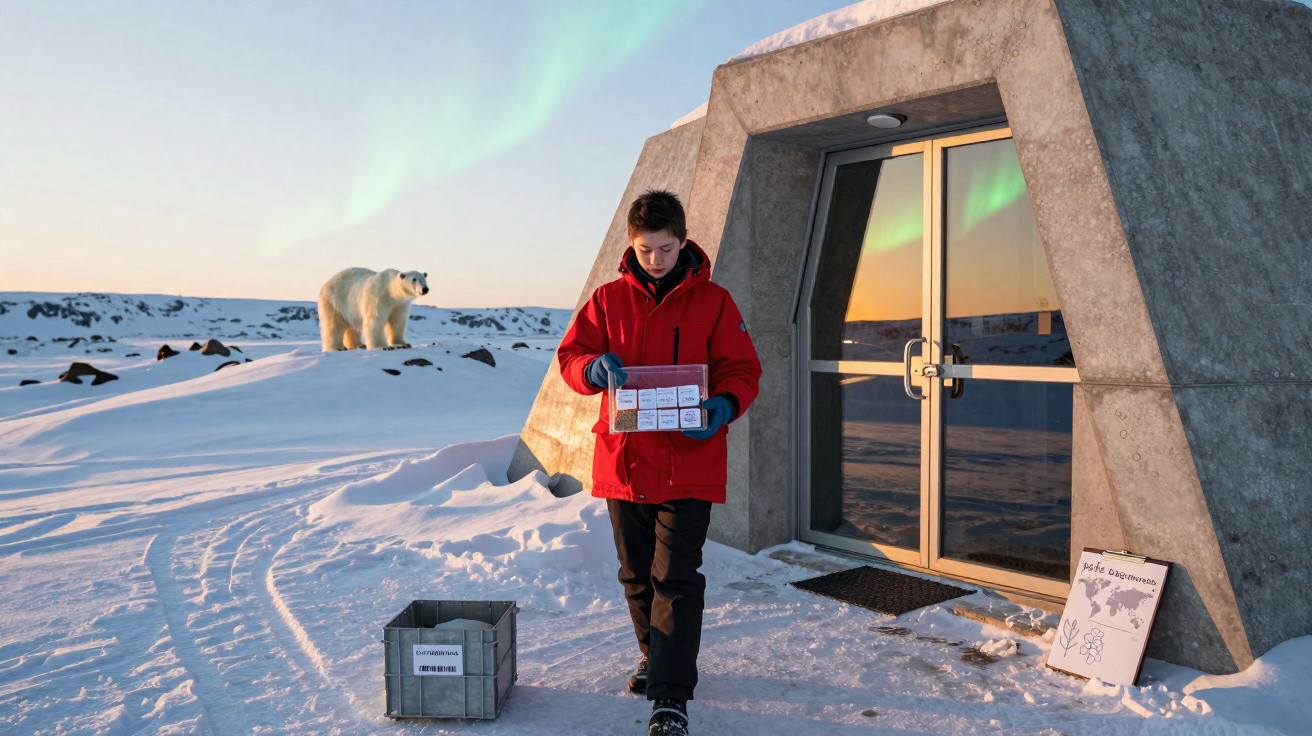
Svalbard, a Norwegian archipelago in the High Arctic, is home to just over 2,500 residents in the settlements of Longyearbyen and Ny-Ålesund, and lies within the range of the Barents Sea polar bear population. Amid permafrost, mountains and extreme cold stands the Global Seed Vault, established to hold back-up copies of agricultural diversity preserved by gene banks around the world.
Does Svalbard really have more polar bears than residents?
The comparison needs an important qualification. Figures for 2026 record 2,512 people in Longyearbyen and Ny-Ålesund, whereas the widely cited estimate of around 3,000 bears does not represent animals permanently living within Svalbard itself. Instead, it concerns the Barents Sea population, which is shared across the Norwegian archipelago, sea ice and parts of the Russian Arctic.
The Norwegian Polar Institute estimated this population at roughly 3,000 individuals in 2004, with a calculated range of 1,900 to 3,600 animals. Studies suggested that about 300 stayed near Svalbard year-round, while many others followed the ice and could travel as far as Franz Josef Land in Russia. As a result, simply claiming that there are “3,000 bears in Svalbard” overstates the local figure.
- Longyearbyen and Ny-Ålesund had 2,512 residents at the beginning of 2026;
- the bear population belongs to the Barents Sea region;
- the animals travel vast distances by following sea ice;
- some remain close to the archipelago throughout the year;
- Svalbard remains one of the species’ important breeding areas.
Why was the Global Seed Vault built there?
Its location brings together remoteness, geopolitical stability and natural cold. The Svalbard Global Seed Vault was tunnelled more than 100 metres into a mountain of solid rock and is surrounded by permafrost. Its chambers are mechanically kept at -18 °C, while the mountain itself stays below freezing, helping to preserve the material for longer if the cooling system stops operating.
Was the vault truly built to survive the end of the world?
That image made the facility famous, yet its day-to-day role is less cinematic. The repository primarily acts as a back-up for seed banks that may lose collections because of war, natural disasters, management failures, political changes or other local events. A global catastrophe is also among the possible scenarios, but it is not the sole reason for the vault’s existence.
Every institution retains ownership of the material it deposits. The boxes stay sealed under a system comparable to a bank vault: only the gene bank that deposited a particular sample can request its return. The facility provides this long-term storage free of charge to qualifying collections.
- seeds are dried before storage;
- the material is placed in airtight packaging;
- the chambers are kept at approximately -18 °C;
- depositors retain ownership of their seeds;
- total planned capacity reaches 4.5 million samples.
How many of the world’s seeds are already stored in Svalbard?
The collection continues to expand. In June 2026, the vault passed 1.4 million seed samples after receiving more than 15,000 new deposits from gene banks in Africa, Asia, Europe and the Americas. Brazil also takes part in the system through Embrapa, which sent new samples during the opening held that month.
Why could storing frozen seeds prove crucial in the future?
Agricultural diversity works like a genetic library. Different varieties of rice, wheat, beans, maize and other crops contain traits that may prove useful in the face of disease, drought, temperature shifts and new growing conditions. When a variety disappears completely from a collection, some of those possibilities may disappear with it.
That is why the small concrete entrance in the Arctic safeguards something far greater than its appearance implies. Inside a mountain surrounded by snow and permafrost, millions of seeds remain frozen as back-up copies of global agriculture. The contrast between the small resident population, polar bears moving through the region and boxes arriving from gene banks across several continents has made Svalbard one of the most unusual places ever chosen to protect part of the planet’s food future.





Comments
No comments yet. Be the first to comment!
Leave a Comment