
The capacity to create art has long been viewed as one of the defining traits of our species.
More than a hundred years ago, prehistorians struggled to accept that Upper Palaeolithic modern humans, living between 45,000 and 12,000 years ago, could have possessed such artistic imagination.
Unequivocally ancient art subsequently discovered in European caves and rock shelters quickly put those doubts to rest.
Neanderthal art in caves
But what about Neanderthals, the ancient large-brained sister group of our own species? We now know that they, too, could produce art.
So far, however, every known example of Neanderthal art is non-figurative: none portrays animals or humans.
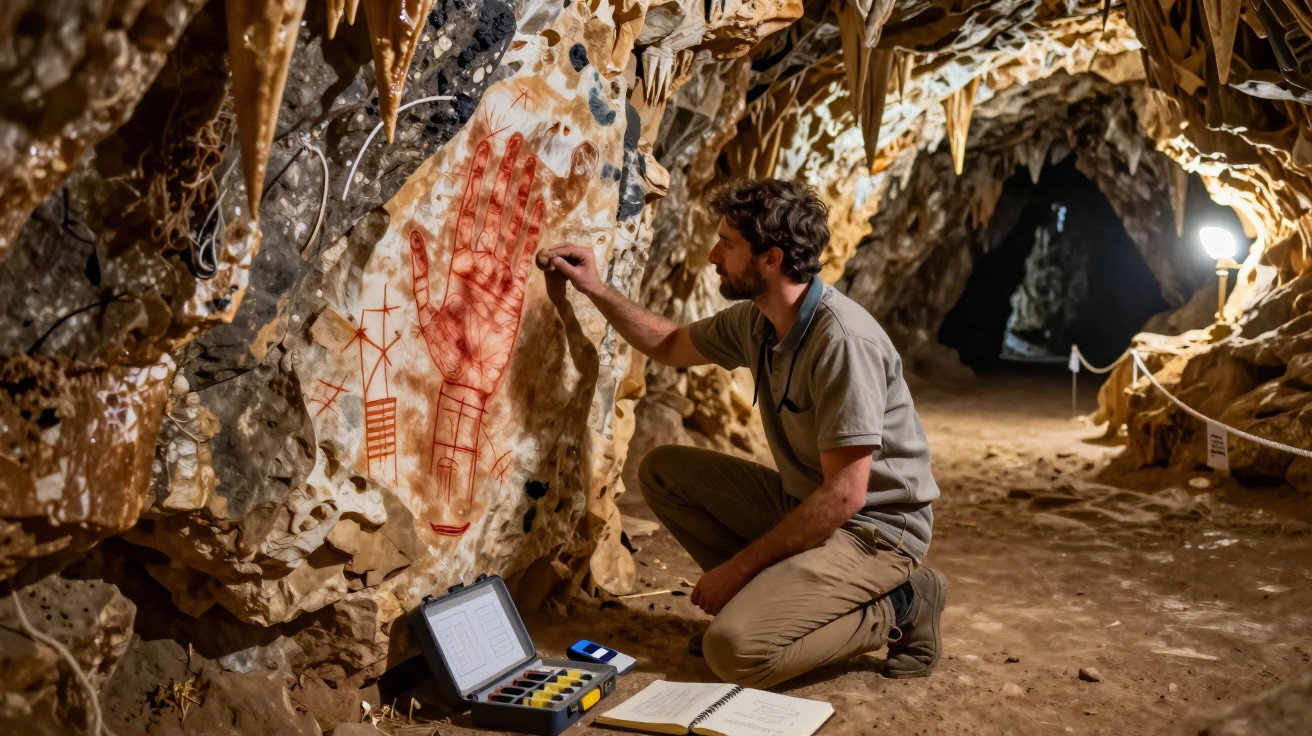
Depictions of this kind may have been exclusive to Homo sapiens. Neanderthal art instead includes hand stencils, created by blowing pigment across a hand; finger flutings, formed by pressing fingers into a soft surface; and geometric designs.
Neanderthals lived across western Eurasia from around 400,000 years ago until they died out approximately 40,000 years ago. They have often been reduced to the stereotypical image of the "cavemen".
Debates over the sophistication of their thinking and behaviour have never fully disappeared, and their ability to make art lies at the centre of this question.
Although we know Neanderthals could make jewellery and use coloured pigments, the suggestion that they ventured far into caves to leave art on their walls has attracted considerable resistance.
Recent research has nevertheless demonstrated beyond doubt that they did so. In three Spanish caves - La Pasiega in Cantabria, Maltravieso in Extremadura, and Ardales in Malaga - Neanderthals used pigments to make linear symbols, geometric forms, hand stencils and handprints.
At La Roche Cotard, a cave in France’s Loire Valley, Neanderthals produced various lines and shapes through finger flutings: marks left when fingers move across a yielding surface.
Far inside Bruniquel Cave in south-western France, they snapped stalactites into similarly sized sections and arranged them into a large oval structure, on which they lit fires.
This was not a shelter, but something more unusual. Had it been made in a contemporary art gallery, we would probably call it installation art.
The challenge of dating Palaeolithic cave art
With firmly established examples of Neanderthal cave-wall art in France and Spain, further finds are unavoidable. Yet identifying them is difficult because determining the age of Palaeolithic cave art is challenging and frequently sparks intense specialist debate.
Relative dating approaches, based on artistic style and subject matter or comparisons with objects recovered from archaeological layers of known age, have been valuable but are limited.
Establishing an actual age requires at least one of three circumstances. The first is charcoal pigment that can be dated by radiocarbon. This identifies precisely when the charcoal was made - when the wood from which it came died. Yet black pigments are often mineral-based, particularly manganese, leaving much black cave art impossible to date.
There is an additional complication: charcoal may have been produced at a different time from its use as pigment. I could collect 30,000-year-old charcoal from a cave floor and write "Paul was here" on a cave wall. Its radiocarbon result would not indicate when my graffiti was actually made.
A second possibility is the presence of calcite flowstones - stalactites and stalagmites - that developed over the art. Where they can be shown to have formed on an artwork, they must be more recent than it.
Scientists can determine when such flowstones formed through a technique based on uranium decaying into an isotope - a specific form - of thorium. This gives the art below a minimum age.
Evidence from Spain and La Roche Cotard
I belonged to a team that applied this method to date flowstones covering red-pigment art in the three Spanish caves already mentioned. We showed that the hand stencils, dots and colour washes had to have been made more than 64,000 years ago. That is only a minimum age, as the pictures themselves may be substantially older.
Even at the youngest end of that range, the images are at least 22,000 years older than the earliest arrival of modern humans (Homo sapiens) in Iberia. Middle Palaeolithic archaeology - the characteristic traces of Neanderthals - occurs commonly in each of the three caves. The most straightforward explanation consistent with the dates is therefore that Neanderthals made the images.
Criticisms of our findings overlooked the supporting evidence we had published. Did the samples dated genuinely lie over the art? Yes. Is the method reliable? It has been used for half a century.
The third condition has now delivered additional evidence for Neanderthal artistic activity. Winding lines made by fingers drawn through the soft mud on the walls of Roche Cotard Cave reveal a further way of engaging with this enigmatic underground setting. The marks include wavy, parallel and curved lines, arranged in orderly patterns that demonstrate they were intentional.
Dating of sediment that accumulated over the entrance indicates that the cave was fully sealed by no later than 54,000 years ago, and probably before then. As with the Spanish examples, this was well before Homo sapiens reached the area, while the cave contains only Neanderthal-made tools. It expands the known Neanderthal artistic repertoire.
Even committed sceptics must accept that these data clearly demonstrate artistic activity deep within caves that could only have been created by Neanderthals.
The art may reflect Neanderthal individuals developing a stronger awareness of their own agency in the world. It could amount to the earliest evidence of involvement with an imagined realm. The years ahead will undoubtedly provide still more to debate.
Paul Pettitt, Professor in the Department of Archaeology, Durham University
This article is republished from The Conversation under a Creative Commons licence. Read the original article.






Comments
No comments yet. Be the first to comment!
Leave a Comment