
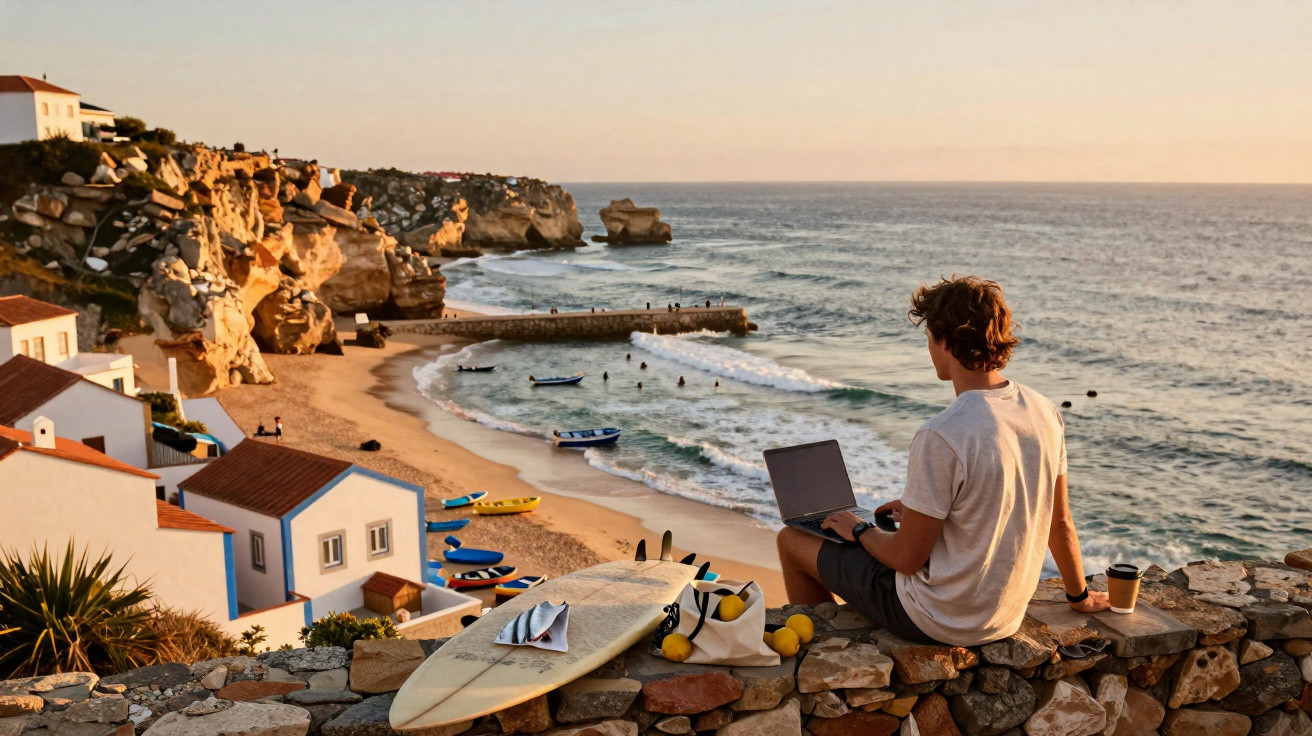
North of Lisbon, where cliffs fall into Atlantic swells, a low-key village brings together fishing boats, surfboards and reasonable prices.
France’s Île de Ré has long attracted visitors after sea air and stylish harbours, but an unassuming Portuguese counterpart is now quietly gaining attention. Ericeira lies on a dramatic coastal strip under an hour from Lisbon, pairing Atlantic scenery, just-caught fish and surf-town energy without the daunting costs or crowded seafronts.
Ericeira, an Atlantic village faithful to its roots
Around 45 km north-west of Lisbon, Ericeira clings to cliffs descending directly into the Atlantic. Originally a working fishing port, the town still follows that same maritime rhythm. It is evident at dawn, as small vessels return to harbour, and at lunchtime, when smoke from grills rises outside family-run restaurants.
Its historic core is small enough to explore on foot. Cobbled alleys wind past whitewashed homes trimmed in blue or yellow, with many featuring traditional azulejo tiles. Rather than big resort hotels, visitors will find mostly guesthouses, surf lodges, unfussy pensions and a small number of understated boutique hotels. Although costs are increasing, they remain lower than in France’s trendier Atlantic destinations.
Ericeira has managed a rare combination: a functioning fishing town that also feels like a laid-back coastal getaway.
Praia dos Pescadores, the old fishing beach, is still central to local life. Brightly painted boats sit on the sand or float just offshore, with waves breaking across the reef farther out. Climb a few streets from the shore and cafés, bakeries and tiled fronts reappear, with washing fluttering overhead in the narrow lanes.
A quieter choice than Europe’s busy coastal favourites
For British and French visitors devoted to Île de Ré or the Basque coast, Ericeira provides another sort of break. There is no lengthy bridge to navigate, no luxury shop on every corner and fewer polished beach clubs. Its appeal is instead rooted in scale and tempo: it takes ten minutes to walk across town, but there is still plenty to do.
Its position near Lisbon means many travellers add Ericeira to a city break. While that closeness could imply heavy visitor numbers, the town is generally quite easy-going beyond the August peak. At weekends, Lisbon residents come for seafood lunches and surfing, but weekdays often feel more like a small sea-view town than a purpose-built tourist resort.
Getting to Ericeira on a sensible budget
Buses from Campo Grande in Lisbon take roughly an hour to reach Ericeira, generally costing less than a London Underground day ticket. A hired car gives access to more isolated beaches and rural areas, though it is not essential for those staying near the town centre and principal surf breaks.
- Distance from Lisbon: ~45 km north-west
- Travel time by bus: around 60–70 minutes
- Best seasons: spring and autumn for value and milder crowds
- Good value for: surf learners, couples, small groups, remote workers
Ericeira World Surfing Reserve: protected waves
Ericeira’s coast holds an unusual distinction. In 2011, it was named Europe’s first World Surfing Reserve, recognising both the standard of its waves and work to protect the shoreline. The designation is more than a badge: it reinforces opposition to overdevelopment and maintains focus on water quality and coastal erosion.
Along just a few kilometres of shoreline, Ericeira concentrates a dense series of point breaks and reefs that rank among Europe’s most consistent waves.
A number of breaks have legendary status among surfers:
- Ribeira d’Ilhas – a lengthy right-hand wave that stages international competitions and, on favourable days, runs for remarkable distances.
- Coxos – strong, quick and frequently unforgiving, best left to skilled surfers accustomed to substantial Atlantic swell.
- Foz do Lizandro – a beach break where a small river meets the sea, typically more forgiving and well suited to lessons and improving technique.
Reserve status also supports an economy centred on surf schools, board-hire outlets and cafés overlooking the breaks. Group lessons are often cheaper than equivalents in France or California, attracting European beginners seeking Atlantic surf without top-tier prices.
Ericeira is not just for advanced surfers
For all its big-wave credentials, Ericeira is not solely a destination for professionals. A number of beaches, especially the sheltered coves near Praia dos Pescadores and certain sections of Foz do Lizandro, have milder conditions for swimming and introductory lessons when the swell eases.
Even so, the Atlantic is seldom gentle here. Water temperatures usually range from 14°C to 20°C over the year, meaning most people wear a wetsuit outside the warmest months. Cool seas sit in contrast to the long, dry summers ashore, making an afternoon surf followed by a warm pastel de nata and coffee an inviting routine.
| Season | Average water temperature | Typical crowd level |
|---|---|---|
| April–May | 15–17°C | Quiet to moderate |
| June–August | 18–20°C | Busy weekends, lively evenings |
| September–October | 18–19°C | Surfer-heavy, manageable overall |
Between the market hall and sunset cliffs
The sea sustains more than surfing. Morning stalls at the local market are filled with sardines, dourada, octopus and mackerel landed by small boats. As many restaurants buy their supplies there directly, menus stay fresh while prices remain approachable.
Fish from the grill takes centre stage. Sardines are coated in coarse salt, cooked over charcoal and served simply with boiled potatoes and salad. On cooler nights, caldeirada, a slowly simmered fish stew with potatoes and peppers, is commonly available. Servings are usually substantial, while a carafe of house vinho verde rarely costs much.
For travellers used to northern European prices, a full seafood dinner in Ericeira can feel surprisingly affordable.
Away from the table, the cliffs form a natural viewing platform. A paved walkway follows much of the town’s edge, offering open views across surf breaks and the layered rocks beneath. At sunset, residents sit on benches with beers or ice creams, while visiting surfers watch changing light fall on waves they had ridden earlier.
Things to do beyond the beach
Ericeira suits visitors who never step on a surfboard, too. Walkers can take coastal routes north to untamed headlands, or head south towards broader sandy beaches. Families with small children often choose quieter bays and the river mouth at Foz do Lizandro, where water may be a little warmer and shallower.
In town, small churches and chapels, some centuries old, break up the whitewashed streets. Traditional celebrations, particularly during summer, combine religious processions with fireworks and late-night music in the squares. This element keeps Ericeira deeply rooted in Portugal, even as surf hostels and smoothie bars become more common.
Costs, crowds and some realistic compromises
It is no longer quite accurate to call Ericeira a “secret”. Cheap flights and social media have placed it on international travel itineraries. Room prices rise during July and August, and certain places become busy when sunshine coincides with a good swell. Timing is important for travellers seeking the most affordable experience.
Those watching their spending often choose the shoulder seasons of April, May, late September and October. Guesthouses commonly lower their rates during these periods, restaurant queues are shorter and waves remain dependable for surfers. Weather can be unsettled and evenings cooler, so it is worth packing a light jacket alongside a wetsuit.
Environmental concerns also remain. The World Surfing Reserve designation is helpful, but tourism puts pressure on coastal towns through higher housing costs for residents, water-supply strain and waste-management demands. Choosing small, locally owned accommodation, following beach rules and supporting businesses throughout the year can reduce some of these effects.
Combining Lisbon, remote work and surf lessons
A growing number of visitors now divide their stay between Lisbon and Ericeira: using the capital for museums, food and nightlife before moving to the coast for a slower final part of the trip. Three days in the city followed by four beside the sea offers variety without additional flights or long rail journeys.
Remote workers are increasingly using Ericeira as a temporary base as well. Reliable internet, cafés with plug sockets and several co-working spaces appeal to people who enjoy laptop time in the morning and an afternoon in the water. The obvious difficulty is that, when perfect swell is visible from the window, concentrating on spreadsheets can prove difficult.
For first-time visitors unsure whether they belong on a sandy towel or a surfboard, one straightforward plan works well: book a weekend, arrange one group lesson, take one coastal walk and enjoy one leisurely harbour lunch. Should you be looking up long-stay rental prices by the end, it becomes clear why some regulars are quietly leaving Île de Ré behind and embracing this Portuguese fishing town instead.





Comments
No comments yet. Be the first to comment!
Leave a Comment