
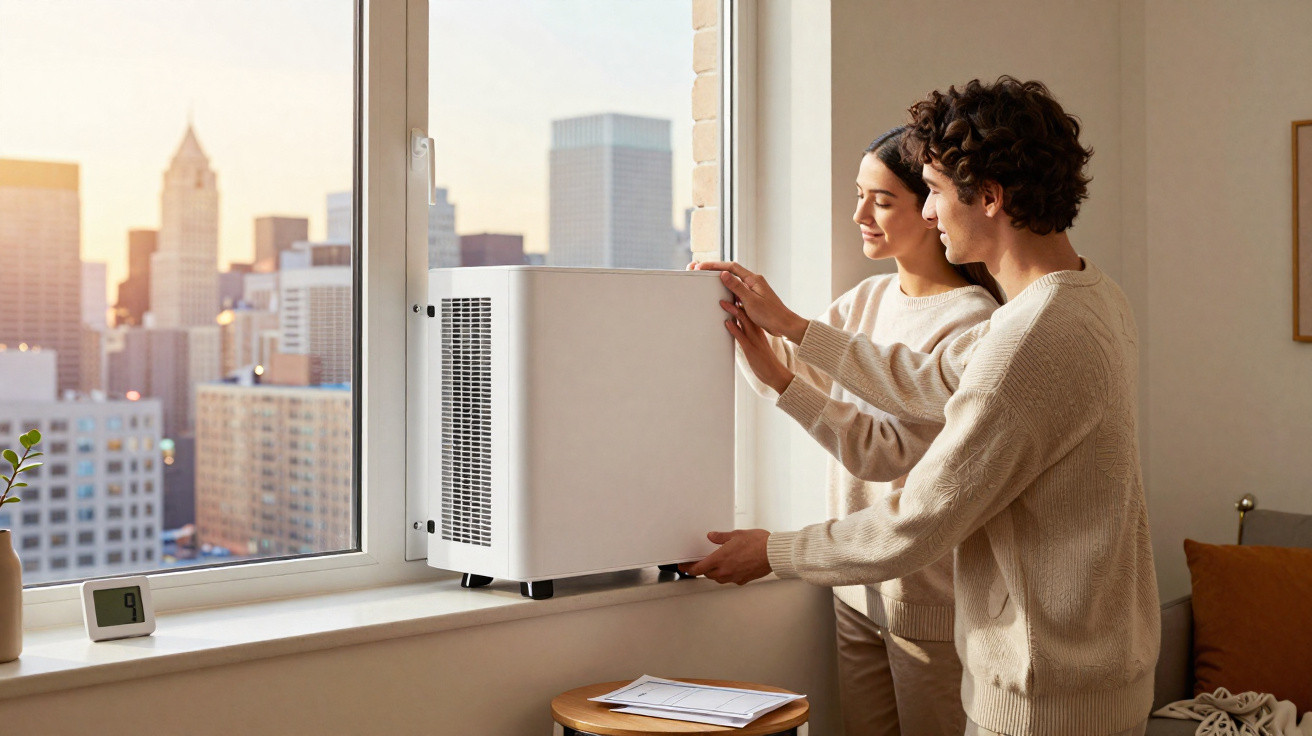
A year after Gradient, Chinese home-appliance giant Midea is bringing its first window heat pump to market. This alternative to electric radiators and oil- or gas-fired heating can be fitted in under an hour and is attracting interest in North America, where building design is well suited to the system.
Midea window heat pump: designed for severe cold
Following years of development and full-scale trials in social housing in Queens, New York, Midea is launching its first window heat pump. Developed in the United States by its Midea America subsidiary, which operates much like a start-up, the heating unit aims to outperform the products currently available, whose performance and operating conditions are limited. The window heat pump can provide efficient heating even in extreme cold, down to –22 degrees.
Like its major US rival Gradient, Midea is relying on a sleek heating system that is simple to fit and takes up little space. A Fast Company journalist installed the window heat pump in her own home to assess the solution, confirming that fitting it took less than an hour. By comparison, installing a wall-mounted unit takes a day, requires professional help and involves drilling through walls. To maintain its performance in extreme outdoor temperatures, Midea uses a more powerful compressor developed in-house.
For efficient heating while keeping electricity use under control, that compressor is linked to an outdoor temperature-measurement system that adjusts its output. “Older compressors were either on or off,” explained Brian Langness, project manager at Midea America’s research centre, as quoted by Fast Company. The window heat pump is not intended to heat several rooms, but it can warm a room more effectively than a portable electric heater while using less energy.
More even heating than a gas boiler
Ultimately, the journalist said the heat produced by the window heat pump was more evenly distributed than that from her gas boiler. She wrote: “when I turned up the heating with an outdoor temperature of around -7°C, the room quickly became pleasantly warm, more comfortable than the rest of the house”.
She nevertheless noted its bulk, similar to that of a conventional radiator. This could explain why some homeowners may favour wall-mounted systems, which are better suited to certain rooms.
Midea window heat pump at a glance:
- Heating capacity: 9,000 BTU/h (2.6 kW) at an outdoor temperature of 8.3 degrees
- “Plug-and-play” installation in 1 hour
- Operation down to –25 degrees (capacity reduced to 5,050 BTU/h)
- Noise level: high at ~51 dB(A), low at ~43 dB(A), quiet mode at ~29 dB(A)
- Weight: 59 kg
- Power supply: 115 V electric supply
- Price at the end of 2025: $2,800 to $3,000
Who is the window heat pump for?
For now, the window heat pump remains an entirely American proposition. Existing heating models have been designed to fit window types that are highly common in North America but rarely found in France. As the market is still in its infancy, heating units suited to the UK and other European markets may emerge later. However, English-speaking markets such as Canada and the United Kingdom are clearly likely to come first.
Midea has started producing its first window heat pump, but its priority is to secure agreements with professionals rather than private buyers. The brand is dealing directly only with distributors and property developers that own residential buildings. Fast Company reported that Midea America was in talks with several housing authorities, including in Boston, over pilot schemes modelled on the New York programme. Another pilot project is about to begin in Canada.
Each Midea window heat pump costs $2,800 or $3,000, which remains expensive for private buyers compared with more affordable heating options. However, Midea is a Chinese home-appliance giant focused more on the mid-range than the premium segment. According to its product manager, Brian Langness, prices will fall as production volumes rise. Even if the US federal tax credit is set to disappear at the end of the year, local incentive schemes such as New York State’s Clean Heat programme will help reduce the bill.






Comments
No comments yet. Be the first to comment!
Leave a Comment