
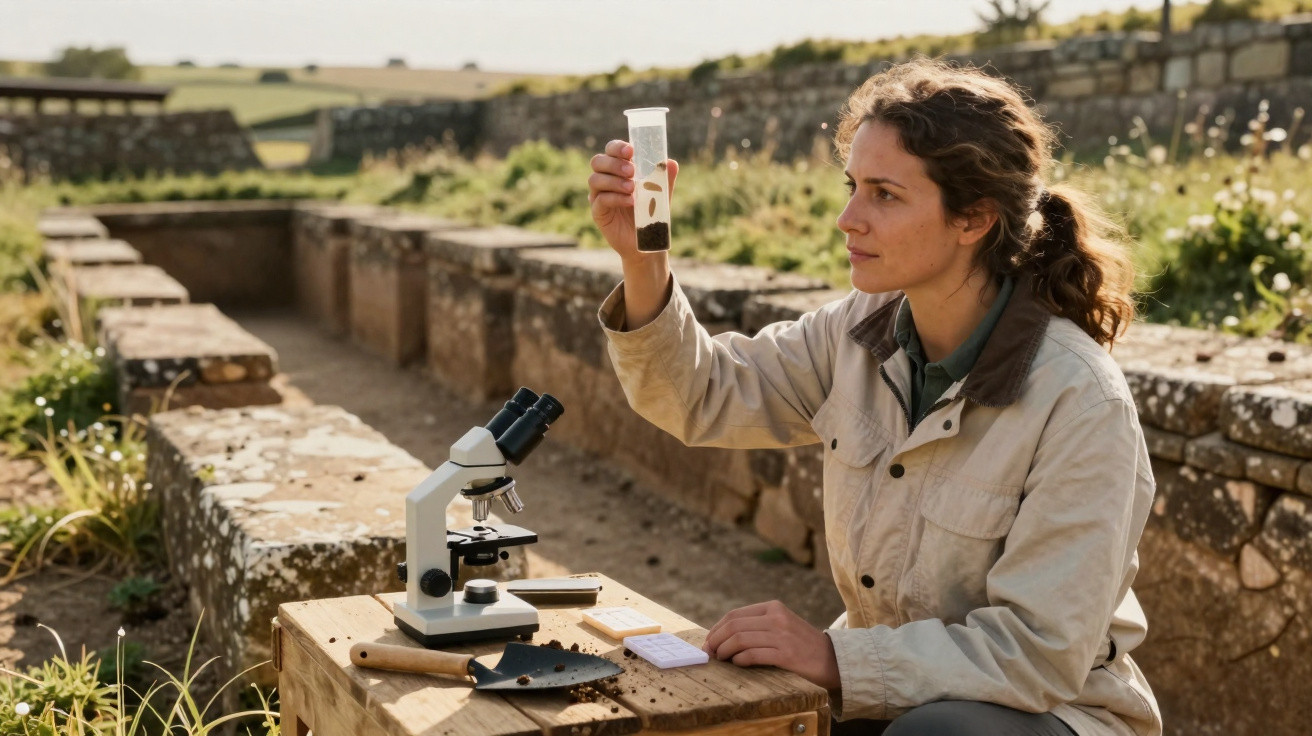
In a remote fort on the former edge of the Roman Empire, fossilised sewage has revealed an unsettling aspect of military life.
Archaeologists already understood a great deal about Roman weapons, walls and strategies in Britannia. Far less visible was what took place inside the latrines. Microscopic analysis of the sewage system at Vindolanda fort, south of Hadrian’s Wall, now indicates that soldiers - and their families - lived with a substantial burden of intestinal parasites around 1,800 years ago.
The fort where sewage became a historical record
Vindolanda was a Roman fort positioned strategically near Hadrian’s Wall in what is now northern England. Soldiers sent to guard the Empire’s frontier lived there, alongside women, children and civilians whose lives revolved around the military community.
In 2019, researchers from the Universities of Cambridge, Oxford and British Columbia collected 58 sediment samples from the main drainage channel serving the fort’s latrines, which dated to the third century AD. The feature stood beside a bath complex supplied by an aqueduct and equipped with what was regarded as an advanced drainage arrangement for its time.
Built up at the base of the drain and preserved for almost two millennia, these sediments act as a kind of health “black box” for the community. They retained microscopic traces of faeces, food remains, worm eggs and microorganisms.
In the muddy layers of the latrines, scientists found what ancient texts do not usually describe: the quiet impact of intestinal disease on everyday Roman life.
What the microscopes revealed
In the laboratory, the samples were concentrated and viewed under microscopes to identify helminth eggs, meaning intestinal worms. To identify protozoa, which do not produce visible eggs, the team used an immunological ELISA test (enzyme-linked immunosorbent assay).
The findings were striking:
- Ascaris (human roundworm) eggs appeared in 22% of samples;
- Trichuris (whipworm) eggs occurred in 4% of samples;
- one sample contained both worm types at once;
- the presence of Giardia duodenalis, a protozoan responsible for giardiasis, was confirmed.
This was the first confirmed archaeological detection of Giardia in Roman Britain. With three parasites sharing the same transmission route, there is little doubt that the environment around the latrines and the water used daily was extensively contaminated with human faeces.
Even with aqueducts, baths and drainage channels, Roman technology could not interrupt the cycle of parasites circulating through water and food.
Three parasites, one route of infection
All three identified organisms share a classic transmission mechanism: the faecal-oral route. In other words, eggs or cysts shed in the faeces of infected people contaminate water, food or surfaces before being swallowed by someone else.
Ascaris: the persistent roundworm
Ascaris lumbricoides is a roundworm that can grow to several tens of centimetres inside the human gut. A single female can lay as many as 200,000 eggs a day, and those eggs may survive for years in damp soil.
After being swallowed, they hatch in the small intestine, may migrate through the body, and can lead to:
- recurring abdominal pain;
- changes in appetite;
- malnutrition in severe infections;
- intestinal blockage in extreme cases.
Trichuris: a slow, chronic infection
Trichuris trichiura, or whipworm, is less prolific but no less troublesome. It lives chiefly in the large intestine. Infections are often long-lasting and subtle, with symptoms including:
- persistent tiredness;
- progressive anaemia;
- intermittent diarrhoea;
- delayed growth in children.
Giardia: the mark of contaminated water
Giardia duodenalis is a single-celled protozoan that signals water contamination. Its cysts are resilient and can easily travel in water from springs, rivers and reservoirs.
Among the Vindolanda population, giardiasis probably presented as:
- watery diarrhoea;
- wind and abdominal bloating;
- recurring cramps;
- weight loss and impaired nutrient absorption.
Found together in the same sewage system, Ascaris, Trichuris and Giardia indicate continual exposure rather than isolated outbreaks.
How soldiers lived surrounded by worms
Archaeological evidence makes clear that Vindolanda was not simply a men-only barracks. Children’s sandals, women’s jewellery and domestic utensils confirm that families lived within or around the fort.
Roman soldiers were legally barred from formally marrying while in service. In reality, they lived with partners and children. This family life is documented in the famous wooden writing tablets recovered at the site, which mention requests for food and clothing, as well as invitations to parties.
In this cramped setting, with heavy use of public baths, shared latrines and food-preparation areas, parasites had ideal conditions in which to keep circulating. Children, whose immune systems were still developing, were affected more severely.
| Affected group | Main risks | Likely impact at Vindolanda |
|---|---|---|
| Children | Dehydration, delayed growth, cognitive impairment | Greater vulnerability to repeated infections |
| Adult soldiers | Abdominal pain, fatigue, reduced physical performance | Temporary reduction in fighting and working capacity |
| Women and civilians | Anaemia, chronic digestive complications | General weakening of the community’s health |
Although it is impossible to reconstruct the precise number of infected people, concentrations reached 787 Trichuris eggs per gram of sediment at some locations. Comparative evidence suggests that between 10% and 40% of the Roman Empire’s population may have been infected with intestinal worms at some point.
A problem extending far beyond Vindolanda
Vindolanda was not an isolated case. Investigations at other Roman forts, including Carnuntum in present-day Austria, Viminacium in Serbia and Bearsden in Scotland, show a comparable pattern of persistent Ascaris and Trichuris.
More complex parasites, such as tapeworms and certain flukes (trematodes), are notably rare at military sites of this kind. This indicates that life in garrisons encouraged particular routes of transmission, especially those linked to water and poor handling of human waste.
Another relevant finding is that Vindolanda yielded no parasites typically transmitted from animals to humans. Pigs were kept and eaten there, which could have encouraged this form of contamination. Even so, most pollution appears to have come from humans.
The fort, seen from outside as a symbol of order and discipline, concealed a sanitary reality in which the danger came from within: the community itself and its waste.
Why Roman engineering could not ensure hygiene
Romans were renowned for aqueducts, baths and drainage systems. In theory, these should have delivered better health, but the Vindolanda study demonstrates that the relationship was not so straightforward.
Several factors probably helped parasites persist:
- the short distance between latrines, bathing areas and water points;
- water reused for several purposes without suitable treatment;
- ground with a high water table, allowing sewage to seep through it;
- limited cleaning without knowledge of effective disinfectants;
- inconsistent hand-hygiene practices.
In practical terms, the very structures that gathered and removed waste could also disperse small quantities of eggs and cysts across wide areas, keeping the infection cycle active for years.
What these findings mean for public health today
Although this may seem purely historical, the Vindolanda case speaks directly to conditions in many places today where basic sanitation remains inadequate. Ascaris, Trichuris and Giardia are still found in numerous countries, including Brazil, particularly in areas with open sewers or untreated water.
From a public-health perspective, the research underlines that infrastructure alone cannot solve the problem. It must be combined with:
- effective sewage collection and treatment systems;
- genuinely safe drinking water, tested regularly;
- hygiene education, especially for children;
- regular deworming programmes in at-risk areas.
A term frequently used in this type of research is palaeoparasitology. It is the study of parasites in ancient settings through microscopic evidence preserved in sediments, mummies, coprolites (fossilised faeces) and even latrine dust. The discipline helps explain the history of diseases that still circulate today, functioning like a long-term medical record of humanity.
Projected into a modern setting, Vindolanda would resemble a neighbourhood with sewers and piped water, but also illegal connections, leaks and poorly sealed septic tanks contaminating the surrounding ground. The infrastructure exists, yet works only partially, leaving room for persistent worm infections. The difference is that at the Empire’s frontier there were no antibiotics, no stool tests and no public-health campaigns.






Comments
No comments yet. Be the first to comment!
Leave a Comment