
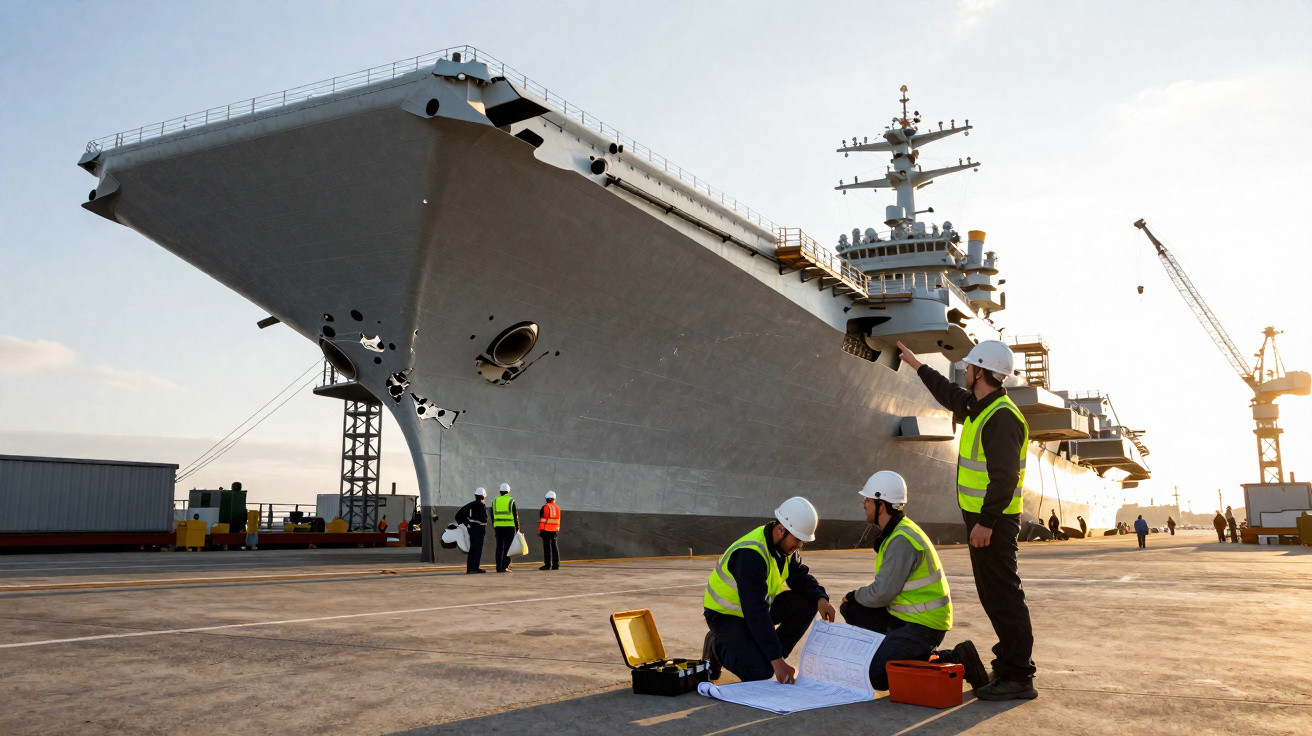
On a dull morning off England’s south coast, HMS Prince of Wales forms a vast outline on the horizon. Seen from afar, Britain’s newest aircraft carrier still appears to embody the promise made for her: a floating airbase, an emblem of strength and a £3 billion wager on the future. Closer in, however, the picture begins to unravel. Her paint is scraped, while crew members move with the slightly guarded manner that suggests events are not unfolding as intended.
The vessel is at sea, certainly, yet the questions surrounding her are louder than her engines.
They are apparent in the careful phrasing chosen by officers. They can be heard in lower-deck jokes about “the world’s most expensive repair project.”
An aircraft carrier is meant to convey confidence.
At present, HMS Prince of Wales conveys uncertainty.
When HMS Prince of Wales starts to wobble
Speak to sailors on Portsmouth’s quay and, in their own words, they will tell a similar tale. The Royal Navy placed much of its future in two enormous vessels: HMS Queen Elizabeth and her younger sister, HMS Prince of Wales. In theory, the reasoning was sound. With two carriers, one could remain ready while the other underwent refit. The UK would have a continuing capability to operate F-35 jets at sea.
In practice, matters have been considerably more complicated.
HMS Prince of Wales has attracted more dry-dock time and headlines than operational service. That is particularly painful for a ship commissioned in 2019. For a navy under pressure to demonstrate its value, it has become a drawn-out embarrassment.
The scale of the difficulties became unmistakable in August 2022. The carrier departed Portsmouth with great ceremony for a major deployment to the United States. Within days, she returned under reduced power and the mission was cancelled. A problem with the starboard propeller-shaft coupling had produced “significant damage.” This was not a fault that could be resolved with a simple repair.
She needed to be taken to Rosyth in Scotland, raised in dry dock and put through the sort of inspection no one expects for a new, advanced warship. Engineers also identified problems with the port shaft. Rather than merely applying a temporary fix, the entire system required reconsideration.
For months, one of NATO’s largest carriers remained unavailable, photographed from above like a beached whale.
The shaft failure was more than a one-off annoyance. It exposed a wider strain in Britain’s defence narrative. These vessels were constructed within a restrictive budget, amid political demands to provide “value for money” and create jobs throughout the UK. Trade-offs were built into the programme. Redundancy was reduced. Planned upgrades were discreetly deferred.
When such a prominent component fails so early in a ship’s service life, the questions quickly mount. Was there a design defect? Were contractors put under too much pressure? Did savings take priority over resilience?
Metal can be replaced by engineers. Restoring confidence is much harder.
The hidden cost of keeping a giant afloat
Those who follow defence expenditure repeatedly make the same point: a warship’s purchase cost is simply the first offer. The Royal Navy must now undertake the demanding task of transforming HMS Prince of Wales from an unpredictable prototype into a dependable workhorse. That will require years of additional maintenance, redesign and continual adjustment.
Behind the scenes, planners must balance this against every other pressure. Frigates are ageing. Submarines require refits. Personnel are departing more quickly than replacements arrive.
A carrier needs more than repairs; it needs an entire navy built around it.
The consequences are visible in deployment plans. After Prince of Wales broke down, HMS Queen Elizabeth had to be brought in quickly to meet exercises and commitments. She is now carrying expectations that were meant to be divided between two hulls. There is less room to breathe and fewer opportunities to stop and address small faults before they develop into major ones.
There is also the less visible issue of spare parts. Sophisticated ships depend on a supply chain extending from Scottish shipyards to specialist producers in Europe and the US. A hold-up involving one essential part can disrupt plans prepared with great care.
In truth, no one operates a flawless, frictionless maintenance timetable with a budget this constrained.
Behind the machinery lies a human cost. Personnel trained for carrier operations can suddenly be left alongside, repeating exercises or being reassigned with little warning. Families arrange their lives around deployments that are moved or disappear altogether. Young sailors who enlisted to “see the world” may spend weeks in harbour, following social-media rumours about what is actually happening aboard their ship.
Defence analysts take a wider view, and their assessment is direct.
“When your flagship carrier is repeatedly unavailable, allies notice, rivals notice, and your own people notice. A carrier is meant to be a promise. Right now that promise looks shaky,” one former Royal Navy officer told me.
- Repeated breakdowns weaken morale aboard ship and throughout the fleet.
- Uncertain timetables harm Britain’s standing with allies.
- Rising expenditure puts pressure on other essential naval programmes.
- Political scrutiny intensifies whenever the vessel makes headlines for the wrong reasons.
- Long-term trust in expensive defence programmes steadily erodes in the background.
A symbol that cannot afford to fail
HMS Prince of Wales carries more than aircraft and helicopters; she also bears expectations. The UK presented the carrier programme to the public as a declaration: post-Brexit Britain remained a serious military power, still capable of entering crisis zones with a flight deck lined with F-35s. That story is vulnerable. Every mechanical fault and every abandoned deployment weakens it.
There is an obvious reality that those connected with the programme recognise, but seldom state openly.
When a £3 billion warship repeatedly breaks down, the problem is not merely technical; it becomes a political weakness.
No one in Whitehall wishes to revisit the period when British carriers were retired with nothing available to replace them. Building two ships was intended to prevent a “carrier gap.” However, the Royal Navy now confronts an awkward fact. On certain days, that gap is not hypothetical but real: one vessel is undergoing extensive maintenance, while the other is under heavy strain.
There is also debate over what these carriers are designed to achieve. Created for high-end conflict between states, they now operate in an era of drones, cyber-attacks and hypersonic missiles. Critics question whether Britain has invested heavily in a platform whose vulnerabilities are increasing more rapidly than its relevance.
Programme supporters argue that adaptability is what matters. In their view, the ship is a floating platform rather than a fixed concept.
Within the navy, sentiment is more complex than either straightforward optimism or despair. Sailors take pride in their ship. Engineers are committed to repairing failures and learning from them. There is a determined, somewhat stubborn conviction that, once the early faults are overcome, Prince of Wales will justify her role.
But time is running on. Each year devoted to resolving fundamental reliability problems is a year not spent testing new air wings, drones and methods of warfare. Allies such as the US are already moving in that direction, using carriers as platforms to test unmanned aircraft and new operational approaches.
Britain does not want to reach 2030 with a “new” carrier that already seems outdated.
The issue hanging over HMS Prince of Wales is not only “will she work?” but also “will she matter, when she finally does?”
| Key point | Detail | Value for the reader |
|---|---|---|
| Chronic technical issues | Propeller-shaft failures and prolonged repairs have restricted deployments | Explains why a “brand-new” carrier repeatedly reaches the news for negative reasons |
| Strain on the wider fleet | Queen Elizabeth must undertake more duties while budgets and crews remain stretched | Illustrates how one troubled ship can affect the readiness of the whole navy |
| Symbolic and political risk | A struggling flagship damages Britain’s military image and future defence debates | Provides context for future headlines and disputes over defence spending |
FAQ:
- Why is HMS Prince of Wales considered “in trouble”? The carrier has experienced serious technical faults, particularly involving her propeller shafts, resulting in lengthy repair periods, cancelled deployments and increasing doubts over her reliability and overall value.
- Is HMS Prince of Wales currently operational? Her status changes as repair work and trials continue, but she has spent substantial periods in dry dock or under restricted use instead of conducting full front-line deployments.
- How much did HMS Prince of Wales cost? Construction of the ship is commonly put at around £3 billion, although lifetime spending on personnel, maintenance and upgrades will be many times greater.
- Why does the UK need two aircraft carriers? The intention was for one carrier to be available while the other received maintenance or a refit, giving the UK continuous carrier-strike capability instead of brief periods of availability followed by long gaps.
- Could HMS Prince of Wales be retired early? There is no official proposal to withdraw her early, and scrapping a comparatively new carrier would be politically explosive. However, continuing difficulties are already prompting debate about whether the existing carrier strategy can be sustained.






Comments
No comments yet. Be the first to comment!
Leave a Comment