
On a scorching July afternoon, caught somewhere between the laundry basket and the kitchen sink, you suddenly think of your tomato plants.
You step outside, flip-flops tapping along the path, and find them tall, leafy and seemingly full of potential. At first glance, they look splendid. Look closer at the fruit, though, and another picture emerges: split skins, yellow shoulders, a mealy texture, and flowers that have withered and fallen without any obvious explanation.
You might blame the heat, the variety, or that inexpensive bag of compost.
Yet the real offender is already in your hand: the hose.
It is the unnoticed error that countless gardeners make summer after summer.
The hidden problem is not the sun but your watering habit
Many gardeners assume tomatoes are straightforward: sunshine, soil, water, finished.
But stroll down almost any suburban street at dusk and the same routine is on display. Someone wearing sandals casually waves a hose over their tomato plants for a few minutes, watches the leaves shine with water, then goes indoors again. The soil receives a light sprinkling, only the upper few centimetres turn dark, and the job is considered done.
To anyone looking on, the plants appear content. For their roots, however, it is relentless stress.
This seemingly harmless habit of shallow watering can quietly undermine the whole crop.
Consider Marie, a novice gardener who proudly filled her balcony with six tomato plants in large plastic containers. Every evening, without fail, she watered until the compost surface looked dark and glossy. The plants grew quickly, thick with green foliage, and she shared photographs of their first flowers on social media. Then, a few weeks later, problems began to appear.
The first ripe tomatoes developed large black patches at their blossom ends. After a summer storm, others split open dramatically. A number remained frustratingly firm and pale around the top. Marie assumed she was dealing with a disease.
She was not. The cause was that daily, superficial sprinkling.
Tomatoes are hungry plants with deep-reaching roots. Their roots want to grow downwards rather than linger near the surface. When plants receive only brief drinks, the roots gather in the topsoil, where moisture comes and goes rapidly.
That repeated pattern of “feast then famine” puts the plants into survival mode: sudden bursts of growth followed by drought stress. Nutrients such as calcium travel unevenly through the plant, leading to blossom end rot and oddly shaped fruit. The plant may look large and vigorous, but below the surface it is constantly coping with a small-scale crisis.
How to water tomatoes properly - the method almost nobody uses
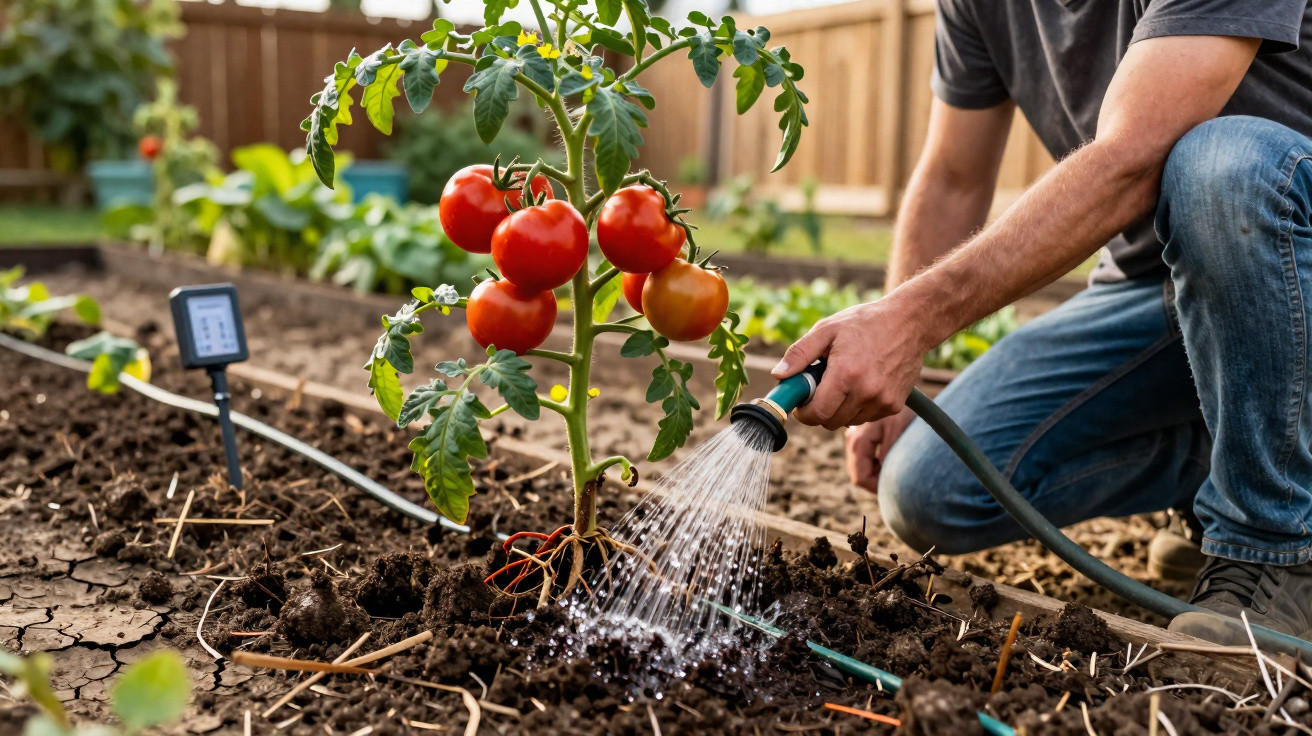
Tomatoes do not require water every day. They need water that reaches their roots. In practice, that means watering deeply but less frequently. Rather than giving them a small amount each afternoon, provide long drinks with proper gaps between them.
Keep the hose at the plant’s base instead of spraying the foliage, and allow it to run gently. Your aim is to moisten the soil to a depth of 20–30 cm. In most garden beds, this means a slow, steady trickle for several minutes per plant, followed by enough time for the soil to dry slightly before watering again.
In truth, hardly anyone manages this every day.
The usual worry is: “If I don’t water daily, they’ll die.” In reality, tomatoes benefit from a distinct cycle: deep soak, pause, deep soak. This encourages roots to grow down into soil that remains cooler and more consistent.
Evening overhead watering, the familiar hose approach, has the reverse effect. It dampens the leaves, increases humidity and does little for the root area. This creates ideal conditions for fungal diseases, leaf spots and fruit splitting after storms. The plant may live, certainly.
But the harvest suffers.
“Once I stopped babying my tomatoes with quick sprinkles, the difference was shocking,” says Jean, who’s been gardening in a small city yard for 15 years. “I went from cracked fruit and sad, dry clusters to baskets I could barely carry. Same soil, same varieties. Just deeper watering and less fuss.”
- Water less often, for longer
Go for one or two thorough waterings each week, depending on the temperature and soil, instead of sprinkling every day. - Focus on the base, not the leaves
Direct water onto the soil, preferably using a slow trickle or drip system, to limit disease. - Use mulch to lock in moisture
A 5–8 cm covering of straw, shredded leaves or grass clippings helps keep soil moisture stable. - Check with your fingers
Do not rely on what the surface looks like. Press a finger 5–7 cm into the soil; when it is dry at that depth, it is time to water. - Avoid wild swings
Extended dry periods followed by heavy soaking encourage splitting and blossom end rot.
Tomato plants remember how you have treated them
After seeing the effect of deep, reliable watering on a tomato plant, it is difficult to return to the old approach. Stems become thicker, leaves remain firmer during the midday heat, and fruit forms more evenly along the trusses. You pick more tomatoes with a consistent size, colour and juicy texture from top to bottom.
There is a subtle mental change too. Watering no longer feels like a hurried, guilt-driven chore at the end of the day; it becomes an intentional pause. You spend time beside the plants, notice bees visiting the flowers, and catch the first sign of a hornworm before it becomes a major problem. You are less of a sprinkler and more of a carer.
We have all experienced it: biting into the season’s first tomato only to find it… disappointing. Watery. Grainy. Nothing like the juicy, almost sweet fruit you pictured when buying those seedlings in spring. It is easy to accuse the variety, the shop or even the weather gods.
But much of that flavour and texture is determined by what you do with the hose in June and July. The plant never complains, but every cracked skin, pale shoulder and dry, corky mouthful is a silent report card. If any garden plant can hold a grudge, it is a stressed tomato vine.
Altering one habit can seem insignificant. It is only water, after all. Yet small actions repeated over time shape the entire season. Deep watering needs no elaborate equipment or costly fertiliser. It asks for something much less common: steady attention and a readiness to slow down.
Those extra few minutes once or twice a week can often make the unseen difference between “The tomatoes were a bit of a letdown this year” and “We couldn’t eat them fast enough, I had to give bags away to the neighbors.” The plants do not applaud, offer thanks or post online.
They simply produce fruit that finally tastes as summer should.
| Key point | Detail | Value for the reader |
|---|---|---|
| Deep, infrequent watering | Soak soil 20–30 cm down once or twice a week instead of daily splashes | Reduces stress, supports stronger roots, improves yield and flavour |
| Avoid watering foliage | Keep the hose at the base of the plant and skip overhead spraying | Lowers disease risk and sends water where tomatoes actually need it |
| Stabilise moisture | Use mulch and finger checks to avoid extreme wet–dry swings | Limits blossom end rot, cracking, and uneven ripening |
FAQ:
- Question 1 How often should I water tomatoes in peak summer?
- Question 2 Why do my tomatoes crack right after rain even if I water?
- Question 3 Can I use a sprinkler for my tomato patch?
- Question 4 Does mulch really change how often I need to water?
- Question 5 Is blossom end rot only about calcium, or about watering too?



Comments
No comments yet. Be the first to comment!
Leave a Comment