
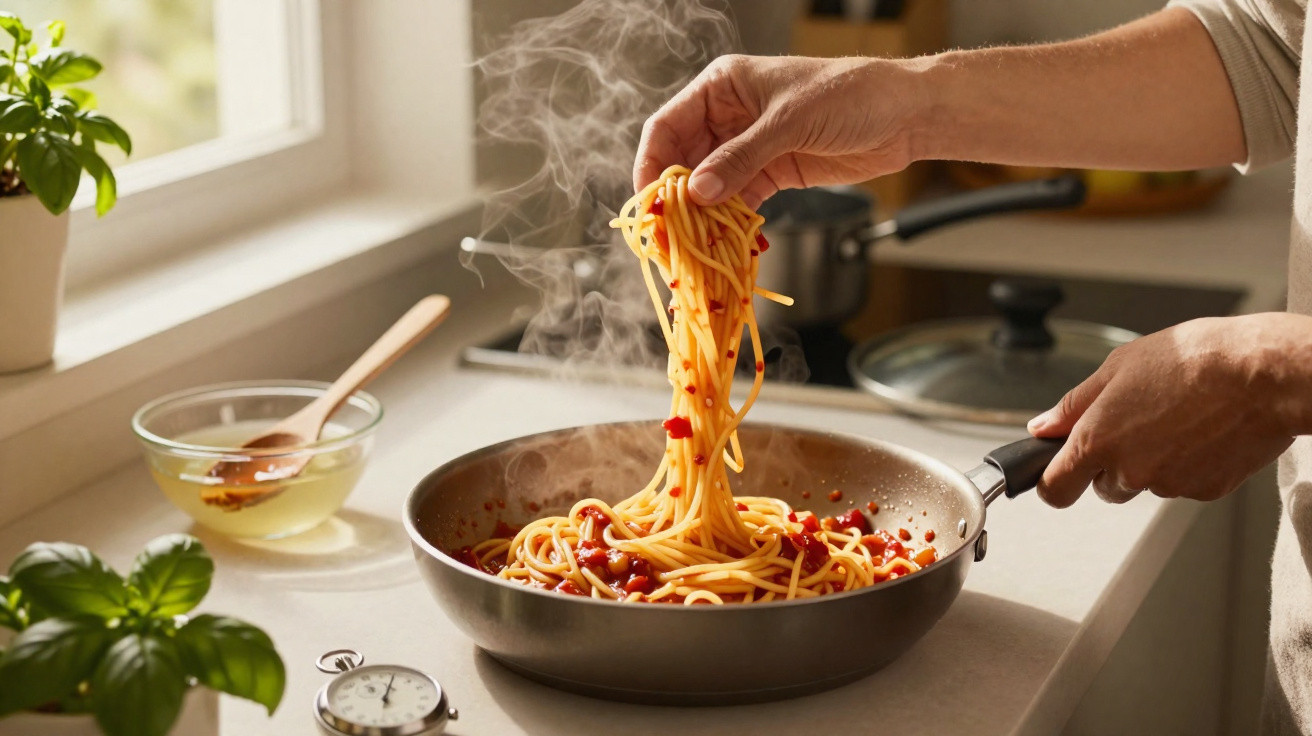
The once-questioned practice of cooking dry pasta directly in its sauce is moving into the mainstream. Busy home cooks, food scientists and pressed-for-time parents are embracing it for proper flavour without filling the sink with cookware.
How cooking pasta in its sauce changes everything
A conventional pasta supper tends to follow the same set routine: bring a large pan of water to the boil, cook the pasta, drain it, then toss it through sauce in another pan. Once the boiling time and washing-up are included, that “simple” dinner can easily take 40 minutes from your evening.
The one-pot approach turns the process around. Put uncooked pasta into a broad pan or deep sauté pan with a relatively small quantity of water or stock, along with aromatics and sauce ingredients. While everything cooks together, the pasta softens, the liquid cooks down and the flavours intensify.
Instead of juggling two or three pans, you stir one single pot and sit down to dinner in around 20 minutes.
This is more than a social-media fad. Popularised in the US by Martha Stewart and with roots in southern Italian cooking, the technique has become a regular choice for people wanting “proper food” on a Tuesday night without dedicating the entire evening to making it.
The time-saving maths behind one-pot pasta
The biggest saving begins with the water. Standard guidance suggests around 1 litre of water per 100 g of pasta. One-pot pasta cuts this to approximately 1 litre for 500 g of pasta: five times less water for the same amount of pasta.
Heating a smaller volume of water takes less time than bringing a large pan to a rolling boil. You also eliminate two stages altogether: draining the pasta and mixing it into the sauce afterwards. Individually these jobs are minor, but their impact grows when you cook several nights each week.
- Less water to heat = faster boiling
- No colander to wash = reduced clean-up
- No separate sauce pan = fewer dishes, less gas or electricity
- Pasta and sauce ready at the same moment = no overcooked, claggy noodles
For people feeding children, getting in late from work or cooking in a small flat kitchen, even 15 minutes saved at dinnertime can transform the atmosphere of the evening.
The science: starch, gelling and natural creaminess
There is no magic involved in this method; it is simply chemistry. Pasta consists largely of starch, which contains two principal molecules: amylose and amylopectin. At about 60°C, the starch granules begin to expand and split through a process known as gelatinisation.
When pasta is cooked in a large pan of water, much of that starchy liquid is discarded down the drain. In one-pot pasta, it remains in the pan. As the pasta cooks, the limited quantity of water becomes increasingly concentrated with starch.
That concentrated starch clings to every piece of pasta and thickens the liquid, giving you a glossy, silky sauce without adding cream.
Once this starch-heavy water combines with fat from olive oil, cheese or a knob of butter, it forms a stable emulsion. Small fat droplets stay evenly suspended in the saucy liquid, creating the rich mouthfeel of the finished dish.
Food scientists, among them French molecular gastronomy pioneer Hervé This, regard the approach not as a lazy shortcut but as an intelligent domestic application of starch chemistry. In effect, it is a quick, family-friendly version of the chef’s technique of finishing spaghetti in sauce with a ladleful of pasta water.
Pasta risottata: the Italian cousin of one-pot pasta
This cooking style has long been called pasta risottata in areas of southern Italy, particularly Puglia. Its name explains the principle: pasta is handled rather like risotto rice, absorbing a flavour-packed liquid as it cooks.
Many cooks begin with a cold pan. The pasta, liquid and seasonings are all added before the heat is switched on. This allows more time for starch to release gradually, helping to create the creamy finish later.
The key ratio is simple: about one part dry pasta to two parts liquid by volume, adjusted slightly depending on shape and brand.
For instance, 500 g of pasta and roughly 1 litre of water or stock are well suited to a 28 cm-wide sauté pan. A wider pan provides greater surface area, allowing liquid to evaporate more quickly so the sauce thickens rather than becoming watery.
Step-by-step: a basic one-pot pasta that works
Use this straightforward, weeknight-friendly template and adapt it to the ingredients you have available:
- Choose a pan: use a wide, deep frying pan or lidded sauté pan.
- Add dry pasta: use 300–500 g, according to the number of people eating.
- Pour in liquid: add about twice the pasta’s volume in water, stock, passata or a combination.
- Add flavour: include sliced garlic, onion, herbs, a pinch of salt, pepper and perhaps chilli flakes.
- Include extras: try cherry tomatoes, spinach, mushrooms, or small pieces of sausage or bacon.
- Add some fat: use a drizzle of olive oil or a small spoon of butter.
- Start cold, then heat: with the lid on, bring the pan to the boil over medium-high heat for about 3 minutes.
- Uncover and stir: take off the lid, reduce the heat slightly and stir every couple of minutes to prevent sticking.
- Adjust: if the liquid disappears before the pasta is al dente, pour in a splash of hot water.
- Finish: once the pasta is just cooked and the sauce has thickened, take it off the heat and mix in cheese or fresh herbs.
How often you stir makes a difference. Stirring every two minutes prevents the pasta from fusing to the base of the pan, while still allowing a light crust to develop in spots, adding toasted notes and greater flavour depth.
Common mistakes that ruin one-pot pasta
Although the technique is fairly forgiving, a handful of errors can lead to underwhelming results. The three most common problems are excess liquid, unsuitable pasta and insufficient seasoning.
| Problem | Likely cause | Simple fix |
|---|---|---|
| Watery sauce | Too much liquid or pan too small | Use a wider pan, reduce liquid slightly, let it simmer uncovered for a few extra minutes |
| Pasta undercooked | Heat too low or not enough liquid added towards the end | Keep a gentle simmer and add small splashes of hot water as needed |
| Pasta sticking badly | Not stirred often enough during the first 10 minutes | Stir every 1–2 minutes at the start, then less frequently |
| Flat flavour | Seasoning left to the end | Salt the liquid from the beginning and taste at least twice during cooking |
Nutrition, budget and energy: the hidden benefits
The advantages extend beyond saving time, with more subtle benefits for households dealing with rising food prices and high energy bills.
Using a smaller amount of water and one hob for less time reduces energy use. The difference for a single meal is modest, yet across dozens of winter dinners, those saved minutes of boiling can add up on an energy bill.
Starch-rich sauces can also make plant-based dishes feel more filling. A pan of pasta, beans, vegetables and stock can feel substantial without depending on cured meats or double cream. This may help those reducing their meat intake for health or environmental reasons.
Financially, this method also works well with fridge leftovers: half a courgette, an odd carrot or a handful of frozen peas. Each can be added straight to the pan, benefiting from the shared cooking liquid.
When one-pot pasta makes sense – and when it does not
This technique does not suit every pasta dish. Fragile shapes that can easily break, including fresh ravioli, are better cooked by the traditional boiling method. Extremely thick sauces made with slow-cooked meat need their own extended simmer, since pasta cannot safely remain in the pan for hours.
One-pot pasta is at its best on busy weeknights: after getting home late, returning from the gym, or supervising children’s homework at the kitchen table while supper cooks. The ability to stir with one hand while answering emails with the other helps explain why this style has caught on on both sides of the Atlantic.
It is also practical in holiday lets and student halls. A decent pan, a wooden spoon and a chopping board are enough to make a basic kitchenette usable for cooking, with no specialist equipment needed.
Key terms and practical tweaks
Two expressions appear regularly in conversations about this cooking style:
- Al dente: pasta cooked until it is soft on the outside but retains slight firmness at its centre. One-pot pasta reaches this point quickly, so tasting a piece every minute towards the end can prevent it from overcooking.
- Emulsion: a stable combination of two substances that would not normally mix, such as water and fat. Pasta starch acts as a bridge, keeping olive oil and water together in a smooth sauce.
Understanding these ideas makes adjustments more straightforward. If the pan appears oily, it probably needs an extra splash of water to let the starch bring the fat into a proper emulsion. If the result feels gluey, the pasta may have cooked for a minute too long; next time, reduce the cooking time slightly or loosen the sauce with more liquid right at the end.
As increasing numbers of home cooks adopt these speedy, science-led methods, pasta cooked directly in its sauce is becoming less of an internet novelty and more of a dependable midweek routine. Its attraction is straightforward: fewer choices, fewer pans and a comforting plate of food that does not take over the entire evening.




Comments
No comments yet. Be the first to comment!
Leave a Comment