
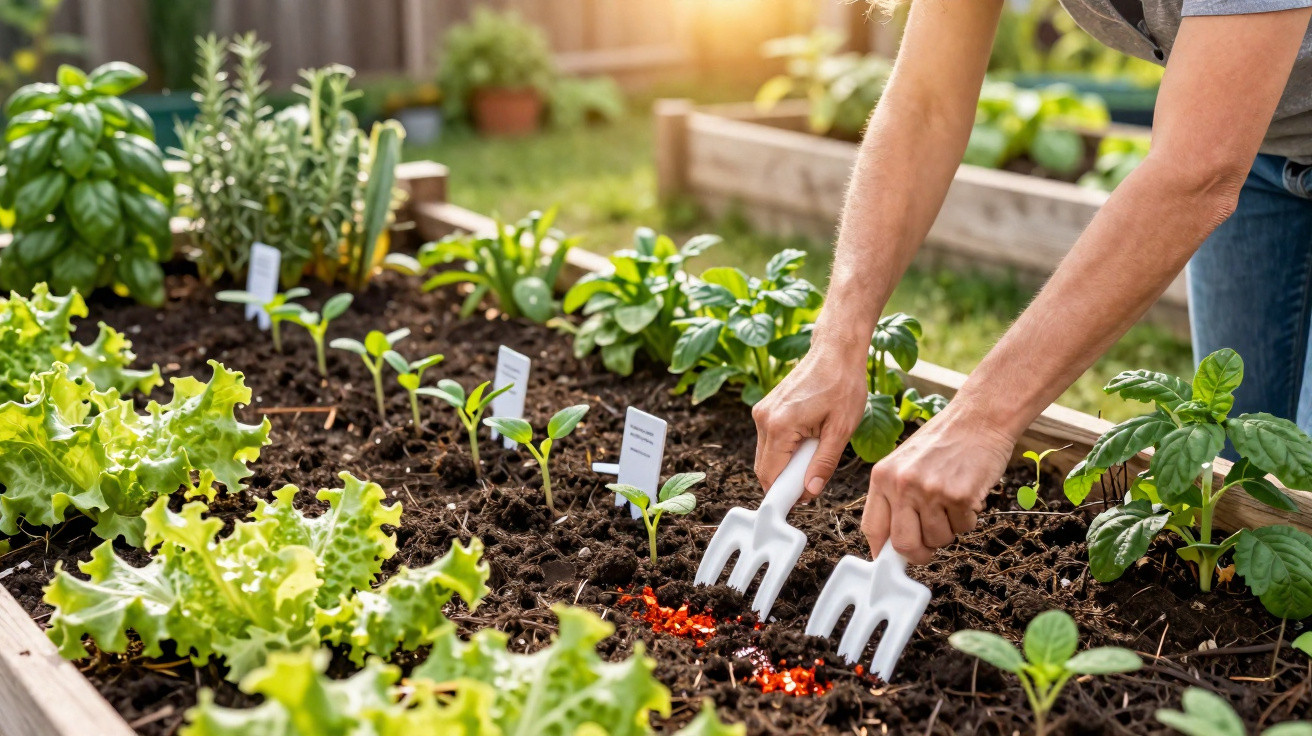
At first glance, it is easy to mistake this for a joke or sheer coincidence. Yet the plastic forks conceal a well-considered trick that has quietly become popular in many home gardens – especially among people who want to protect their beds from cats, birds and other raiders without poisons or major expense.
Why plastic forks in a garden bed genuinely make sense
The forks work through a straightforward combination of instinct and discomfort. Many animal visitors are drawn to loose soil. Cats often treat freshly prepared beds as litter trays, while birds and squirrels dig around for seeds. Rabbits and other rodents also move through the rows in search of tender young plants.
When forks are pushed into the soil throughout the bed with their prongs facing upwards, the soft surface becomes a kind of obstacle course. Every step may feel uncomfortable or irritating. The risk is no longer worthwhile for the animals, so they move on to a more convenient location.
The vegetable garden remains what it is meant to be: a place for vegetables – not for cat litter trays, scratch marks and shredded young plants.
There is also a visual effect. Many animals are wary of unfamiliar shapes. A dense pattern of upright forks can resemble a warning signal of sorts. As the area looks unsettled and hazardous, they will often avoid it from a distance.
Another benefit is that plastic forks stay where they are placed. Rain does not wash them away, and sunlight does not make them disappear. Unlike sprays, powders and liquid deterrents that require frequent reapplication, forks can do their job for months with virtually no maintenance.
Young plants benefit most from the plastic fork barrier
The period when seedlings have only just emerged is particularly vulnerable. One visit from a cat or a pecking bird can destroy an entire row of tiny plants. Many home gardeners say that using forks at precisely this stage makes the difference: considerably more plants survive their early growth with forks in place.
Anyone struggling with birds, cats, hedgehogs or squirrels in a garden bed can try the technique in one corner first. One season is often enough to show what happens: the animals simply alter their routes – away from the vegetables.
How to place plastic forks correctly in a vegetable bed
The key factor is the layout rather than the number of forks. Scattering five forks somewhere in the bed will have little effect. A successful result needs a system.
Four proven layout strategies
- A protective edge barrier: Insert forks closely together along the edge of the bed. This blocks direct access points.
- Circles around individual plants: For vulnerable crops such as kohlrabi, lettuce or young tomato plants, arrange four to six forks in a circle, creating a small fence.
- Between the rows: Place forks between two vegetable rows so that no clear straight path remains.
- Blocking animal routes: Watch where animals regularly pass and put a dense line of forks in their way.
A spacing of around seven to eight centimetres has proved effective. If the forks are farther apart, animals can find gaps and simply slip through. Their prongs should point vertically upwards, while the handles need to be pressed sufficiently deep into the soil to prevent the forks from toppling over immediately.
Gaps in the pattern are an invitation to march straight through. The more even the barrier, the fewer animal visitors there will be.
After a storm or heavy rain, a quick inspection is worthwhile: stand any fallen forks back up and straighten shifted rows. In practical terms, the method needs no further care.
Combining forks with other natural deterrent methods
Forks do not solve every issue; they are one part of a wider set of measures. Anyone who genuinely wants to protect their vegetables should combine several gentle techniques.
Aromatic plants as a living protective wall
Strongly scented plants deter a number of insects and small mammals. Popular choices include:
- Marigolds around tomato or bean beds
- Basil beside peppers and tomatoes
- Mint in pots around the edge of the garden
As well as offering a degree of protection, these plants can often support neighbouring crops. In many beds, tomatoes grow more vigorously next to marigolds, while peppers enjoy being planted near basil.
Sharp and bitter deterrents at ground level
A fine powder with a powerful effect: sprinkling cayenne pepper around plants can create an unpleasant surprise for animals sniffing and digging nearby. The powder irritates the noses of many mammals. However, it must be reapplied after heavy rain.
Many people use essential oils on a similar principle. Scents such as peppermint, eucalyptus or citrus deter animals without harming bees or other pollinators. Just a few drops mixed with water and dripped onto stones or pieces of wood in the bed can be enough. It is important to use them sparingly and test them in a small area first.
Coffee grounds: protection and fertiliser in one
Coffee grounds are a classic kitchen leftover and provide two benefits at once:
| Property | Benefit in the garden |
|---|---|
| Coarse, crumbly texture | Makes it harder for slugs and other molluscs to move forwards |
| Strong smell | Disrupts the sniffing of some small mammals and insects |
| Nitrogen content | Slowly feeds the soil and encourages soil life |
It is best to dry the coffee grounds briefly before scattering them in a loose ring around vulnerable plants. Thick layers can become compacted, so it is better to apply small amounts more often.
Reuse plastic forks instead of throwing them away
Many households still have old plastic forks from parties sitting in a drawer. Ordinarily, they eventually end up in the bin. In the garden, however, they are ideally suited to a second life.
Anyone who uses existing plastic forks in a garden bed saves money, reduces waste and avoids buying new plastic products for the same purpose.
The forks can be rearranged each year, moved to other beds and cleaned easily when necessary. For people on a limited budget, this is one of the cheapest ways to keep animals away from garden beds.
Those wishing to avoid purchasing new single-use products can instead use already-owned reusable plastic forks or durable bioplastic forks – as long as they withstand rain, sunshine and minor knocks in the soil.
Points to consider in everyday use
Despite all the advantages, there are a few considerations to keep in mind:
- Children: Forks with pointed prongs can be uncomfortable for young children running and playing in the garden. It is therefore best to explain where they should not run.
- Harvesting: In densely planted beds, take care not to prick yourself on the prongs while harvesting.
- Appearance: Anyone who dislikes the look can use coloured forks or push them partly into the soil to make them less noticeable.
In very small gardens, a narrow row of forks along the boundary with a neighbouring property is often enough. In larger spaces, a clear system is worthwhile: fork zones for sensitive crops, and open areas for hardy plants such as courgettes or potatoes, which tolerate animal visits more readily.
Who benefits most from the plastic fork trick
Beginners growing vegetables can quickly become discouraged when their first home-sown radishes are destroyed before they can be harvested. Starting again season after season eventually takes the enjoyment away. This is where plastic forks can make that all-important difference – the first success remains intact and the frustration never arises.
Their value is also clear in allotments with many cats, or suburban areas where squirrels, mice and birds are ever-present. Many people report that animal activity shifts more strongly towards areas without forks, such as paths, ornamental sections or compost heaps.
Ultimately, the method fits well with a trend that is gaining momentum across German-speaking countries: growing vegetables in your own garden with as little chemical input as possible, using simple measures and a little observation. A handful of old plastic forks can achieve a surprising amount – quietly, unobtrusively and with unexpectedly effective results.

Comments
No comments yet. Be the first to comment!
Leave a Comment