
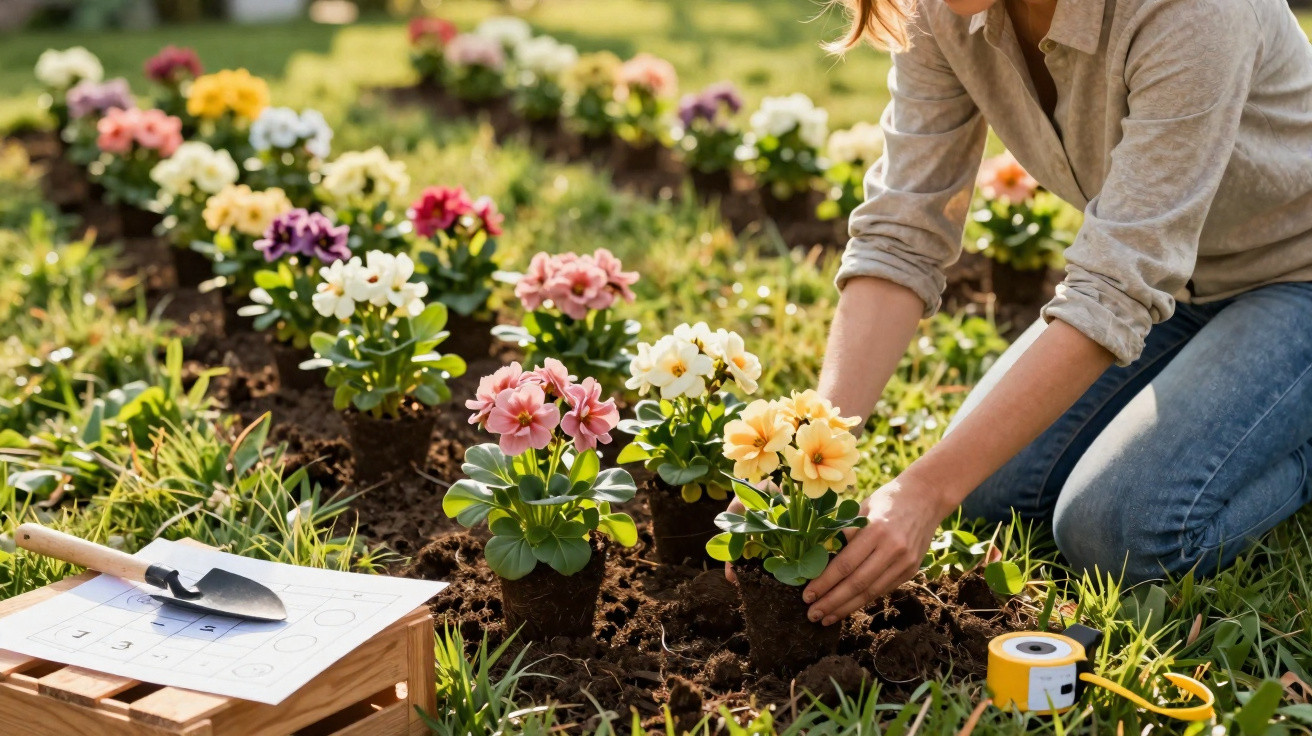
Last weekend, I was in my neighbour’s back garden, doing my best not to make it too obvious that I was staring at her flawless borders. Every plant seemed deliberately placed, as though a magic wand had turned everyday greenery into a scene from a glossy magazine. By comparison, my own garden looked as if I had scattered seeds with my eyes shut and simply wished for the best. She noticed me admiring her neatly positioned lavender clumps and gave a knowing smile. “It’s just the rule of three,” she said, as though that answered everything. I had no idea what she meant, but I was about to find out.
Why Your Garden Feels Chaotic (And How Professionals Fix It)
Take a walk through a botanical garden or browse a landscape design magazine and one thing quickly becomes clear: the planting schemes never feel haphazard. An unseen rhythm guides your gaze from one area to the next, producing a harmony that may be difficult to define but is impossible to miss.
Professional garden designers use a technique that many casual gardeners have never encountered. Known as the rule of three, it draws on the way our brains interpret visual information. Research shows that groups with odd numbers create dynamic, engaging visual tension, whereas even-numbered arrangements can appear still and formal.
Odd-numbered plantings work so well because they encourage the eye to settle on a focal point. In a group of three, we instinctively look towards the middle plant. With five plants, the eye travels through a satisfying triangular arrangement. Even-numbered groups, on the other hand, divide our attention in two, creating a subconscious impression of separation instead of cohesion.
The Simple Maths That Transforms Amateur Gardens
Begin modestly by planting clusters of three, five or seven of the same variety. Pick a plant you genuinely enjoy – perhaps flowering perennials or ornamental grasses – and arrange it in a triangle instead of a rigid row. The improvement will be obvious straight away.
In truth, most of us plant one of each thing because we want plenty of variety. We spot a lovely hosta at the garden centre and buy a single plant, then see beautiful astilbe and add just one of those as well. The result is what designers refer to as “polka dot syndrome” – individual plants dotted about like confetti.
“Repetition creates rhythm, and rhythm creates a sense of intentional design. When you repeat the same plant in odd-numbered groups throughout your garden, you’re essentially creating a visual melody that ties everything together.”
The essential principles for repeating plants successfully are:
- Select 3-5 “anchor” plants to use repeatedly across the space.
- Plant them in odd-numbered groups of 3, 5 or 7.
- Position the clusters at uneven intervals to create a natural flow.
- Combine different plant heights within each group to increase interest.
Creating Your Own Professional-Looking Paradise
Consider your garden a conversation in which certain “words” reappear to support its central theme. This could mean the silvery leaves of lamb’s ear recurring in groups of three through a border, or purple salvia clusters forming visual anchors every metre or two. Repetition builds recognition, while odd numbers maintain energy. Rather than calling out a collection of unrelated plant names, your garden begins to tell one coherent story.
| Key point | Detail | Value for the reader |
|---|---|---|
| Rule of Three Application | Plant in odd-numbered groups of 3, 5, or 7 | Creates natural-looking, professionally designed borders |
| Plant Repetition Strategy | Repeat same varieties in clusters throughout garden | Builds visual cohesion and intentional design flow |
| Avoid Polka Dot Syndrome | Group identical plants rather than scattered singles | Transforms chaotic gardens into harmonious landscapes |
FAQ:
- How many different plants should I repeat throughout my garden? Begin with no more than 3-5 anchor plants. Repeating too many elements can feel overwhelming and undermines the aim of achieving visual harmony.
- Do I need to use exactly the same plant, or can I mix varieties of the same species? Using mixed varieties can look wonderful. Try hostas in different colours or several types of lavender, provided they share similar growing habits and visual weight.
- What’s the ideal spacing between repeated plant groupings? Place them unevenly – perhaps 1.2 metres apart, then 2.1 metres, then 1.5 metres. Uniform spacing can look overly formal and mathematical in most garden styles.
- Should I use the rule of three for trees and shrubs too? Absolutely, although mature dimensions need careful consideration. Three small ornamental trees can be highly effective, whereas three large oaks may overpower most residential gardens.
- What if I already have a mixed garden with single plants everywhere? Add companions little by little. Purchase two additional examples of the plants you like best to make immediate groups, which will start changing the overall appearance of your garden.






Comments
No comments yet. Be the first to comment!
Leave a Comment