
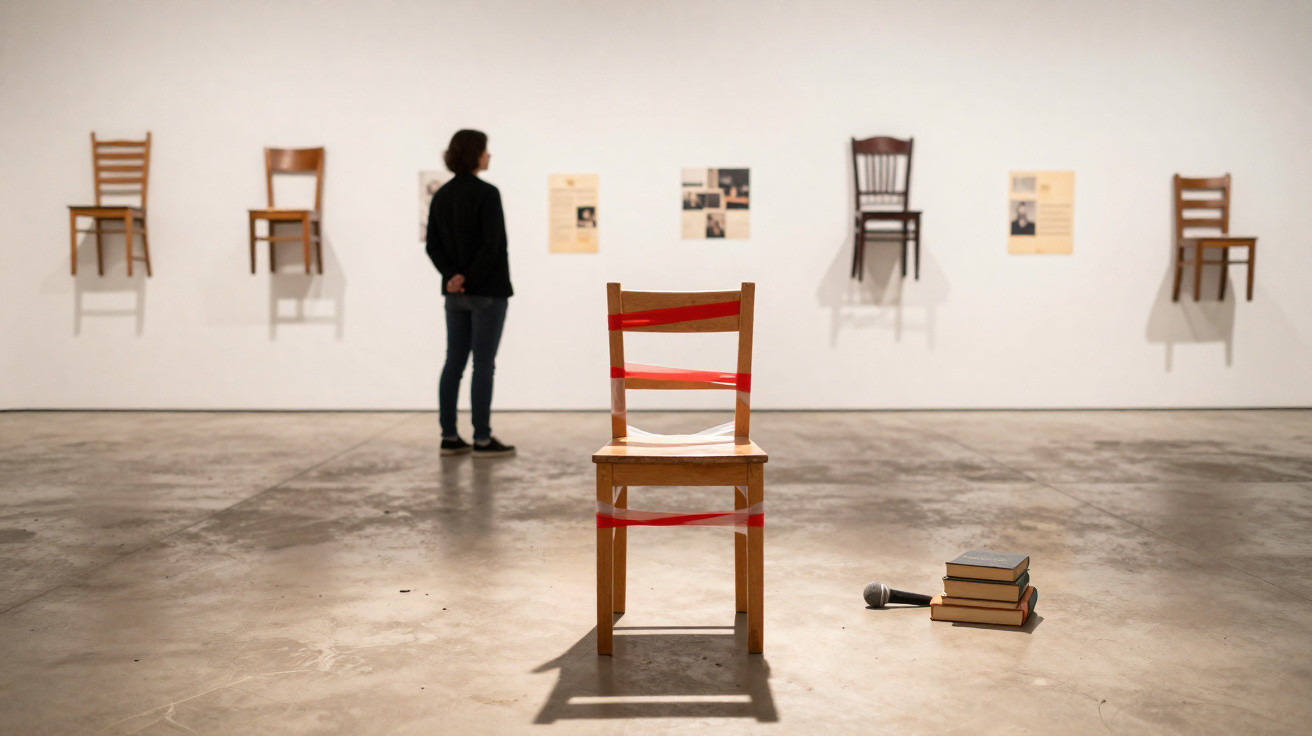
What do you see when you look at a chair? Is it merely a functional object? For the artists taking part in the Cadeira Proibida exhibition, opening next Saturday (27 June) in the foyer of Fundação das Artes (Rua Visconde de Inhaúma, 730, Oswaldo Cruz district, São Caetano do Sul), this object can take on countless meanings.
Cadeira Proibida: chairs as symbols of absence and censorship
In Cadeira Proibida, the everyday object ceases to be simply a piece of furniture and enters a symbolic and political realm. Traditionally linked with rest, presence and encounters, the chair becomes a metaphor for absence, censorship and exclusion-echoes that engage with the periods of repression experienced under Brazil’s military dictatorship.
Each artistic intervention shifts its meaning: chairs that are stitched, tied, covered, broken, suspended or blocked reveal forms of impossibility. It is no longer possible to sit. It is no longer possible to remain. The object becomes a silenced body.
Within the visual arts, intervening in everyday objects is a powerful way of creating unease and encouraging reflection. By altering the chair, the artists disrupt its practical purpose and invite visitors to notice what would usually go unseen. The chair no longer serves the body; instead, it carries ideas, memories and questions.
Material, memory and resistance
In conversation with contemporary and conceptual artistic practices, the exhibition brings materiality together with poetic experience. Wood, straw, iron, fabrics and the traces built up across the surfaces become symbolic records of time, violence and resistance. Some works may evoke imprisonment; others suggest abandonment, waiting or silent resistance.
The “prohibition” in the title should not be understood solely as the physical denial of sitting down, but as a reflection on the mechanisms of control that run through society: who is allowed to occupy spaces, who may speak, who is made invisible and who remains absent.
As they move through the exhibition, visitors encounter chairs that no longer offer comfort, but rather an aesthetic and sensory experience. Ordinary objects are transformed into instruments of memory, capable of turning silence into image and absence into poetic presence.
In this way, Cadeira Proibida offers a passage between art and historical reflection, in which every intervention shows that even the simplest objects can bear profound marks of the human condition and freedom.
Exhibition information
Opening: 27 June 2026, 11 am
Venue: Foyer of Fundação das Artes
Exhibition period: 27 June to 31 July 2026
Opening hours: Monday to Friday, 8 am to 9 pm; Saturdays, 9 am to midday
Free admission
The exhibition includes works by Alexandre Barsanov, Anete Nascimento, Carlos Habenchus Junior, D. Medeiros, Dariene da Silva Baia, De Oliveira, Denise Fabretti, Eduardo de Amorim Nunes, Elza Fatobene Ando, Fernanda Norizzo, Julia Silva Paes Oliveira, Liliane Santos, Luiza Bastos Camilo, Meire Megumi Nahara, Pedro Quinho, Regiane Casemiliano, Rosely Lunak, Valdivo Recheio, Victor Henrique de Oliveira and other participants connected with the institution’s Visual Arts courses.
Curated by Valdo Rochelo, with support from Neicla de Freitas and Andradina de Aguiar.
Fundação das Artes de São Caetano do Sul
Rua Visconde de Inhaúma, 730 – Oswaldo Cruz district – São Caetano do Sul/SP
Telephone and WhatsApp: (11) 4239-2020




Comments
No comments yet. Be the first to comment!
Leave a Comment