
The strawberries looked flawless in the shop: plump, vivid red and carrying a faint summery scent despite the supermarket’s fluorescent lighting. You put the punnet proudly on the top fridge shelf, imagining yoghurt bowls, smoothies and that elaborate dessert you keep promising to make this week. Then, two days later, you take them out and spot it: a fuzzy white patch in one corner, spreading through the rest like a small, soft catastrophe.
You pause. Could you discard the spoiled ones and save the others? Should you rinse them? Eat them quickly and hope for the best? This small dilemma reflects the way many of us live: hurried, making do, and wasting food we had vowed to handle better. But perhaps the strawberries are not the real issue. Perhaps it is how we bring them into the kitchen.
A simple tip has been quietly making the rounds in home kitchens. It almost seems too easy, yet it can make a remarkable difference.
Why strawberries go mouldy so quickly in the fridge
Strawberries are delicate from the moment you pick up a punnet in the shop. They may already have travelled a long way, been handled repeatedly and perhaps knocked about. Every slight bruise provides an opening for mould spores. Once home, we place them in a cold, humid fridge and hope they will still be fine by Wednesday. By the time we think of them again, the fridge has effectively become a damp nursery for fuzz.
The pattern is almost predictable. On day one, they are perfect. Day two, still good. By day three, there is a questionable mark. Day four brings the “oh no” moment. A US nutrition researcher who monitored berry spoilage in typical homes found that a substantial share of fresh berries ends up in the bin within five days. It is not because the fruit was unsuitable to eat in the first place; mould simply gets there first. Those tiny grey-white fluffy patches account for a surprisingly large amount of food waste.
There is nothing mysterious about the science behind this small tragedy. When strawberries come home, invisible mould spores are already on them: some from the field, others from the packing line or even from other food in your shopping basket. Combine that with condensation inside the punnet and poor airflow, and the conditions are ideal for growth. Refrigeration slows the process, but it does not eliminate it. The answer, then, is not only to keep strawberries cold, but to make conditions less favourable for mould.
The vinegar and water bath that keeps strawberries fresh for weeks
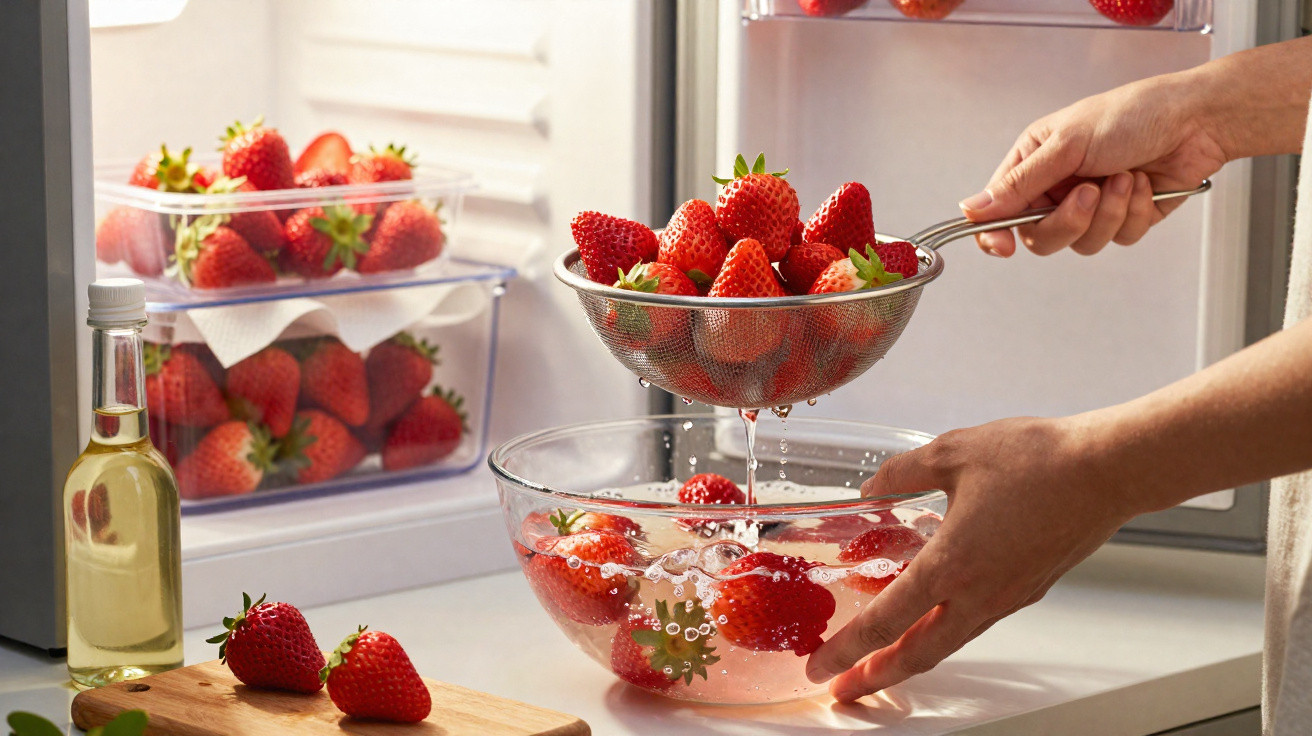
This is the method that can turn your fridge from a berry morgue into a safe place for fruit. As soon as you get home, take out a large bowl and mix one part white vinegar with three parts water. For instance, use about 240 ml of vinegar and 720 ml of water. Carefully place the strawberries in the mixture and gently swirl them by hand for 20–30 seconds. Do not scrub or stir roughly; a light rinse is enough.
Remove them with your hand or a slotted spoon, then arrange them in one layer on a clean tea towel or sheets of kitchen roll. Next comes the waiting: let them dry completely. It may test the patience of anyone eager for a snack, but it is an essential part of the process. When they are dry, transfer the strawberries to a container lined with kitchen roll. Leave the lid slightly open, or make a few small air holes. No expensive equipment or specialist spray is required: only vinegar, water, time and a little airflow.
The first time you try it, you may doubt the idea. Vinegar on sweet strawberries? Once the fruit has dried, however, there is no vinegar taste. Instead, you may notice that the days pass without any fuzz appearing. After a full week, and sometimes two, the berries can still be bright and whole. Food scientists explain that the mild acidity of vinegar interferes with mould spores and some surface bacteria. It does not sterilise the strawberries; it simply reduces the problem enough to give the fruit a better chance against time.
Common mistakes that quietly spoil your strawberries
Although this technique is effective, a few common pitfalls can undermine it when people are tired, busy or simply human. First, do not soak the fruit for too long. A brief bath is all that is needed. Leaving strawberries in the vinegar solution for several minutes may cause them to take in too much liquid and soften sooner. Treat it as a rinse, not a marinade. The aim is to reach every surface, not submerge the fruit for ages.
Another major mistake is overlooking the drying stage. We have all done it: you are hungry, so you put damp strawberries into a container and close the lid. Condensation accumulates, water droplets sit on the berries, and mould has exactly what it needs. Drying is the dull, unglamorous stage that quietly saves you money. Dab them carefully and allow room for them to air-dry. Honestly, hardly anyone manages this perfectly every day. But whenever you do, the improvement is clear.
The third issue is the container. A tightly sealed plastic tub with no airflow becomes a miniature sauna. An overfilled glass jar has the same effect. Choose a setup that lets moisture be absorbed while allowing a little air to circulate. As one home cook told me after a month of testing this method:
“I stopped blaming the strawberries. Once I learned to prep them right with a quick vinegar rinse, they stopped going bad on me. It was like someone finally turned off the mold switch in my fridge.”
Keep this straightforward checklist in mind:
- Use a 1:3 ratio of vinegar to water for the bath.
- Rinse briefly rather than soaking for extended periods.
- Dry the berries fully in a single layer.
- Keep them in a lined container with slight airflow.
- Take out any damaged berries before storing the remainder.
Living with strawberries that really last
When you have strawberries that remain good for ten, twelve or even fourteen days, your approach in the kitchen changes. You no longer rush to eat them because you fear they will spoil. Instead, you can plan without pressure: yoghurt at Monday breakfast, a salad topped with sliced berries on Thursday, and pancakes using the final handful on Sunday. The fruit fits around your week instead of making you reorganise your plans around its decline.
There is a quieter relief, too, in opening the fridge without finding a punnet that makes you feel guilty. No more looking at a slimy corner and thinking about the money spent, the grower who produced the fruit or the planet’s resources used to bring it there. Extending the life of strawberries is more than a useful trick; it changes your relationship with the food you buy. A small ritual at the sink, involving a bowl of vinegar and water, can prolong their life well beyond what the label might lead you to expect.
You may even start passing the tip on. Share it with a neighbour who enjoys fruit but dislikes waste, a friend with children who hates throwing away snacks, or that colleague who always says their berries spoil “in like two days”. These little household discoveries often move quietly from one kitchen to another long before official guidance catches up. Perhaps that is the bigger story of the vinegar wash: not merely strawberries lasting for weeks without going mouldy, but a growing shared feeling that we can tilt time a little in our favour, beginning with the smallest items in the fridge.
| Key point | Detail | Value for the reader |
|---|---|---|
| Vinegar-water bath | 1 part vinegar to 3 parts water, quick rinse | Reduces mould spores and extends freshness |
| Thorough drying | Single layer on towels until fully dry | Prevents moisture pockets where mould thrives |
| Smart storage | Lined container, slight airflow, remove damaged berries | Helps strawberries stay firm and edible for up to weeks |
FAQ:
- Question 1: Will my strawberries taste like vinegar after this wash?
- Question 2: Can I use apple cider vinegar instead of white vinegar?
- Question 3: Do I still need to rinse the strawberries with plain water afterwards?
- Question 4: How long can strawberries last in the fridge with this method?
- Question 5: Is this safe for children and people with sensitive stomachs?





Comments
No comments yet. Be the first to comment!
Leave a Comment