
An important occasion is approaching, your tailored trousers are too long, and there is no useful equipment at home: no sewing machine and no iron. For exactly these situations, many families still rely on a technique that grandmothers already knew. With a few basic tools, some patience and one small household aid, you can create a neat, almost invisible hem – strong enough for everyday wear and smart enough for the office.
Why the traditional trouser turn-up is popular again
When trousers need shortening, many people turn to a tailor or supermarket adhesive tape. However, neither solution is necessarily available while travelling or just before an event. This is where the traditional approach proves useful: it needs no electricity and uses only items that most households already have to hand.
A length of thread, a needle, several pins and a bar of firm soap are enough to make a hem that looks professionally finished.
The resulting turn-up is particularly suitable for fabric trousers, suit trousers and other finer materials. The stitching is almost impossible to see, the trousers hang smoothly and look as though they had been altered in a workshop. It is especially useful for anyone new to sewing: the method is straightforward, follows a clear sequence and is easy to manage.
Preparation: measure the length and decide on the turn-up
The first stage determines how the trousers will sit in the end. Taking a little time here avoids the need for corrections later.
- Put on the trousers, ideally with the shoes you are most likely to wear with them.
- Stand upright in front of a mirror without rising onto your toes.
- Fold the hem inwards until it reaches the desired length.
- Check each leg separately, as legs and shoes can differ slightly.
For many fabric trousers, a turn-up of around 3 centimetres is a useful guide. This width gives the trousers a balanced drape and looks visually proportionate. Very short or tall people may adjust it slightly, but both legs should always be set to precisely the same measurement.
Mark the position before taking the trousers off
Once the length is right, it needs marking. Small safety pins or ordinary dressmaking pins are useful for this. Secure the fold at several points – ideally at the front, back and both sides. Then carefully take off the trousers without disturbing the turn-up.
The no-iron trick: ‘ironing’ with your fingers
An iron would normally make a crisp fold. Without one, your fingers can do the same job – with surprisingly effective results.
Fold the turn-up exactly along the intended line. You can then begin the process known as ‘finger ironing’:
- Clamp the fabric firmly at the edge between your thumb and forefinger.
- Work your way around the entire trouser leg using this motion.
- Repeat for around 30 seconds, maintaining steady pressure throughout.
Natural fibres such as cotton, linen and wool hold this shape remarkably well. Even without heat, the material retains the crease.
Soap as the secret to a precise crease
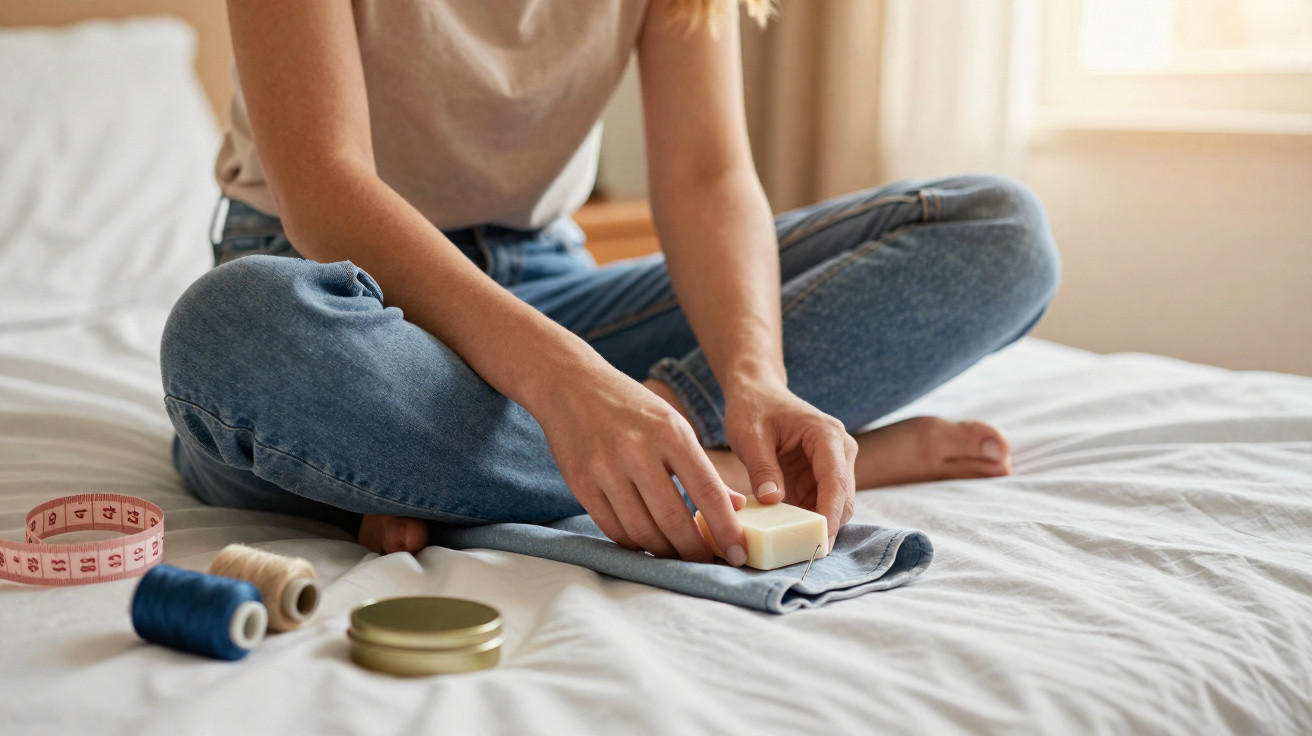
One detail often passed down through generations is a hard, dry bar of soap. Plain household soap or olive soap is especially popular because it washes out without leaving residue.
A fine line of soap on the inside of the fold acts as a natural alternative to starch and helps keep the edge firm.
Run the soap directly along the future fold line on the inside of the fabric. Then ‘iron’ the area once more with your fingers. The soap gives the spot a little extra firmness, makes the fabric easier to fold and keeps the edge clearly defined. It will wash out of the fabric during the first wash.
How to sew an almost invisible hem by hand
Once the turn-up has been prepared and held in place with a few pins, the actual sewing can begin. The aim is an unobtrusive hand stitch that is barely noticeable in daily use.
Choosing materials and thread length
For a tidy finish, the small details matter:
- Thread colour: choose a shade as close as possible to the trousers, preferably slightly darker rather than too light.
- Thread length: roughly an arm’s length, as longer thread tangles more easily.
- Needle: use a slim, sharp needle so that it does not make unnecessary holes in the fabric.
Use the thread doubled over or single, depending on the thickness of the material. Tie a knot at the end to prevent it pulling through.
Stitching method, step by step
This hand stitch always follows the same sequence. It joins the turn-up to the outer fabric without leaving obvious puncture marks.
- Insert the needle from the inside into the folded hem, hiding the knot within it.
- Just above the hem edge, catch only a single tiny thread of the outer fabric with the needle.
- Return the needle to the turn-up approximately 1 centimetre further along.
- Continue this pattern all the way around the trouser leg, without pulling the thread tight.
Pulling too firmly creates small ripples or puckering. If the thread remains loose enough, the fabric lies flat and the stitching virtually disappears into the material. From the outside, only tiny dots may be visible, and these are barely noticeable when the thread colour is well matched.
Why this trouser-hemming technique holds so securely
The combination of finger pressure, soap and fine hand stitching is surprisingly hard-wearing. The folded hem creates a double layer of fabric, which distributes the weight of the trousers more effectively. At the same time, the fine stitch spreads tension across many small points.
Done properly, a hand-sewn turn-up can withstand pulling forces of several kilograms – without adhesive strips or specialist tape.
The seam works with the fabric rather than against it. Its advantage becomes especially clear during movement, whether sitting down, climbing stairs or walking for longer periods: nothing pulls tight, nothing tears away, and the trouser fabric stays smooth.
Suitable fabrics – and their limitations
This method works particularly well for classic trousers made from:
- lightweight wool
- cotton or blended fabrics
- straight-leg linen trousers
- finer fabrics used for officewear or suits
It can also be used on very thick fabrics, such as coarse denim or heavy workwear, although the stitching will be more visible. In those cases, a visible topstitch is not a problem, as it suits the look. Very smooth synthetic fabrics may not hold a finger-made crease as strongly, so it is worth ‘ironing’ them a little longer.
Practical tips for everyday life and travel
Many people only discover that their trousers are too long while on holiday or away on business. That is exactly when this grandmother’s trick comes into its own: a needle, thread and a small piece of soap fit into any wash bag. A secure turn-up can be sewn in a hotel room in the evening and will comfortably last until you return home.
Anyone who shortens trousers regularly can keep a small kit ready:
- a case containing sewing needles in different sizes
- small scissors or nail scissors
- dressmaking pins or safety pins
- neutral thread colours such as black, navy, grey and beige
- a piece of firm soap
With practice, the process becomes familiar and the hand stitch will soon feel almost automatic. Many people who try this technique properly once rarely return to the tailor afterwards, at least when the only issue is the length.
What beginners should also know
If you are unsure, first practise the stitch on an old garment or a scrap of fabric. This lets you develop a feel for spacing, thread tension and rhythm without putting your favourite trousers at risk.
Patience is another important factor. Although the trick is quick, it is worth working in a calm, well-lit space. The more carefully the stitches are placed, the less noticeable the result will be. Small irregularities are not a major concern: they are rarely visible when the garment is worn and can even give the work a handmade character.
Once you develop a taste for it, the technique can be used more widely – for example, for skirt hems, shortening curtains or adjusting fabrics in a child’s bedroom. The same hand stitch is also suitable for repairing inner linings or securing loose hems on coats. What begins as an emergency solution can gradually become a practical everyday skill.




Comments
No comments yet. Be the first to comment!
Leave a Comment