
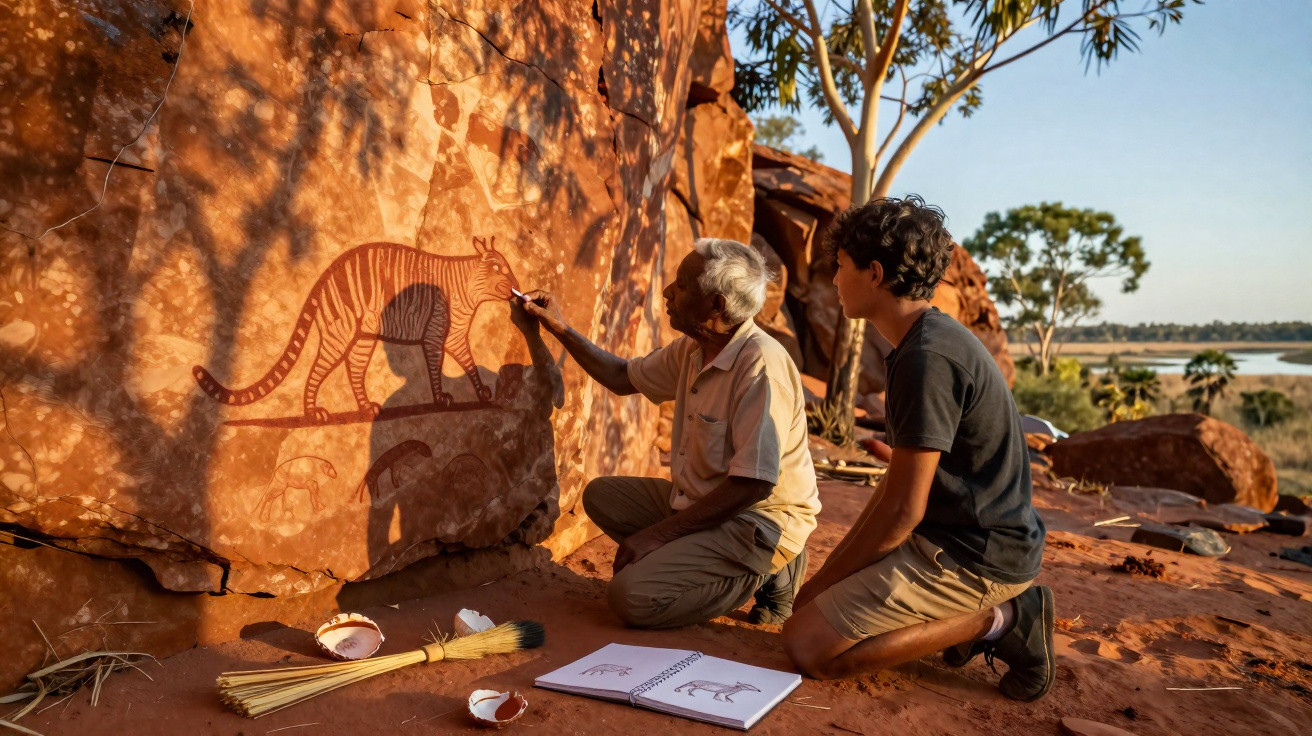
The Tasmanian tiger – the striped, dog-like marsupial better known as the thylacine – has taken on legendary status in Australia. It is remembered as an animal lost prematurely, represented by blurred photographs, museum specimens and continuing “what if?” discussions.
Fresh rock art findings from northern Australia now add another dimension to that history.
Rock art depicting thylacines
A Griffith University project led by Professor Paul Taçon has recorded 14 previously undocumented thylacine images and two images of Tasmanian devils at two sites in north-west Arnhem Land in the Northern Territory.
The artworks do not establish that thylacines survived on mainland Australia until recently. However, they are prompting scientists to reconsider when the animals actually disappeared and the cultural significance they retained long after their extinction.
Big gap in the thylacine record
The prevailing view is that thylacines and Tasmanian devils disappeared from mainland Australia around 3,000 years ago. This is the timeline generally accepted and taught.
Yet some of the newly recorded paintings could be much more recent – perhaps under 1,000 years old – creating an intriguing and challenging possibility. These animals may have survived in northern areas for longer than is commonly believed.
Different art styles suggest ages
Researchers documented paintings created in several Aboriginal art styles. Many use red ochre, occasionally yellow ochre, within a regional tradition extending back about 15,000 years.
Some works, however, also use white pipe clay, a less durable material that does not mark the rock in the way red ochre does.
Since white pigment generally survives for less time, rock art specialists frequently regard paintings made with it as more recent – often less than 1,000 years old.
The choice of material is therefore important. If thylacines shown in white-pigment artworks genuinely date to a later painting period, it becomes more difficult to dismiss them as depictions based solely on ancient recollection.
Did artists paint what they saw?
Professor Taçon does not present the new artworks as definitive proof. Nevertheless, he offers two credible reasons why apparently “recent” thylacines might appear in the art.
“The artists who made the more recent paintings may have seen actual living thylacines and some of these creatures may have survived longer in Arnhem Land,” he proposed. “Alternatively, artists may have been inspired by earlier paintings.”
“Regardless, the thylacine remains culturally important today and some contemporary artists make paintings of Tasmanian tigers on bark, paper, and canvas. It even has a name: Djankerrk,” added Professor Taçon.
The images may point to genuine late survival, or to an enduring visual tradition in which later artists adapted earlier motifs. In either case, they indicate that the thylacine occupied an important place in the cultural landscape.
Thylacines were more common in art than devils
A further finding from the study helps place this importance in context: on the mainland, thylacines seem to have been represented far more often than Tasmanian devils.
Taçon says that just 25 Tasmanian devil images have been recorded, against more than 160 depictions of thylacines.
This cannot be treated as a direct measure of animal populations, but it does reveal something about cultural prominence. These were not isolated or unusual images; people across Australia continued to paint thylacines.
Retouching indicates significance
Co-author Andrea Jalandoni, of the Griffith Center for Social and Cultural Research, highlighted another indication of the animals’ lasting importance.
Several local paintings were retouched, an action that often suggests an image continued to hold meaning for successive generations.
“Thylacine rock art offers rare insight into how people related to this animal in the past,” she said.
“These depictions show that the thylacine held a meaningful place in everyday life and local knowledge, long before it went extinct.”
This is among the article’s central observations. Rock art is not simply an image of an animal; it can reveal how people understood that animal, whether as prey, a companion, a spiritual being, or an element of story and place.
Rainbow Serpent connection and hunting tradition
The research also draws on regional oral histories that connect thylacines with water.
In some accounts, thylacines were described as pets of the Rainbow Serpent that lived in rock pools, and were commonly linked to swimming and waterways.
For community members, moreover, the thylacine is more than an extinct creature described in books. Joey Nganjmirra, a Djalama man from Western Arnhem Land and study co-author, relates it directly to ancestral life.
“They used to tell stories about going hunting with thylacines,” Nganjmirra said. “Not a ghost from the past.”
Thylacines, culture, and rock art
Taçon stresses the value of the collaboration itself. The work involves more than dating pigments and tallying images; it demonstrates that thylacines continue to matter in the region.
“The thylacine lives on in western Arnhem Land not as a ghost from the past but as a meaningful creature that still has present-day significance,” he said.
This framing is powerful. Even if thylacines did vanish from mainland Australia thousands of years ago, the cultural relationship with them endured.
If some of the paintings are indeed comparatively recent, the assumed extinction timeline may require reassessment.
Lessons from thylacine rock art
Rock art by itself cannot prove that thylacines remained alive in Arnhem Land less than 1,000 years ago. Dating such art is famously difficult, while cultural memory can preserve knowledge of animals long after they have disappeared.
Even so, the study provides further evidence that thylacines and devils were sufficiently significant to be depicted, revisited and, at times, repainted.
It also poses a reasonable question: if the art is more recent than anticipated, what else may be unknown about when these animals last lived alongside people on the mainland?
At minimum, this is not solely an extinction story. It is also one of continuity, showing how an animal can remain alive in language, art and memory long after leaving the physical landscape.





Comments
No comments yet. Be the first to comment!
Leave a Comment