
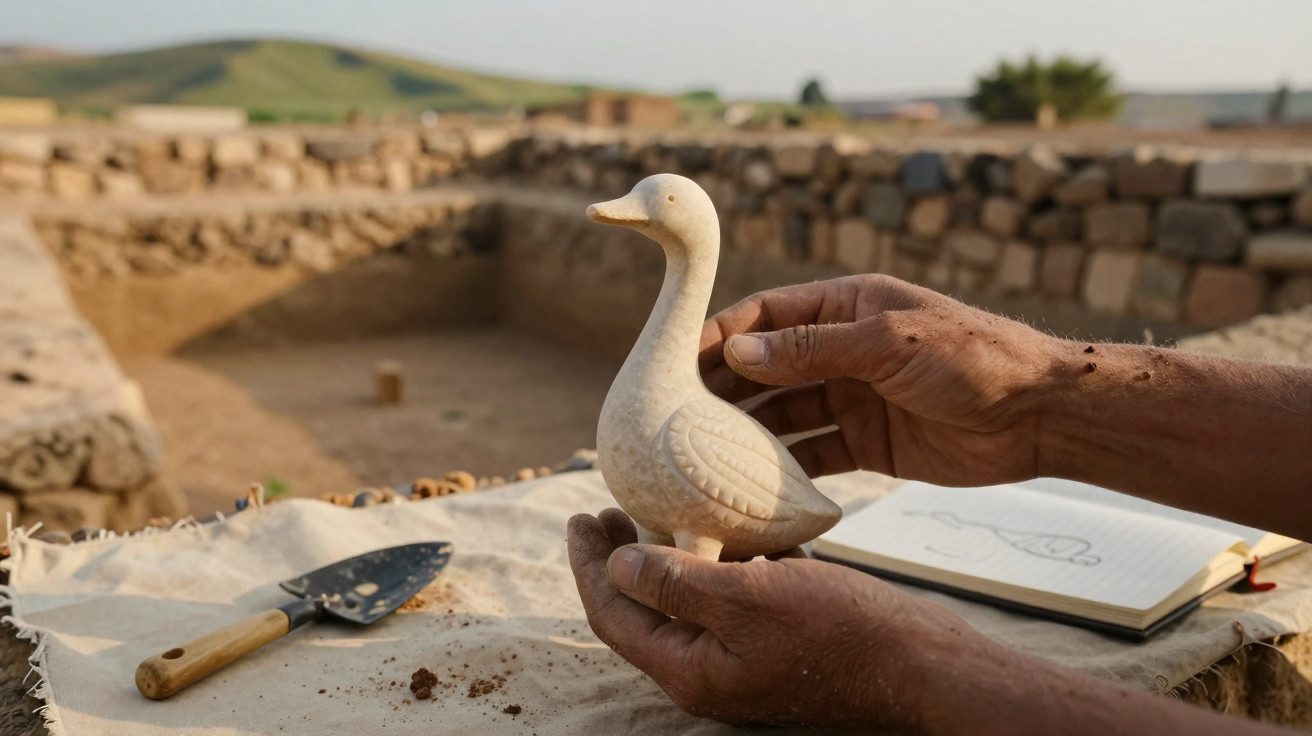
A clay object measuring under four centimetres is prompting archaeologists to reconsider the spirituality of communities that lived in the Near East 12,000 years ago. Discovered in northern Israel, the figurine appears to depict a crouching woman with a goose on her back, forming a symbolic scene that may shed light on ancient beliefs about people, animals and spiritual forces.
What does the figurine discovered in Israel represent?
The artefact was unearthed at the Nahal Ein Gev II archaeological site, roughly two kilometres from the Sea of Galilee. Researchers say the sculpture portrays a female figure leaning forwards, with a bird-most likely a goose-positioned on her back with its wings spread.
The team suggests that the scene may show a symbolic mating between a woman and an animal, an interpretation linked to myths in which humans encounter animal spirits. A different explanation is that it depicts a hunter carrying a bird, although the position of both figures has led specialists to favour a ritual or mythological reading.
How did archaeologists identify the female figure?
The figurine was shaped from a single piece of clay, heated in a hearth and coated with red mineral pigment. Although it was found in three pieces and stands only 3.7 centimetres tall, the object retains enough detail for researchers to examine the figures’ anatomy and posture.
Triangular marks on its lower section were understood as a depiction of the female pubis, while oval impressions close to the chest may represent breasts. Laurent Davin, an archaeologist at the Hebrew University of Jerusalem, said it could be the most complete image of a human body yet identified in Natufian culture.
Why might the goose have held spiritual importance?
The study, published in the scientific journal PNAS, notes that goose bones recovered from the settlement show that these birds were used for food as well as raw material for decorative items. Their regular presence may therefore have made the animal an important figure in the community’s imagination.
The features supporting a symbolic interpretation include:
- The crouched posture of the female figure;
- The apparently living bird on her back;
- The open wings partly enclosing the body;
- The red pigment applied after heating;
- The funerary setting in which the object was found.
According to Davin, stories of encounters between human and animal spirits occur across various historical cultures. The object may suggest that comparable ideas were already circulating long before major myths were put into writing, revealing a sophisticated way of depicting transformation, fertility or contact with unseen forces.
Could a woman have made the Natufian figurine?
A partial fingerprint preserved in the clay offers a clue to the identity of the figurine’s maker. By comparing ridge density with modern fingerprints from people of known sex, the researchers concluded that it is possible the object was modelled by a woman.
The proposal is not yet conclusive, but it strengthens discussion of women’s involvement in Natufian spiritual practices. Davin suggested that the increasing number of female representations may be connected to women having a more prominent role in producing images, passing on beliefs and leading community rituals.
What does the discovery reveal about the Natufians?
The Natufians were sedentary hunter-gatherers who lived between 15,000 and 11,500 years ago in areas now occupied by Israel, Palestine, Jordan, Lebanon and Syria. The figurine was recovered from a funerary area, close to the burial of a child and an unusual deposit of human teeth.
For Leore Grosman, an archaeologist at the Hebrew University of Jerusalem and co-author of the study, the artefact brings the world of hunter-gatherers closer to that of the first farming communities. The discovery demands immediate attention because it shows that symbolic thought, creativity and complex beliefs were already shaping society before the Neolithic Revolution.






Comments
No comments yet. Be the first to comment!
Leave a Comment