
How is all this a game? What are the advantages and drawbacks of creative freedom? What is truth?
Questions such as these sit on photographer Duarte Belo’s desk. Leaf through one of his small field notebooks and these existential questions immediately come into view. The in-house artist has filled them with handwritten notes in several colours, using pens and markers. They are notebooks made for the road, containing answers to some of those existential doubts alongside numbers and drawings.
Books line the walls. There are many of them. Yet the geographical centre lies in the photographic archive at this flat in Vale Abraão, near Queluz. It contains millions of images, duplicated at another of the photographer’s homes in Viseu.
If asked where he lives, Duarte Belo would now say Viseu, although he often comes to these outskirts of Lisbon. He could equally say that he has spent the past four decades travelling, above all across Portugal.
Perhaps work needs love, as one of Duarte’s grandmothers used to say. His grandmother Olívia was a pastry chef and an excellent listener and collector of recipes in Vila do Conde in years gone by. Her grandson Duarte was born in 1968, one of Teresa Belo and Ruy Belo’s three children. He began taking photographs at 14, studied Architecture, and has built a photographic body of work presented in exhibitions, including one currently held in the former primary school in the village of Picote, near Miranda do Douro.
Duarte Belo’s photography can also be encountered through the dozens of books he has published with authors including José Mattoso, Suzanne Daveau, Fernando Alves, João Abreu and Álvaro Domingues. His newest book, Portugal Refractário, was created with António Araújo, his fellow photographer-walker.
Belo has crossed the country with a meticulous eye, humour and tenderness for the landscape. He would rather pitch his tent at dusk, so that others do not see him. He finds comfort in photographing a country emptied of human figures, and is pessimistic about the climate’s future. As for humanity, he considers it life on Earth’s most extraordinary creation.
Duarte Belo, landscape and photographic freedom
You have just been appointed Minister for Landscape. What would be your first measures?
The first would be a major awareness and educational campaign, aimed at much greater landscape literacy. I would seek practical ways to act, communicate and promote, in an attempt to contain the progressive degradation of the Portuguese landscape that we witness every day. This applies at every level, both urban and natural. Natural in quotation marks. Portugal has virtually no natural space, meaning space from before human presence. What is called the rural world lacks people. There is a chain of problems that is very difficult to solve.
What are your earliest memories of Professor Álvaro Duarte Almeida?
I have wonderful memories of Professor Duarte Almeida; he was among the most important people in my life. I remember the first days of lessons in my final year of secondary school, in 1985. He taught me Descriptive Geometry at D. Pedro V Secondary School in Lisbon. He was an exceptional teacher, distinguished by taking pupils out on fieldwork. On one occasion, we undertook an archaeological campaign at some megalithic tombs between Mora and Pavia. It made a profound impression on the students who took part. The campaigns essentially involved clearing the dolmens and conducting topographical surveys.
Did you also go walking during the holidays?
We went on long walks during the holidays, sometimes spending almost a month hiking through the northern mountain ranges. We covered Peneda-Gerês and the Serra da Estrela, among others. He organised a series of walks, with larger or smaller groups of pupils. We also walked nearby, in the Arrábida hills and the Sintra hills.
“There is no Promised Land, no ending; we shall never stop,” you wrote in Terra Mineral - Terra Vegetal, made with João Abreu. “There is always an unknown horizon that challenges us.”
That is it. We inherited the myth of Paradise and the Promised Land from our Judeo-Christian culture. Yet whenever we draw near to a place, it is always moving further away. On one hand, we are never satisfied with what we find: we will invariably want more. And everything is continually changing, both ourselves and the places.
“The eye is a machine, a creation of nature, utterly singular. Photography extends the survival value of vision”
Are we always saying goodbye?
I would not call it saying goodbye. We perhaps have a somewhat difficult relationship with memory and with what we lose. I would not use the word farewell, although many situations are irreversible-indeed, I would say almost all are. But this is bound up with the very nature of the biological process, in which nothing repeats itself and everything is constantly transformed. We struggle to accept this condition of ours and remain attached to fixed models. That subsequently makes life, and our understanding of reality, more difficult.
Family, architecture and the first photographs
Vila do Conde, 1982. At 14, you began using your mother Teresa Belo’s camera.
It was a Voigtländer, and I found the camera immensely seductive. My mother knew a little about photography. She was no longer using it much by then, but it was the camera with which she photographed us: me, my siblings Diogo and Catarina, and my father. Most of the photographs that exist of my father were taken by my mother with that camera.
Your father, the poet Ruy Belo.
Yes, the poet Ruy Belo... I went down to the seafront in Vila do Conde, began photographing, and never stopped from that point onwards. My mother always gave me every encouragement to do it. There was no digital photography then; it was all analogue. In the first year, I shot one roll of film, between Christmas and New Year, when I was spending the holidays at my grandparents’ house in Vila do Conde.
In black and white?
The first roll was in colour. They all came out slightly blurred because I was fixated on depth of field and wanted to make the most of it. I had read a few things. The world was entirely different then. There were two or three books on technique available on the market, and little beyond that. So I used slow shutter speeds to try to keep everything in focus, and the pictures ended up blurred.
Your father died when you were 10. When did you start picking up his poetry books?
I had picked them up before then, but did not understand half of what I was reading. It was later, during adolescence-perhaps at 13 or 14-that I truly began.
That coincides with the beginning of your photography.
Yes. And I regret not beginning earlier, so that I could have recorded my father, my grandparents’ house in Vila do Conde, and a whole series of things that were lost soon afterwards. My archive is very extensive and I revisit it quite regularly. I bring archive photographs into many of my projects, so I am always living with that past time. It is very interesting, and I wish I had older material from before I photographed, when I did not yet have that resource.
Did you get to say goodbye to Doce de Santa Clara in Vila do Conde?
I said goodbye after the fact. In other words, at a certain point I had the chance to make a book with the support of Vila do Conde Municipal Council, by which time the pastry shop had passed into other hands.
It no longer belonged to your grandparents.
We still kept the house, but the pastry shop belonged to other people. I wanted to make a kind of cookbook in tribute to them. I photographed the kitchen implements that I had kept when the house was dismantled. It is a book of my grandmother’s recipes, which she gathered orally from the surrounding area. Many came from the former Convent of Santa Clara, hence the pastry shop’s name, Doce de Santa Clara. Rather than photographing the cakes she made, I photographed the implements. They are wonderful objects, marked by time and by hands. There was no food safety authority yet.
It is an archaeology of your grandmother’s tenderness.
Yes, that too. My grandmother was an extraordinary person. These two women, my mother and my grandmother, profoundly shaped my whole personality.
What was your grandmother’s name?
Olívia da Conceição Carriço. My grandfather was Joaquim.
“Work needs love”?
That is one of the maxims I still use in talks and conversations. My grandmother said that work needed love, and I still believe she was right. It is an act of love, comfort and sharing.
Did you ever come to love architecture?
I did, and I still love architecture. I am extremely fond of it and see my photography as an extension of architectural practice. I already wanted to pursue photography when I began studying architecture, but there was the idea that photography would hardly guarantee a livelihood. So I completed an architecture degree, and I was already very interested in architecture at that stage. I did work as an architect, but when I could, I left architecture as a project and as drawing behind, and devoted myself solely to photography. That is why I work so much on documenting Portuguese space, landscape and architecture. It is a way of continuing to make architecture through photography.
Do you have more than two million images?
Two and a half million.
Do you like numbers?
I do.
The proportion of people in your images is very small.
Yes, very small. Family-wise, I photographed my children a great deal. They are grown up now and no longer like being photographed, but I have many, many pictures. Pedro, the eldest, is already 30. He was still photographed on analogue film, and there are fewer photos of him because I was more restrained. I have many of Afonso, who is now 18. I have several thousand photographs of both of them and of people close to me. If I go walking with friends, I photograph the friends much more than the landscape. But I generally travel alone and photograph only places, landscape and architecture. The percentage does not reach 1%, certainly. Over the past two years, up to the present, I have photographed Portugal’s 160 cities. There are quite a lot of people in the streets in those images.
Do they appear against your wishes?
No, I like them. But it is increasingly difficult to photograph people against their will. I have had trouble and arguments several times because people think I photographed something that belongs to them: a building, a façade, anything at all. Or, if they feel photographed, they pull a face and sometimes voice their objection. It is quite rare, but it happens. That is also why I avoid photographing people, unless it is in an urban setting and from some distance, because otherwise I know I may have problems. In a rural environment, if there is only one person in the photograph, they draw enormous attention. Anyone looking at it notices the person much more than everything around them. That is one reason I avoid photographing people.
But people are present in everything I photograph, because everything bears marks of human settlement. This ranges from very subtle things connected with farming to cities, where nothing but human gestures is visible. I have no bad relationship with people, but there is another issue. When people are present, one has to negotiate that permission, in quotation marks. You have to wait for the person to move away or turn their back, or receive their consent through an exchange of looks. When I am alone, everything flows. I even describe my work as a performative movement across the landscape that leaves a trail of images, and nothing more. With people there, I have to think and negotiate... An entropy enters the system. When there are no people, there is total freedom. That gives me great joy.
What was it like photographing Mário Cesariny’s home while he was there?
It was an immensely rich experience. He gave permission and even asked me to photograph him sitting on the bed, wearing a hat. He gave me complete freedom. Regarding houses, people have questioned whether this is not an invasion of people’s privacy. To a certain extent, it is. I also photographed Orlando Ribeiro’s house, and Suzanne Daveau-his widow-said at the time that she had felt very apprehensive. But I always show every photograph before publishing it, and the person gives consent for me to make it public. If they do not approve a particular one, I set it aside and it remains only in the archive.
But with Mário Cesariny, I went there on two consecutive days in 2003. He was around 80, and by the second day he had changed a great many things. He lived in a house with his sister and worked in a room where he also slept. On the second day, there were piles of different objects because he was constantly and frenetically working on his pieces. In this way, one enters people’s world and a certain intimacy that is very interesting: the revelation of their creative process.
You started photographing more than 40 years ago. One thing that has changed enormously is our relationship with images. Everyone takes photographs.
Yes, everyone takes photographs. My relationship with it has not changed much. I take far more pictures with digital technology. To the shock of many fellow photographers, I have taken more than five thousand images in a day in the field, including this year. I welcomed digital with open arms. I changed straight away and began taking many more photographs, because although equipment initially cost considerably more, the process afterwards is much cheaper.
What I like about digital photography is that one can photograph with almost no limit. It comes back to movement: one records everything. The selection process then takes longer, but the relationship with the visible becomes much more intuitive. As for the ever-increasing amount of photography, I have reached a rather curious conclusion. I am interested in photographs of the country. There are websites and photographers who sometimes work on themes similar to mine, and when I look, the same places are repeated to a certain extent. People seem always to go to the same places, photograph the same angles, and do it in the same way. That has not changed since analogue photography. There are far more photographs, but thematic variation is relatively limited.
There is another issue: few people take care to archive material properly. Very little will remain, because phones are lost, files are not saved, and people do not back them up to the cloud. We live in a sea of images. Yet this does not particularly bother me, nor do I have any special criticism to make. Photography has a very direct relationship with vision, with this biological construction. The eye is a machine. I like biology very much, and the eye is an utterly singular creation of nature. Photography is, in some way, an extension of the survival value of vision.
Movement, continuity and travel are three of the 144 words in your atlas of words.
144 is 12x12, simply as a way of arranging and fixing things. I like perfect squares.
Walking through Portugal and the archive of places
Are you chiefly a traveller?
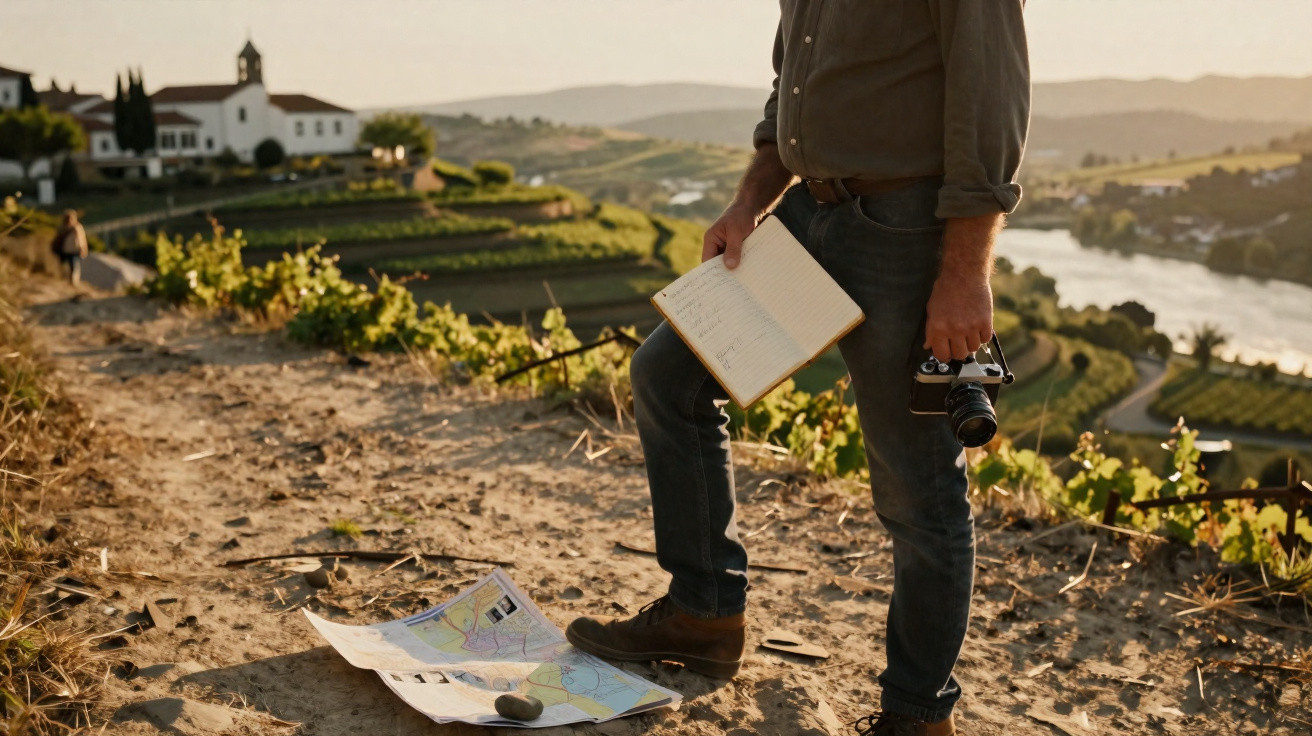
I travel mainly in Portugal. I go abroad too, but far less than I travel here in our country. There are several reasons: proximity, language and cost. I have never had substantial resources to travel freely. One thing I learned from Álvaro Duarte Almeida is that, with very little, we can make extraordinary journeys with a backpack. I once calculated the cost of a book I made with the Landscape Museum, Caminhar Oblíquo. I travelled from Penedo Durão in Freixo de Espada à Cinta to Cabo da Roca: 530 km in 15 days.
“People have questioned whether [photographing houses] is an invasion of privacy. To a certain extent, it is. I photographed Orlando Ribeiro’s house and his widow felt apprehensive”
Was it a pilgrimage?
Not a pilgrimage. I am completely atheist. At least in the religious sense, it was not. It was a hard and very enriching test from a range of perspectives. But I worked it out: I spent the equivalent of 2.60 euros a day. Those 15 days of holiday cost me 40 euros, sleeping in incredible places.
And meeting hunters, sheepdogs and swarms of bees?
That too, sometimes. Many years ago, I was frightened by bees. I was on the banks of the Douro, having gone from Barca d’Alva to Miranda do Douro. I was 19 and had just finished my first year of Architecture. I studied in Porto and was fascinated by Domingos Alvão’s photographs. I caught the train to Barca d’Alva-it now only goes as far as Pocinho-and walked from Barca d’Alva to Miranda in five days. I was carrying a very heavy backpack, anyway...
With analogue photography and lots of tinned food?
With analogue photography, yes. I did not take tinned food; that was one of the things I had learned from Álvaro Duarte Almeida. I mainly took bread, crispbreads and things like that. I never leave rubbish in the places I travel through. If I had carried tins, I would have had to carry them until I found a bin. But I was in a sort of gravel pit when a black cloud passed over me with an almost deafening sound. It was a swarm of bees moving from one place to another. I understood what it was later, and I have never experienced anything like it again. I have slept close to hives, but being flown over by a swarm... I was barefoot, cooling my feet away from the water. I later learned that they never stop when they are in motion. They do not attack; they are focused on their journey. In principle, there would have been no danger.
A large part of your work involves solitude.
Yes, and I am especially fond of it. When travelling, I very much like going alone because I am entirely free. I am not very disciplined, and sometimes I have an itinerary but do not follow it strictly. Those walks are demanding, whether through lack of water or stretches where I walk more than I estimated. The hardship can be considerable, and if I am with others, I dislike subjecting them to it. Often they lack either the preparation or the motivation for a certain degree of hardship. So I prefer walking alone most of the time.
Then there is the freedom to go wherever I want, at any time, without being tied down or having to negotiate. I also enjoy travelling with people, but it has a different character. At those times, I photograph much less.
Is there anywhere you have returned to throughout these decades?
There are Vila do Conde and Consolação, the beaches of my childhood that connect me to my parents. I visit them fairly regularly and photograph them almost every time I go. There are also places I find particularly special, though I do not have a disciplined habit of returning to them. The Foz Côa area and its rock engravings; the Miranda plateau; Peneda-Gerês; and the Serra da Estrela. I like low-density settings, but I like cities too. I had enormous pleasure photographing cities recently, when I photographed all 160 cities. I finished 15 days ago, in the Azores.
Where did you finish?
On Faial, in the city of Horta. I had been there in 2007 to photograph the Capelinhos volcano, on the 50th anniversary of the 1957 eruption. I returned to Capelinhos now because I had some time left over. I like revisiting places, seeing how they change and recording that transformation to a considerable extent.
Did Orlando Ribeiro’s work influence you?
Yes. In 1986, I went to Porto to study in my first year of Architecture. The previous year, I had met Professor Álvaro Duarte Almeida and walked with him. I was intensely curious about understanding Portugal, and there was no internet then as we know it today.
Did you have paper maps?
My first map was a Michelin map covering the whole country. Later I had military maps, which could be bought in Porto at Porto Editora. You had to sign a declaration of responsibility stating that you would not give the map to anyone else or reproduce it. It still had a certain military character, linked to knowledge of the territory. I went to the Leitura bookshop-which unfortunately no longer exists-looking for books about Portugal. One of the first I found was Orlando Ribeiro’s Portugal, o Mediterrâneo e o Atlântico. I bought it in the afternoon and had read it by the following morning. I read it that night and was dazzled.
Was that an epiphany?
Yes, it was extremely motivating in terms of going out to photograph. I later got to know him, near the end of his life. To this day, I remain in touch with Suzanne Daveau and with some family members, including his grandson João Ribeiro.
“Since then, you have not stopped contributing to another study of herding. A pilgrim of shifting ground.” Those are Fernando Alves’s words about that epiphany in your book Onde Vais, por Esse Trilho, com o Canto da Toutinegra?.
I have immense admiration for Fernando Alves. He knows Portugal as well as, or better than, I do. He also has a human dimension in his contact with people that I do not possess. When I am travelling alone, I nearly always have little contact, except with people I happen to meet. I often sleep outdoors too, so I do not follow those rituals of going to the café.
Fernando Alves stops in taverns and talks to everyone.
That has extraordinary richness. I have listened to Fernando Alves since TSF was founded; my mother was already a listener. I admire him enormously. In a way, he is like Orlando Ribeiro: a great Portuguese, in the sense that he communicates everything good we have in our country. He is a great journalist and has an enchanting voice.
In Toutinegra, your photographs converse with Fernando Alves’s texts across a gap of 30 years.
How many books have you made?
I do not keep count. Recently, I have made quite a few with the Landscape Museum, alongside João Abreu, another extraordinary person in this process. He was also a student of Álvaro Duarte Almeida, and that is where we met. He is a little younger and has done remarkable work at the Landscape Museum. He created that concept.
Books... If we count the various volumes of Portugal - O Sabor da Terra, with José Mattoso and Suzanne Daveau, there were 14 volumes. They are independent, though everything was reissued in a single volume in 2010. But there are certainly more than 50 books. The Landscape Museum alone accounts for around 14. There are already many books. I enjoy them, and perhaps inherited that from my father. I grew up in a house lined with books. My father wrote books, and my mother also produced some relating to education and pedagogy. I am very fond of the book format, so I followed the model from home.
“There is a tendency to travel beyond our borders. I have never felt that need. I have travelled around Portugal for 40 years and am always finding new things”
Freedom, climate and the meaning of life
“Fazeres de Unidade para a Génese de Um Atlas: FUGA”. Is there an element of escape in your work?
I think there is: I am always escaping something. It is not the escape of a criminal, but an escape from certain stereotypes in our society. It is a search for freedom-escaping towards freedom. I seek to free myself from a series of commonplaces, fashions and things with which I do not identify. I try to draw my own path, with the map of my route always open.
That was also the title I gave to an exhibition in 2019 at the former Xabregas Market, where the Ar.Co school is now located. I covered two walls, each 20 metres long, in A4 sheets. There were more than 12,000 photographs: an extremely exhaustive undertaking. It created a route. It was not a biographical exhibition, but it focused strongly on my methods and on work I had done in the past. Every project I undertake is a kind of cell within a larger body on which I work continuously: a synthesis of all this, which I would like to exhibit soon. I want to see whether I can show it; it is a great deal of material and needs space. But escape is an idea that seduces me as a movement towards freedom.
Outside the consumer society in which we live.
Yes, although I reap the benefits of living in a society such as ours. Living in Europe at this moment is a privilege. But there are many aspects of consumer society with which I do not identify in the slightest. In Portugal and elsewhere, there is a tendency to think that taking a trip means going abroad: foreign countries, planes, visas... I have never felt that need. If a person travels around Portugal for 20 years, they will always find new things. I have travelled through Portugal for 40 years and continue to discover new things. I do so with pleasure, surprise and wonder every time I set out.
It is important to know the world and other realities, other very different cultures. But this piece of land has extraordinary richness. Fernando Pessoa wrote in The Book of Disquiet that he could travel the entire world from his room. I like living surrounded by books; they too are a way of travelling. They carry us to places we cannot imagine.
Does the degradation of the landscape over these decades lead you towards a kind of pessimism?
By nature, I am optimistic about myself and my immediate circle. But I am quite pessimistic about the fate of the planet, not only of this country and its nearby landscapes. Everything is following such a voracious path... Climate change may bring a major planetary catastrophe, above all for our own species. In that respect, I am quite pessimistic because there is no way to halt this process.
Fundamentally, poverty is the greatest condition for sustainability. Once people have the means to consume ever more, there is ever more waste. They travel more, pollute more. If everyone does that, the outcome is set. There are then aspects tied to technology and engineering that people think will provide solutions. But I am a fan of the second law of thermodynamics, the law of entropy. It is a law dating from the 19th century, which says that systems increase in complexity over time and that their approach to chaos is irreversible.
The last mass extinction on the planet was that of the dinosaurs, around 65 million years ago. The dinosaurs vanished and life was greatly depleted. They dominated; they were the great masters. They were what we are now. They disappeared, and a few million years later life flourished with far greater vitality than it had even then. We are now at the threshold. Some say we are already in the sixth great extinction, one brought about by ourselves.
The Anthropocene.
The Anthropocene. Yet species diversity is more numerous than it has ever been in the history of life on Earth. This is connected to that progressive increase in complexity, where energy and the right conditions exist. That is what happens on the planet. We have the six chemical elements fundamental to life, the right distance from a source of energy, liquid water, abundant carbon... These conditions allowed things to evolve from unicellular organisms to us, through a non-linear process of major ups and downs, and mass extinctions that caused very considerable damage.
But we have reached this point, and we are the geological agent-hence Anthropocene, a term from geological nomenclature-probably causing another major extinction, one that may eliminate us ourselves. Even so, I do not think life on Earth will end. It is almost indestructible, given the distance we are from such a possibility. But humanity is life on Earth’s most extraordinary creation. When we arrived: art, music, science, everything we have created... Religion itself, which is a phenomenon for dealing with the unknown... Perhaps this is inevitable, but it is a pity that human history is heading in this direction. It is absolutely fabulous and extraordinary that creatures such as ourselves should emerge from unicellular organisms, capable of all that we are capable of.
I greatly admire space research. The Artemis II journey to the Moon was a beautiful thing. Seeing Earth from afar was wonderful. One of the most extraordinary devices for my relationship with photography is the James Webb telescope. There was Hubble, which gathered an extraordinary collection of images, but it orbited Earth. That imposed certain limitations on its ability to see further. James Webb orbits the Sun and has shown fabulous images that are almost from the origin of the Universe. How can a species peer into the origin of the Universe? It leaves me speechless.
At a closer scale, your work also has a humorous side, as in Paisagem Portuguesa, made with Álvaro Domingues.
Yes, working with Álvaro Domingues also draws out that side of humour. In that book, I wanted to show Portugal’s entire geography: the great rivers, the mountain ranges and the landscape’s structural elements. I also wanted to show all the time of human settlement. It was then a matter of taking these concepts and seeking paradigmatic situations across the country, using each photograph to address different realities.
This idea of purity, which is extremely harmful in almost every sense other than chemistry, does not exist. When we look at a landscape, it is almost always composed of different layers: nature, geology and associated human practices. There is a humorous side to be found in what we see. It makes things more entertaining, appealing and ironic. We need some good humour when looking at things.
There is humour in Portugal Refractário too.
There is humour there as well. It is the most recent book, made with António Araújo and also with the Landscape Museum. There are situations, though I do not deliberately seek them out. Since I photograph so much, there are situations where I do not even notice the humour they may contain, or certain ridiculous aspects, given the diversity of languages found in the visible universe. The book includes things that make us laugh, sometimes with a degree of sadness.
“The last mass extinction was that of the dinosaurs, which were what we are now. Millions of years later, life flourished with far greater vitality”
Because it is dark humour.
There is dark humour too. Many things are careless, but that is connected to the spatial illiteracy I mentioned. People are careless and show things that perhaps they should keep within their privacy, inside their homes.
Is your puzzle-making side connected with this search for organisation?
That is an interesting question. Almost all the puzzles I complete are maps and old cartography. To turn the question around slightly, I see my work as the permanent construction of a puzzle. In other words, I would like one day to exhibit all the photographs-2.5 million photographs-on a single surface and see what image of reality they return to us.
Puzzles arrive in a box, with every piece separated. In a cartographic puzzle, each small piece corresponds to a section of land or sea. They are almost always representations of the planet, and it is interesting that each piece is a world. Similarly, in a set of photographs, each image represents a fragment of reality and tells stories. With a puzzle, we construct the whole.
And I like a logic. For example, the largest one I completed had 9,000 pieces. You cannot build a 9,000-piece puzzle by putting every piece on a table and looking for them one by one. You need a structured view of the matter: first find the edge pieces, then separate structural elements. We go through the sets several times, sorting them into groups. There are principles for completing it in a useful amount of time. Otherwise, we go mad and cannot reach the end.
Is it a matter of training perseverance?
That too, but photography itself is much like that: not giving up. For me, perseverance is always a double-edged sword, because it means knowing the point at which we should stop. Beyond that point, excuse the expression, it is stupid to carry on. If we persist with a task that is too barren, we will get nowhere.
The puzzle is also about the resilience of working away at something and searching gradually. But it has another aspect: for me, it frees the mind. I have completed 53 or 54 puzzles, all cartographic. I once exhibited some at the National Library in an exhibition I made with João Abreu, Terra Mineral - Terra Vegetal. One day I would like to show all the puzzles. That overall view contains different interpretations of planet Earth. Some depict only Portuguese territory, but they relate to the idea of knowledge of the Earth and to a certain parallel with photography. They are representations.
Cartography, just as photography is used by me in mapping Portuguese space, is a representation of Earth. Photography is one too. One is almost a horizontal projection, whereas photography is more of a vertical projection. Obviously, photographs cannot then be assembled like a puzzle, but there is a very interesting parallel in this dialogue between maps and photographs.
“Photography is a working tool, like a pair of boots, helping one to cross the landscape.” Those are your words.
Yes, like a pair of boots. I understand photography as much more than something to place in a gallery. There is nothing against that, obviously, following the tradition of painting that photography later adopted. But I see photography as a tool that I use for knowledge. A pair of boots gives me comfortable movement, while photography gathers images so that I can then think about them and create communicative artefacts, chiefly books and exhibitions.
I very much enjoy exhibiting a large number of photographs. It is this construction, returning to the idea of architecture. It is something between architecture and utopia. It concerns ourselves as humans: the conditions of our dwelling on this planet, why we are here. Ultimately, the meaning of life.
Comments
No comments yet. Be the first to comment!
Leave a Comment