
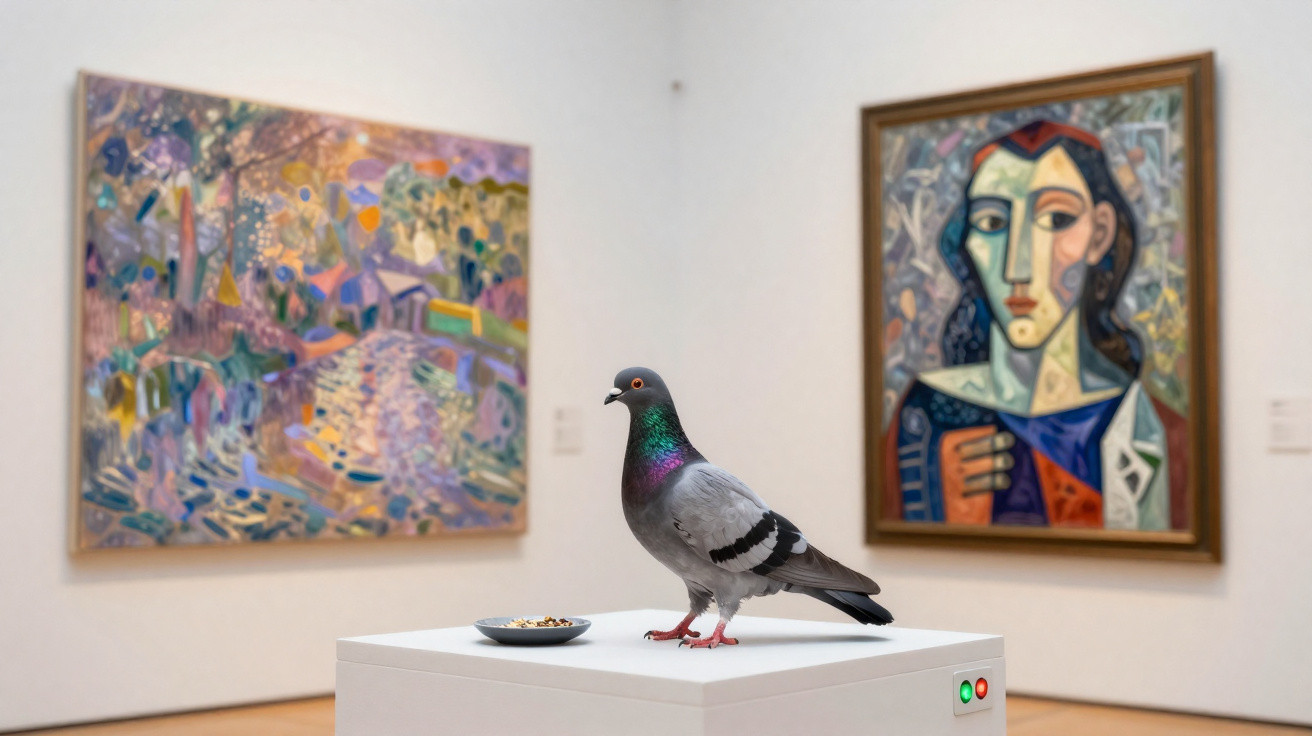
Pigeons may look like ordinary city birds, yet scientific research has uncovered a remarkable ability: they can recognise visual patterns and even tell painting styles apart, showing a far greater cognitive ability than many people assume.
How do pigeons identify painting styles?
One of the best-known experiments was carried out by researchers at Keio University in Japan. They trained pigeons to distinguish between works by Claude Monet and Pablo Picasso. After training, the birds still made correct choices when shown paintings they had not encountered before.
The findings suggested that the birds had not simply memorised particular images. Instead, they had learned to identify visual features and patterns, an ability regarded as important for understanding animal perception.
How was the experiment carried out?
In the trials, each pigeon was rewarded whenever it correctly selected the appropriate group of paintings. Once the learning stage had finished, the researchers introduced artworks the birds had never previously seen.
Their performance remained high, supporting the conclusion that pigeons could detect shared elements across the works. The main aspects identified by the scientists included:
- Pattern recognition across different paintings.
- The ability to generalise learning to unfamiliar images.
- Consistent differentiation between distinct artistic styles.
- Reward-based visual learning.
Why can pigeons do this?
Although their brains are small, pigeons have a highly developed visual system. In the wild, this capability helps them find food, spot predators and navigate over long distances.
Researchers believe that the same mechanism used to recognise surroundings also enables them to assess the shapes, colours and complex patterns found in paintings, photographs and other visual stimuli.
Pigeons are more intelligent than they seem
A range of studies has shown that these birds can remember routes, recognise individuals and learn relatively complex tasks. In some tests, they have also differentiated between letters, objects and different categories of images.
These findings underline that animal intelligence can take forms that differ from human intelligence. Rather than relying on sophisticated language, many species develop specialised abilities to overcome environmental challenges.
What does this discovery reveal about animal intelligence?
The experiment shows that advanced cognitive abilities are not limited to mammals. Pigeons can process visual information in a striking way, offering clues about the evolution of perception and learning.
As well as changing perceptions of these urban birds, the study supports research into neuroscience, animal behaviour and even the development of artificial intelligence systems inspired by natural pattern-recognition processes.





Comments
No comments yet. Be the first to comment!
Leave a Comment