
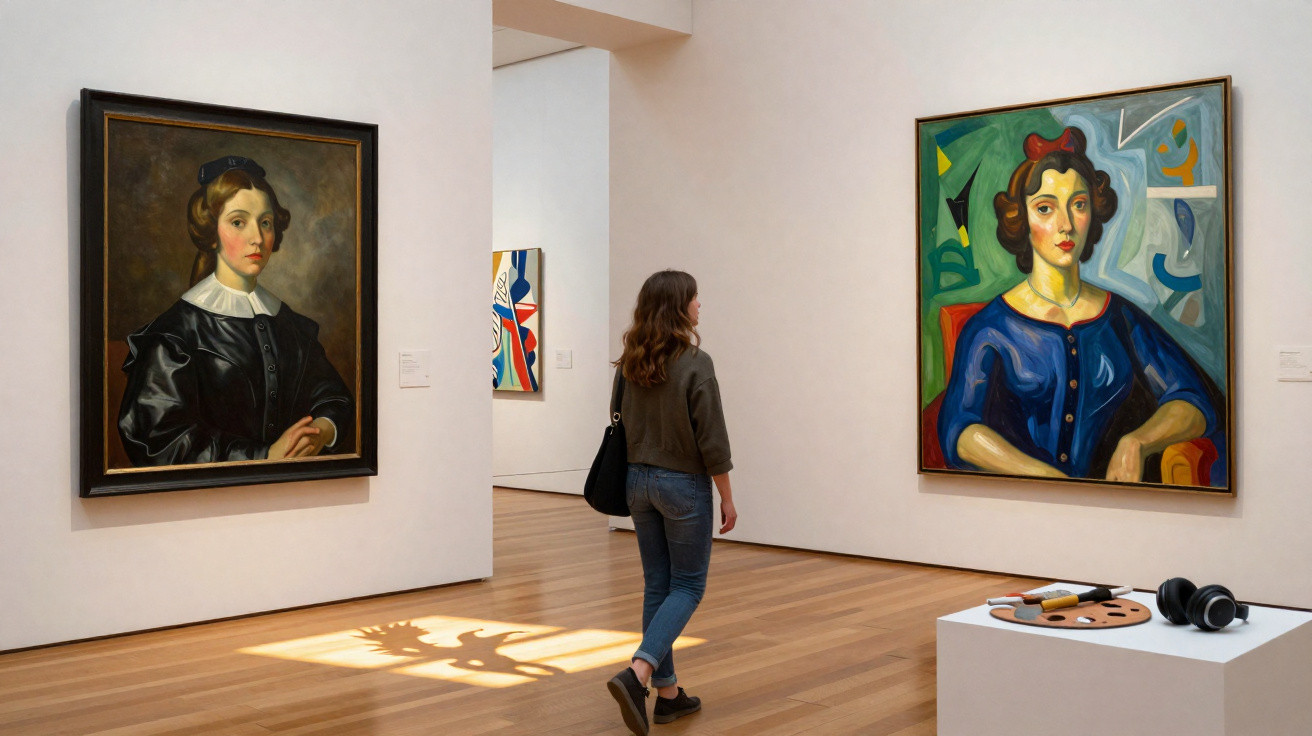
At the new Aurélia and Sofia de Souza Museum, housed within Porto’s Marta Ortigão Sampaio House Museum, visitors can explore in depth the work of two pivotal figures in Portuguese art at the turn of the 20th century. The exhibition “Double Dialogue” brings together works by the sisters, including pieces never previously shown, alongside those of five contemporary women artists.
A renewed focus on Aurélia and Sofia de Souza
As early as 2023, when he was director of Museu do Porto, Jorge Sobrado had been considering a “programme reorientation” for the Marta Ortigão Sampaio House Museum, which forms part of the institution. He told Evasões that the venue deserved a new direction. The house closed for extensive refurbishment in March and reopened on 13 June as the Aurélia and Sofia de Souza Museum. The painters, whose niece was Marta Ortigão, are now at the heart of the redevelopment.
“We believe that this declaration of commitment to Aurélia [1866-1922] and Sofia [1870-1960] is the key to bringing this heritage and this Museu do Porto house out of invisibility and a certain silence. At the same time, we are placing the emphasis on the life and work of Sofia and, above all, Aurélia, whose genius still requires far greater recognition,” says Sobrado, now Porto City Council’s councillor for Culture and Heritage.
There is also a degree of continuity in the project, as Marta Ortigão Sampaio donated both the house - a 1958 modernist building designed by José Carlos Loureiro - and its collection, which already included several works by the artists.
“Double Dialogue” and contemporary artists
Curated by Rita Roque, the reopened house presents two exhibitions. The principal show is “Double Dialogue”, which places the sisters’ work side by side and includes contributions from five invited artists. Roque says the curatorial approach was designed to present the artist sisters “in a clear, frank and complicit way”. The team then “opened the trunk to five contemporary women artists”: Catarina Vasconcelos, Ana Rocha, Isabel Carvalho, Luísa Mota and Sofia Leitão, who developed their work “through an immersion in this proposal by Aurélia and Sofia”.
The refurbishment involved detailed research throughout. “One of the curatorial gestures was to open up every piece, restore them, change the frames and examine the documentation on both sides, because one of the things I realised was that Aurélia drew on the backs of other works.” Among the discoveries was a letter from Sofia, concealed for all these years behind a framed drawing imitating Rubens.
The second exhibition, “Seabranano and Seabrina”, is a project by Constança Meira. It recreates, or represents, an exhibition she mounted four years ago at the Natural History Museum in Lisbon, curated by Raquel Henriques da Silva.
Both exhibitions run until 28 November. After that date, the museum will continue to foreground the two sisters while always creating dialogues with contemporary women artists. “This will be the home of women artists from the city of Porto, the country and the world. That is why we say that the programme we have adopted turns the space into Museu do Porto’s feminist museum,” Jorge Sobrado concludes.
A phoenix reborn
# Sofia’s drawings
One of Rita Roque’s favourite rooms is the one that reveals the sisters’ equal standing in terms of quality. Both studied in Porto and at the Académie Julian in Paris. The room contains 14 drawings by Sofia de Souza, which had been kept in drawers at the Faculty of Fine Arts of the University of Porto, then the Porto Academy of Fine Arts. “Here, it becomes clear that they were absolutely on the same level in terms of drawing. I even think Sofia was more talented in drawing technique, but Aurélia is stronger in oils.” At the centre of the room are two busts, one made by Aurélia and the other by Sofia. While Aurélia’s academic works form part of the Soares dos Reis Museum collection, Sofia’s remained at the academy because “she was not as highly valued”.
# Saint Anthony
One of Aurélia’s best-known paintings is “Saint Anthony”, dated 1900-1902. Rita Roque believes it is “the first time in the history of painting that a woman artist represents herself as a saint and as a man”. The life-size figure in the painting was based on photographs in which Aurélia portrayed herself dressed as the saint. “Double Dialogue” also includes a series of photographs of Aurélia drawn from an archive of 200 negatives that the Soares dos Reis Museum recently acquired from Caiado de Sousa, a member of the family. They have now been enlarged for the exhibition. There is a certain symbolism in the fact that Aurélia was born on 13 June, Saint Anthony’s Day, and that the exhibition opened on precisely that date.
# In flames
The house has been reshaped into something close to a “phoenix reborn”, with red as its dominant colour. “We wanted to embody the house, to make it fire.” The aim, the curator explains, was for the colour to “walk hand in hand with us throughout the visit”. The choice connects with Sofia Leitão’s “Posthumous Light”, created specifically for this setting. “The artist understood that there was a family mythology: Aurélia is said to have asked Sofia to destroy her diaries and letters. From what can be understood, that really did happen, because it is not normal for us to have no documentation of any kind; we have nothing written by her.” The artist “restaged that destruction, went to her personal library, selected books from the same period and constructed this burning bush, a consuming flame held in suspension”.
# Library
The library is on the top floor, where visitors can see books from the collection of Vasco Ortigão Sampaio, Marta’s father. The curator selected several volumes from this library which “almost certainly belonged to Aurélia”. The same room contains a display case holding photographs and drawings. It includes the oldest drawing in the exhibition, made by Aurélia in 1888, and the most recent, created by Sofia in 1931. There are also two caricatures of Aurélia discovered in Vitorino Ribeiro’s collection, neither of which had previously been exhibited. Catarina Vasconcelos also chose this room for her work “Correspondence for Aurélia and Sofia de Souza”, a series of envelopes containing letters from the artist and filmmaker addressed to the two artists.
Aurélia and Sofia de Souza Museum
299 Our Lady of Fátima Street, Porto
Website: museudoporto.pt
10.00am to 5.30pm, Tuesday to Sunday
Price: €4; free entry on Sundays
Comments
No comments yet. Be the first to comment!
Leave a Comment