
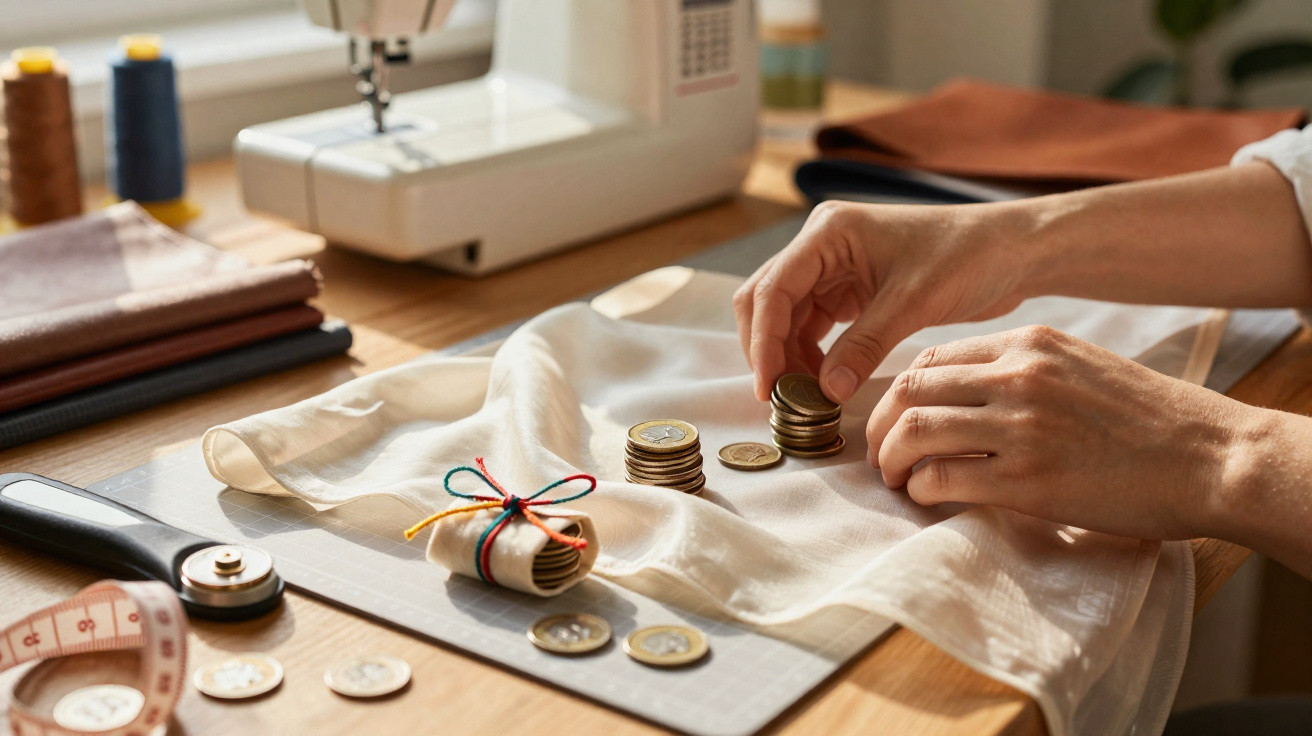
Anyone who sews regularly will know the issue: delicate silk, slippery softshell or expensive leather can be difficult to cut out cleanly. Pins leave holes, pull threads or may even damage a coating. This is where a remarkably simple technique from professional workrooms comes in: obsolete coins can be turned into clever weights for cutting out fabric.
Why coin weights are currently so popular at the sewing machine
Many households still have jars full of old coins with no monetary value. In sewing studios, these unassuming discs have long been regarded as a small tool with a big effect: they work as pattern weights, replacing traditional pins in many situations.
“The principle is to secure fabrics with weight and gravity rather than pins and holes.”
Delicate or technically demanding materials are particularly sensitive to any perforation. Textile professionals have warned for years against pinning certain fabrics too heavily:
- Silk and chiffon: prone to runs and visible pin marks
- Fine jerseys: can lose their shape when stitches are pulled
- Leather: every puncture remains permanently visible
- Coated or waterproof fabrics: every pin creates a potential entry point for moisture
Using weights instead allows you to lay the pattern pieces and fabric flat, weigh them down at key points, then cut precisely along the edges with a rotary cutter or scissors – without making a single hole.
Which coins are suitable, and why checking their value matters
Before turning old coins into tools, it is worth carrying out a quick reality check. Not every old piece is simply loose change from the past. Some coins have collectors’ value or contain precious metals.
Collectors and dealers assess coins using a rarity index from 0 to 100: the lower the score, the more common the coin is and the less collector interest it attracts. Older currencies in particular include many entirely ordinary pieces that nobody really wants any more.
The material is an important consideration. Some older coins are made from silver or other valuable alloys. An example from the coin trade illustrates how substantial the difference can be: depending on its weight and the silver price, a common silver coin may be worth considerably more for its metal alone than its original face value. In that case, it would be a shame to reshape it for sewing or drill holes into it.
“For cutting out fabric, only genuinely common coins made from simple alloys such as cupronickel should go into the sewing box.”
In practical terms, sort first and recycle afterwards. If you are unsure, set aside coins that seem unusually heavy or especially old, then research their value specifically. The large remainder – particularly worn everyday coins with no obvious distinguishing features – is ideal for use in the sewing room.
How sewers choose the right weight for each coin bundle
For coin weights to work reliably, it is not just the number of coins that matters, but above all their weight. A straightforward guideline is useful: a small, easy-to-handle weight measuring a few centimetres across should weigh roughly 40 to 60 grams.
Using old ten-unit coins as an example makes the calculation simple: if one coin weighs around 10 grams, a stack of four to six coins falls exactly within the desired range. This size is sufficient to:
- hold pattern pieces made from thin paper or tissue paper securely in place
- keep lightweight and medium-weight fabrics from moving
- distribute weight evenly across larger areas with several weights
For sturdier materials such as thick coating fabric, heavy cotton canvas or multiple layers of softshell, simply increase the number of coins. If preferred, bundles of different weights can be marked discreetly, for example with differently coloured fabric or a small stitched motif.
Step by step: turning old coins into durable pattern weights
Converting loose change into a sewing tool requires only a few simple steps and no specialist equipment. This straightforward method has proved effective in many workrooms:
- Clean: Soak the coins in lukewarm soapy water, rub them briefly with a brush or sponge, rinse thoroughly and allow them to dry completely.
- Stack: Place four to six matching coins on top of one another to form a small column. This keeps the weight and shape consistent.
- Add an interlayer: Wrap the stack with a strip of felt or masking tape. This prevents rattling, reduces wear and removes the metallic smell.
- Cut a fabric cover: Prepare squares or rectangles of sturdy cotton or linen measuring approximately 10 × 10 cm.
- Cover and sew: Position the stack of coins in the centre, fold in the fabric edges and fit them snugly around it. Then sew it into a closed “parcel” by hand or with the machine.
The result is a set of small, soft weights that will not scratch the cutting table, work quietly and can be kept ready to hand in a bowl or box beside the machine when needed.
How coin weights work with softshell, silk and leather
The advantage is particularly clear with water-repellent fabrics such as softshell. Every pin pierces the membrane and creates a weak point. Anyone planning a rainwear or outdoor project risks creating tiny leaks with pins that can later be difficult to seal again.
“Coin weights leave the surface completely undamaged – so the protective layer remains as watertight as it was when it left the factory.”
The process may appear unremarkable, but it saves frustration: clear the cutting table, spread the fabric out smoothly, place the pattern pieces on top and weigh down all edges and corners. Then transfer the markings using tailor’s chalk or a vanishing fabric marker, and cut along the lines.
With fine materials such as silk, viscose or transparent muslin, weights prevent distortion. The fabric lies more calmly, forms fewer ripples and does not slip out from beneath the paper. This makes even very narrow or curved pattern pieces more accurate to cut out.
The technique is also worthwhile for leather, imitation leather and coated cotton fabrics. Here, every pin mark would remain visible permanently or weaken the coating. Coin weights simply rely on gravity without damaging the surface.
Tips for using them on the cutting table
A few practical techniques from professional workrooms can make the process even smoother:
- Place weights close to the edge of the pattern piece so that nothing can shift.
- Use double or triple weighting at corners and along long straight edges.
- Use more small weights rather than fewer large ones – this spreads the force more evenly.
- When using a rotary cutter, pay attention to a





Comments
No comments yet. Be the first to comment!
Leave a Comment