
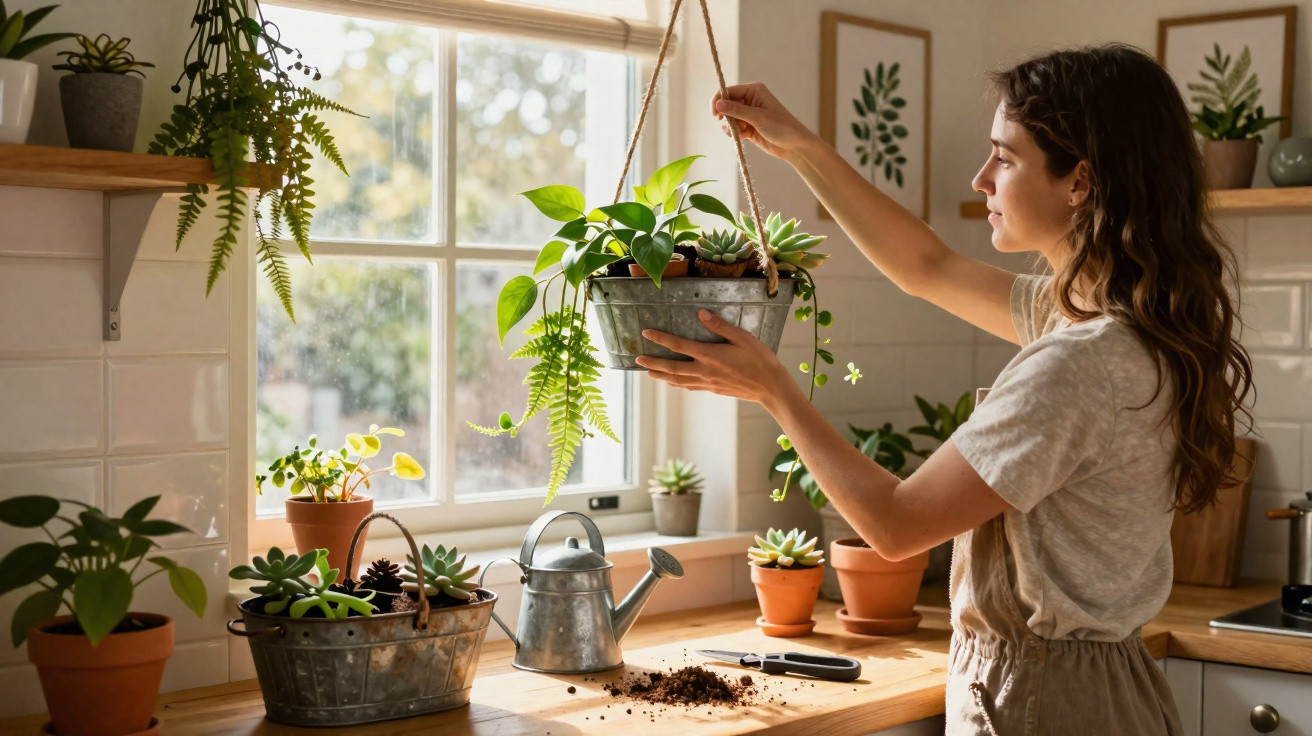
Many people have one tucked away somewhere: a slightly dented wire basket from a car-boot sale, a wooden basket from Gran’s kitchen, or a metal basket from a second-hand shop. It may look appealing, but its practical purpose has long since disappeared from daily life. These finds are ideal for creating a miniature hanging garden – perfect for small flats, dim corners and anyone who enjoys displaying their plants in full view.
Why an old fruit basket is perfect for hanging plants
A traditional fruit basket already has many qualities that houseplants benefit from. Its shape is usually generously sized, the sides are often open, and the material is sturdy. This combination makes it an excellent starting point for a hanging plant basket.
“Open sides, a robust structure and little base area – an old fruit basket already meets almost every requirement of a hanging planter.”
Typical benefits of these baskets include:
- Open sides: Leaves and stems can trail down freely.
- Plenty of room: They will generally accommodate several small pots.
- Strength: Fruit baskets are designed to carry weight, so they can comfortably support compost and plants.
- Cost advantage: Second-hand finds are considerably cheaper than new designer hanging planters.
- Upcycling appeal: A used item gets a new lease of life rather than ending up in the bin.
Before converting it, inspect the basket carefully: is the wood rotten? Does it have deep cracks? Does the metal have rusty areas that are already turning into holes? It is better to leave such examples behind, or use them only as decoration without compost or heavy weight.
Cleaning and preparation: refresh it before hanging it up
Before any plants move in, the basket needs a little care. Warm water, a little washing-up liquid and a brush will usually do the job. Remove all traces of fruit, dust or old decorative material completely, so that mould does not become a problem.
After cleaning:
- Allow the basket to dry fully – ideally overnight.
- Straighten or remove loose parts, sharp edges and bent wires.
- If desired, apply a thin coat of clear varnish or weather-resistant paint to wood or metal, so it copes better with moisture from watering.
Anyone who likes a splash of colour can paint the basket matt black, cream white or in a pastel shade. The resulting mini jungle will immediately look more contemporary and blend more easily with the room’s style.
Materials list: what you need for a hanging plant basket
This DIY project is easy to manage. Many of the items may already be in the home, while the rest can be found at a DIY shop or garden centre.
| Component | Purpose |
|---|---|
| Old fruit basket | Base that holds compost and plants |
| Strong cord or chain | Suspension that distributes the weight |
| Hooks or rings | Connects to the ceiling hook, beam or shelf |
| Fleece, coconut fibre or hessian | Inner lining that keeps compost inside the basket |
| Lightweight compost + clay pebbles | Growing medium and drainage |
| Houseplants | The green centrepiece of the whole project |
If you do not want to use a drill, choose hooks that can be placed over a curtain pole, beam or sturdy shelf. This can be a stress-free option in rented homes with delicate ceilings.
Planning the suspension: safe, stable and practical
Work out the hanging system before putting compost into the basket. Three or four suspension points provide stability. Attach the cords or chains evenly around the rim so the basket does not hang at an angle.
A practical sequence:
- Line the inside of the basket with fleece, coconut fibre or hessian.
- Add holes or eyelets if the basket does not already have openings for the cords.
- Thread through the cords, measure their lengths carefully and tighten the knots securely.
- Hang the empty basket from its final hook as a test, and check it by simulating a load with your hand.
If the basket will sit close to a wall, stick a small piece of felt or cork to the back. This prevents scratches and unsightly rubbing marks.
The right houseplants for the hanging basket
The overall effect depends entirely on the plants. Trailing or climbing varieties are especially suitable, as they make the basket appear to overflow.
Popular choices include:
- Pothos (devil’s ivy) with heart-shaped leaves
- Traditional ivy for lush green cascades
- Tradescantia (“wandering dude”) with colourful foliage
- Philodendron with long, soft stems
- Hanging strawberries for anyone who likes to snack by the window
It looks particularly effective to combine leaf colours and shapes: a variegated variety next to a dark green one, or a plant with rounded leaves alongside one with fine, long trailing stems. This creates a lively scene that resembles a small jungle more than an orderly flower bed.
Watering and care: keeping the mini jungle healthy
Hanging baskets often dry out more quickly than pots on the floor because they are exposed to more airflow. At first, it is therefore worth checking the compost closely. If it feels dry on top but remains slightly damp underneath, a small amount of water is often enough.
“It is better to water little and often than to give a large amount only occasionally – this keeps the roots in a hanging basket healthy.”
A few care tips:
- Put clay pebbles or small stones in the bottom section for drainage.
- Use light, loose potting compost so the basket does not become too heavy.
- Do not leave leftover water sitting in the fleece or in saucers.
- Check cords, chains and hooks regularly for wear.
- Turn the plants from time to time so they receive light evenly.
Where a hanging plant basket looks its best
This new focal point needs very little space, although it is still worth planning its location. Corners with nothing but an empty wall are ideal, as are areas above sideboards where floor plants would get in the way.
Popular locations:
- Above a reading corner with an armchair and floor lamp
- At the kitchen window with herbs or strawberries
- In the hallway, to make a bare wall feel more alive
- In the bedroom, as a green contrast to the bed and bedside table
Light levels remain important: most houseplants prefer bright, indirect light. It is best not to hang them directly above a radiator or in a draughty passageway.
Upcycling, sustainability and a homely feel: why the effort is worthwhile
Using an old fruit basket as a hanging planter not only saves money; it also changes how a room feels. The floor remains clear, the corner looks more airy, and a striking focal point is created at the same time. Unlike many shop-bought hanging planters, the basket brings its own personal history: a car-boot-sale find, a family heirloom or a treasure from the loft.
The term “upcycling” describes exactly this: an object that has fulfilled its original purpose is not thrown away, but improved and used in a new role. At a time when many people are making more conscious purchasing decisions, a project like this fits perfectly into the home.
Once you have started with one basket, it is easy to want variations: two smaller baskets placed one above the other as a vertical plant ladder, an old metal shelving section as a wall-mounted planter, or a wide wire basket suspended above the dining table and filled only with dried grasses. In this way, a simple DIY experiment can grow into a distinctive green design concept for the home.



Comments
No comments yet. Be the first to comment!
Leave a Comment