
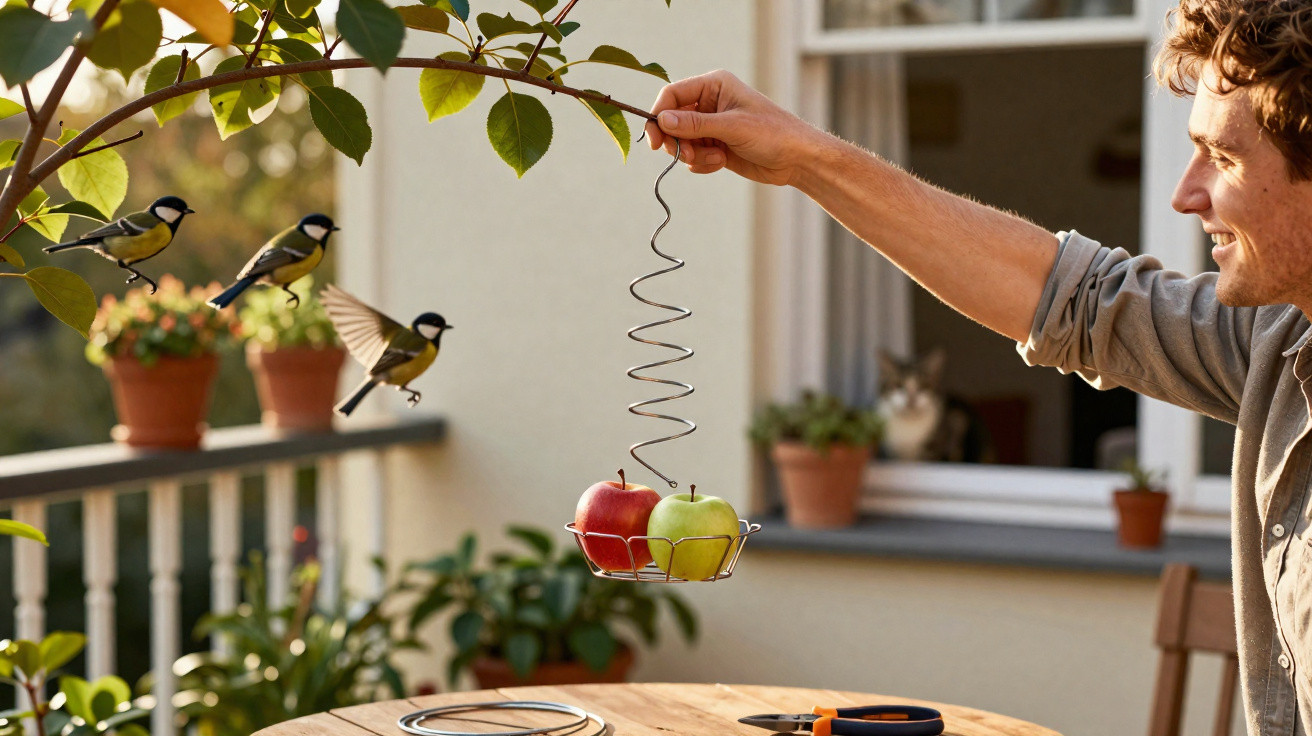
With the first warm days, the garden becomes noisy: tits, finches and sparrows hunt for food to replenish their energy reserves. Anyone wanting to help them does not need to buy expensive accessories from the shops. A simple wire coat hanger from the wardrobe is enough to make a sturdy feeding station in record time – while also doing something for the environment and their wallet.
Why an old coat hanger makes an ideal bird feeder
Metal hangers from the dry cleaner's are often seen as annoying clutter, yet they have plenty of potential. The thin metal can support a surprising amount of weight while still being bendable and shapeable with a little force. This very combination makes a hanger the perfect starting material for an improvised bird feeder.
With just a few simple steps, an apparently worthless everyday item becomes a stable feeding spot for wild birds.
There is another benefit: reusing items already at hand saves resources. There is no plastic feeder, packaging or transport involved, so the environmental footprint remains minimal. Birds benefit immediately, especially in early spring and winter, when natural food sources are scarce.
Materials: what you really need for this zero-cost bird feeder
The greatest advantage of this craft idea is that almost everything can be found at home or in a basic toolbox. Only a small selection of materials is needed to get started.
- 1 metal coat hanger, ideally a thin dry-cleaning hanger
- 1 pair of side cutters or combination pliers with a cutting edge
- 1 pair of flat-nose pliers for bending the metal safely
- 1 apple half or 1 fat ball for birds, without a net
The hanger should not be rusty or badly misshapen. Minor irregularities are not a problem, but severe bends make the structure unstable. The metal needs to be flexible enough to shape by hand and with pliers without snapping.
From coat hanger to bird feeder in three minutes
Step 1: reinforce the hook
The hanger's hook remains the key component, as it will later hang from a branch or balcony railing. Working carefully at this point prevents problems later in strong winds or under a load of snow.
- Place the hanger on a flat surface.
- Using flat-nose pliers, carefully undo the small twist beneath the hook to create one long, straight length of wire.
- Slightly reshape the hook at the top so that it is closed and secure.
- Firmly squeeze the base of the hook with the pliers, ensuring it cannot unexpectedly open in the wind.
When finished, there will be a strong hook at the top and a long, malleable wire section below that will hold the food.
Step 2: shape the holder for an apple or fat ball
This is where the creative part begins. The wire shape changes slightly depending on the type of food being used.
Option A: holder for an apple or soft fruit
Anyone wishing to feed apple pieces or leftover pear needs either a skewer-like support or a U-shaped holder.
- Bend the free end of the wire firmly upwards.
- Either make a pointed, slightly curved tip onto which the apple can be pushed,
- or form a wide U into which half an apple can be pressed.
Important: the point must be sharp enough to keep the fruit in place, but not so exposed that birds could injure their feet. Always bend sharp edges slightly inwards.
Option B: spiral for fat balls
For standard fat balls without plastic netting, a small metal spiral works particularly well.
- Grip the lower end of the wire with flat-nose pliers.
- Wind the wire into a tight spiral, like a small spring or basket.
- Make sure the gaps remain narrow enough that the ball cannot slip through.
- Always bend protruding or sharp wire ends inwards.
A well-shaped spiral holds the fat ball securely in place – even in gusts of wind or when several birds feed at once.
The ideal location: where birds can feed safely
Protection from cats and glass
Even the most attractive feeding spot is of little use if birds are at risk there. Two factors are particularly important: height and distance.
- Height: Around two to three metres above the ground is a useful guideline, so cats cannot easily jump up to it.
- Distance from windows: Keeping at least ten metres away from large glass surfaces greatly reduces the risk of collisions.
- Places to retreat: Nearby shrubs or hedges offer protection, but they should not be so close to the food that cats can approach unnoticed.
A sturdy branch with a clear view in all directions is ideal, along with nearby leaves or needles that give birds cover when danger appears.
Keep weather, wind and cleanliness in mind
Persistent heavy rain and storms can quickly spoil food or tear it from the hook. It is therefore worth choosing the location carefully.
- Slightly sheltered from wind, but not completely hidden away in a corner.
- Not in permanent shade, where everything stays damp for longer.
- Easy to reach, so food can be replaced without difficulty.
Spoiled fruit or rancid fat residues can harm birds. Checking the feeding station regularly protects the animals and prevents unpleasant smells.
Why garden birds love this simple bird feeder
Tits, robins, sparrows and finches are among the typical garden visitors. They favour light, open perches from which they can take off and escape quickly. A narrow, hanging wire feeding station provides exactly these conditions.
The hanger looks inviting to small songbirds, but is less appealing to larger, heavier species or cats.
Its open design gives birds an unobstructed view of their surroundings. Large, bulky bird tables can make them feel less secure because potential predators are harder to spot. The slim wire construction, by contrast, allows quick escape routes in every direction.
Practical advice on food, hygiene and safety
Which food works on the coat hanger?
Not every type of food is suitable for this hanging design. Good options include:
- Fat balls without nets
- Apple or pear halves
- Homemade porridge oat and fat mixtures rolled into balls
- Dried sunflower seeds bound together with fat
Avoid heavily seasoned leftovers, bread and salted nuts. These are unsuitable for wild birds and can make them ill.
Safety for people and animals
Always wear work gloves when bending or cutting the wire to prevent cuts. Children should only help under supervision, particularly when sharp edges or tools are involved.
Before taking the hanger outside, inspect every wire end carefully. Any sharp point should be bent inwards with pliers or rounded off slightly. This keeps birds' legs and wings safe from injury.
Benefits for the garden, balcony and environment
This improvised feeder is not limited to a traditional garden. It can also be hung on a balcony or sturdy railing in a back courtyard, provided neighbours and the landlord agree. Sparrows and tits in particular welcome extra food sources amid urban concrete and glass.
The benefits go far beyond a pleasant sight. Feeding birds regularly helps insect-eating species survive, supports nesting birds during the breeding season and increases biodiversity on the doorstep. Birds eat pests, bring the garden to life and make every green space feel more vibrant.
It also creates a small ritual: checking the food, replacing the apple, hanging up a fresh fat ball – then spending a moment at the window to see who visits today. A bent coat hanger can thus become a lasting meeting place for familiar feathered visitors: free, simple and surprisingly effective.



Comments
No comments yet. Be the first to comment!
Leave a Comment