
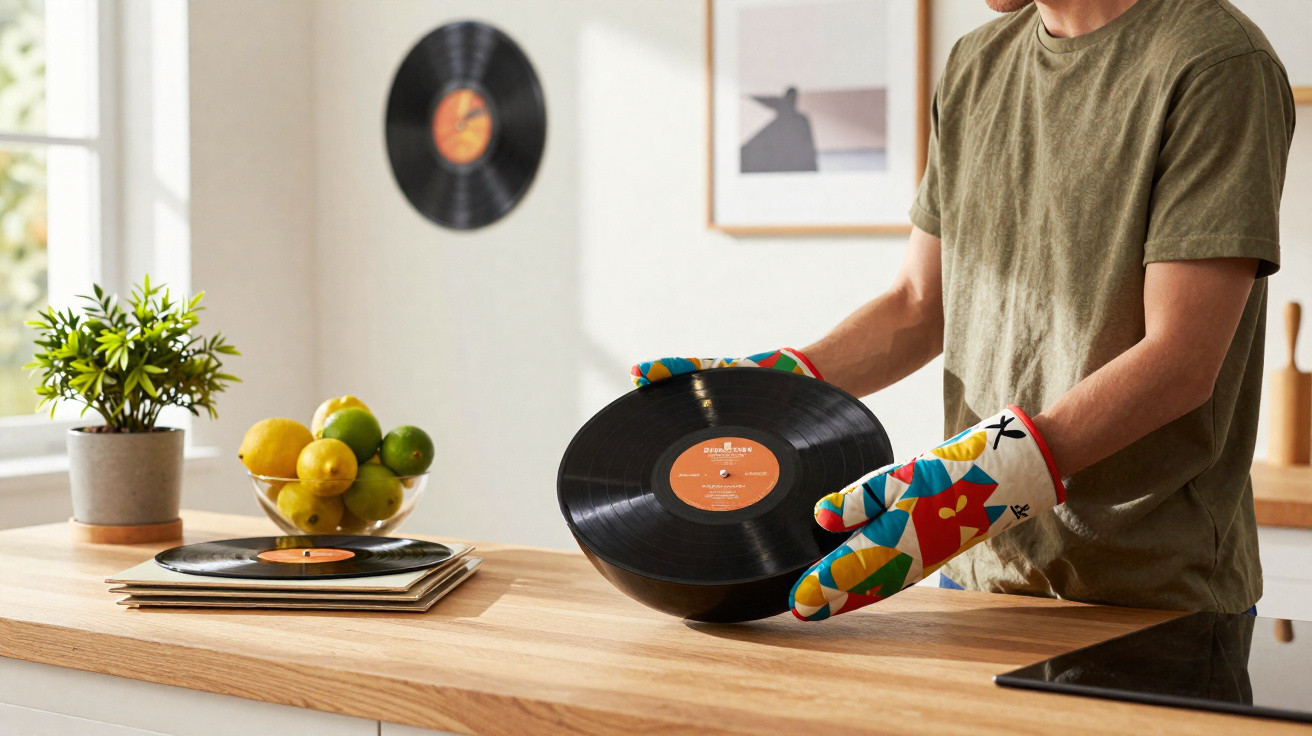
A simple trick can turn them into an eye-catching feature in minutes.
Many people still have boxes full of vinyl records in the cellar, loft or from a house clearance. Much of it is scratched, warped or simply musically uninteresting. Rather than reluctantly putting everything in the bin, some records can be turned into useful decorative items – using only an ordinary oven and a little dexterity.
Why old vinyl records can do more than play music
Vinyl records are not made of “magic”, but of a specific plastic: PVC, or polyvinyl chloride. This material belongs to the group of thermoplastics, meaning it becomes soft and mouldable under moderate heat, then hardens again in its new shape as it cools.
In practical terms, if you place a record in the oven at the right temperature, it will briefly become flexible like rubber. During this stage, you can drape it over a vessel, press it in or create wave-like contours to make a one-off decorative object.
An unusable record can become a sturdy bowl, plant-pot cover or another retro-inspired one-off in just a few minutes.
The ideal temperature range for shaping vinyl
Temperature is the crucial factor. If it is too cool, nothing will happen; if it is too hot, the material can warp badly, smell and become damaged.
A range of 100 to 120 degrees Celsius has proved effective in practice. Within this range, the record softens without melting or forming bubbles. In most cases, 3 to 5 minutes in a preheated oven is enough, depending on the appliance and its position inside the oven.
- below 90 °C: almost no effect; the vinyl stays rigid
- 100–120 °C: ideal; the material softens evenly
- above 130 °C: increasing risk of warping and odour
A designer bowl in 5 minutes: step-by-step instructions
The most popular option is a rippled bowl that resembles the designer objects sold in homeware shops. It works well as a place for keys, paper clips or wrapped snacks, and looks good in a hallway or living room.
Instructions: shape a vinyl bowl in the oven
- Preheat the oven: Set your oven to around 110 degrees Celsius, using either fan-assisted or conventional top-and-bottom heat.
- Prepare the base: Line a baking tray with baking paper so the vinyl does not come into direct contact with the metal.
- Choose a mould: Use a heatproof bowl or a sturdy ceramic or glass tumbler, placing it upside down on the tray. Its base will create the mould for the finished shape.
- Position the record: Centre the record on the upturned vessel, with the hole facing downwards.
- Put it in the oven: Place the tray on the middle shelf. Stay nearby and keep an eye on the process.
- Wait for the edges to “drop”: After around 3 minutes, the outer edges of the record will start to slope downwards and drape over the vessel.
- Remove and shape: Put on oven gloves, carefully take out the tray and use your gloved hands to shape the still-soft edges into waves or folds.
- Leave it to cool: Let everything sit on the tray for at least 10 minutes without moving it. The new shape will harden as it cools.
You will then have your own designer bowl – with the label at its centre, grooves around the outside and an unmistakable retro look.
Turn the bowl into a fruit bowl or plant-pot cover
Small adjustments allow you to create different objects:
- Fruit bowl: Press the base further down while shaping to make a deeper hollow. For unwrapped food, always use a separate glass bowl or a piece of baking paper.
- Plant-pot cover: Seal the centre hole with epoxy filler or a suitably cut cork, then place a matching inner pot inside.
- Pocket emptier and small-items tray: Keep the shape relatively shallow; it is ideal for keys, coins, jewellery or office supplies.
The original record does not need to have any musical value left – the more scratched it is, the more easily you can shape it without feeling guilty.
What you must consider when upcycling vinyl
However appealing the idea may be, it should not be done without a few rules. PVC is a technically demanding plastic that needs to be handled carefully.
Kitchen safety: oven, fumes and children
A few basic precautions help protect both your health and your home:
- Limit the temperature: Do not exceed 120 degrees. Higher temperatures increase fumes and can warp the material uncontrollably.
- Ventilate well: Open a window slightly or switch on the extractor fan while shaping the record.
- Protect your hands: Both the record and the tray become very hot. Always use oven gloves or thick potholders.
- Keep children away: The process looks fascinating, but it is not suitable for curious children’s hands.
- Protect the baking tray: Baking paper prevents vinyl residue from burning onto it.
No direct contact with food
One important point is that the plastic used for records was not developed for food contact, especially not after being heated in an oven.
If you want to use the finished bowl for fruit, sweets or other food, always include a barrier:
- place a small glass bowl inside the vinyl bowl
- line it with a napkin, baking paper or a paper doily
- only put wrapped goods inside, such as chocolate bars in their wrappers
This preserves the decorative effect without creating unnecessary risk.
Which records you should not put in the oven
Before putting the first record into the oven, it is worth quickly checking its collector value. Not every old LP is worthless, even if it no longer looks perfect.
Typical records that are best kept or assessed include:
- first pressings by major bands and artists
- limited special editions, coloured vinyl and picture discs
- smaller labels with cult status that are now sought after
- records with original signatures or rare sleeves
Anonymous compilations, damaged singles, promotional records or sleeveless LPs that have survived in a box in the loft are far less problematic. These are ideal candidates for creative use in the oven.
More ideas: clock, wall art and gifts
If the oven trick does not appeal to you, or you only want to try it once, there are plenty of other ways to give old vinyl a useful new purpose.
Wall clock, frame and gift idea
- Wall clock: Fit a battery-operated clock mechanism through the centre, attach the hands and add a hanging fixture – and your retro living-room clock is ready.
- Picture frame: Glue the record onto a wooden board, attach a photograph or small poster over the label and hang the finished piece.
- Gift with a story: Choose a record with a fitting title or artist, such as a parent’s favourite album, decorate it and give it as a personal present.
By visually coordinating several records, you can decorate entire walls – whether in a music room, rehearsal space or teenager’s bedroom.
Why it is worth the effort with old records
Vinyl records are rarely recycled effectively through ordinary household packaging recycling. As a result, many simply end up in general waste. With only a few simple steps, a discarded item becomes a durable everyday object.
The effect extends beyond a single bowl: anyone who sees how quickly a seemingly useless record can become a decorative bowl will often take a more long-term view of other items too. This conserves resources while creating distinctive individual pieces that cannot be bought from a furniture shop.
This is particularly appealing for people on a limited budget, students or young families: an emptied home, a stack of discarded singles from a car-boot sale, and suddenly very little money can create a whole collection of bowls, plant-pot covers and wall pieces that make a home feel more personal.
One final tip: begin with the least-loved record in the pile. After your first successful bowl, you will soon get a feel for temperature, timing and shape – and then feel confident enough to use more visually appealing records too.


Comments
No comments yet. Be the first to comment!
Leave a Comment