
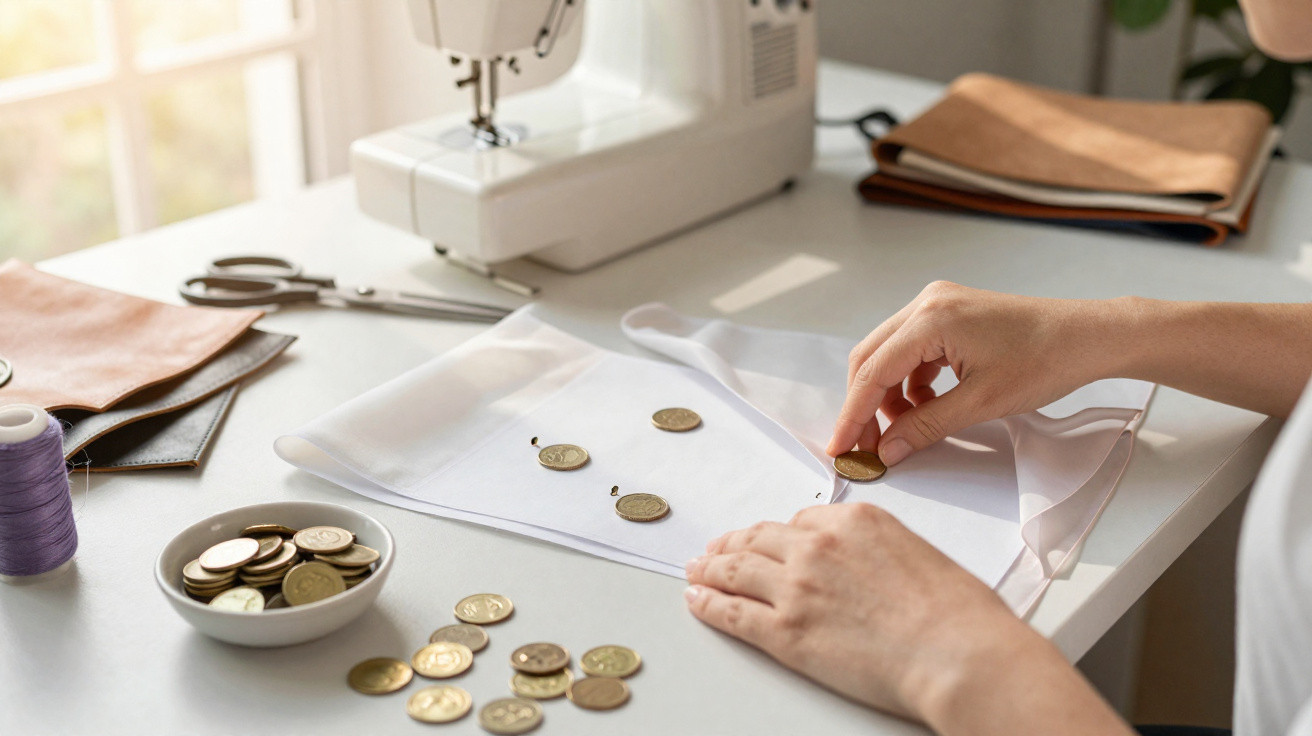
Many households still have tins and jars filled with old coins that are no longer accepted at the till. What may seem like worthless loose change can become a surprisingly useful tool in sewing studios: retired coins work as small pattern weights, replacing pins when every puncture could permanently damage the fabric.
Why coin weights are becoming a sewing-room insider tip
Modern fabrics create fresh challenges for both home sewers and professionals. Softshell for outdoor jackets, coated cotton for wash bags, delicate silk and stretchy performance jerseys leave very little room for error. Every pin makes a tiny wound in the fibre – and it does not always disappear.
“With technical fabrics, every individual pinhole can later cause problems – from water ingress to a laddered stitch.”
Specialist institutes and tutors have long advised using as few pins as possible with sensitive textiles. The following materials are particularly vulnerable:
- Softshell and other outdoor membranes – every hole can become a potential route for water to enter
- Silk, chiffon and delicate woven fabrics – holes and runs remain visible
- Fine jerseys – a broken thread can cause a ladder to develop
- Leather and faux leather – every puncture is permanent and will not close up again
- Coated or waxed fabrics – pinholes damage the protective finish
The alternative is simple: rather than piercing the fabric and pattern piece, hold them down with weights. Small weights sit on the pattern lines instead of pins securing the paper, keeping the fabric flat and stable while it is cut with a rotary cutter or scissors.
Check the value before taking coins into the sewing room
It is worth inspecting old coins before turning them into craft materials. Not every piece of metal is genuinely “worthless”. Some older coins have collector value, while others are struck in precious metals whose material value alone may be considerable.
Collectors often use a rarity index, which typically runs from 0 to 100: the higher the figure, the harder the coin is to find in circulation. Coins with a very low index are regarded as common items, making them the preferred choice for the sewing room.
Older silver coins that once circulated are a typical example. Although they contain real silver, they are often of little numismatic interest. Their metal value may nevertheless be significantly higher than their face value. Historical coins should therefore always be checked briefly:
- Note the year of issue and design
- Compare it with a coin catalogue or reputable valuation websites
- Reserve only genuinely common pieces for craft projects
Coins made from cupronickel or similarly durable alloys are usually best suited to use as sewing weights. They are not strongly magnetic, do not rust and are easy to clean. Genuine silver or gold coins are better kept in a safe or taken to a specialist dealer.
The right weight: how many coins does a sewing weight need?
To stop a pattern piece from shifting, the balance between its weight and surface area needs to be right. If it is too light, the paper moves as soon as the scissors start cutting. If it is too heavy, delicate fabric can be pulled, creased or distorted.
Many sewers use straightforward starting figures: a typical slightly larger circulating coin weighs around 10 grams. Stacking four to six of them produces a weight of 40 to 60 grams. This is generally enough to:
- secure tissue-paper sewing patterns firmly
- keep lightweight woven fabrics steady on the cutting table
- prevent major layers from shifting when cutting softshell
For particularly large pattern pieces – such as the back of a rain jacket – use several of these weights or create taller stacks. Even distribution is what matters most. Three large blocks in the centre are less effective than five or six smaller weights placed along the outer edges.
Make durable sewing weights from old coins
Preparation and cleaning
Coins must first be thoroughly cleaned so that the fabric stays clean afterwards. A short process is all that is needed:
- Soak the coins in warm water with a little washing-up liquid
- Remove dirt using a soft brush or cloth
- Rinse well and allow them to dry completely, so that nothing rusts or develops an unpleasant smell
Stabilising the coin stacks
For a standard weight, many people use four to six coins of a similar size. Adding a layer around the stack prevents it from falling apart or sliding later on:
- Wrap the coins tightly with masking tape or washi tape
- Alternatively, place a piece of thin felt around the stack and secure it with a few hand stitches
This layer stops metal rubbing against metal, reduces unpleasant noise and prevents residue from transferring to pale fabrics.
Sewing fabric covers
A small cover makes the weights easier to hold. Offcuts of sturdy cotton or linen work particularly well. Follow these steps:
- Cut squares measuring about 10 x 10 centimetres
- Place the coin stack in the centre
- Fold the fabric edges upwards as though wrapping a small present
- Topstitch the overlapping edges close to the edge, either by machine or by hand
The finished result is a small, firm “cushion cube” or triangular pouch that is easy to grip and will not slide over the fabric. If desired, use coloured threads to identify weight categories – for example, red for heavy and blue for light.
How to use coin weights correctly with softshell, silk and leather
Softshell and waterproof fabrics
With membrane fabrics for jackets, every hole can allow water through later. Lay the pattern flat on the fabric and position the weights along its lines. It is especially useful to double-weight corners and long edges. Nothing will then shift, even when using a rotary cutter.
When placing two layers of softshell together, do not distribute the weights across the paper alone. Position them specifically where both fabric layers need to align precisely. This keeps the front and back sections perfectly matched.
Fine silk, chiffon and jersey
Thin, flowing fabrics tend to slip off the table or distort under even the slightest pull. Pins can quickly create runs or visible punctures. Coin weights keep the pattern piece in place without putting tension on the threads.
They are also easy to move while cutting. For example, when cutting large flounces or circles, the small parcels can simply be moved progressively along the edge instead of pinning everything again from scratch.
Leather, faux leather and coated fabrics
Leather has one firm rule: make as few punctures as possible. Every pin mark remains visible. Pattern pieces are therefore not the only items that should be held with weights. When marking darts, pocket positions or button stands, combine weights with dedicated marking tools such as tailor’s chalk, a disappearing marker or tape.
“Those who use weights rather than pins with leather and softshell often extend the life of the finished garment considerably.”
Further points to consider when working with coin weights
Although the method seems simple, a few details make a real difference:
- Never place bare metal directly onto very delicate fabrics – the cover provides protection
- Check for sharp edges and burrs so that nothing tears
- Keep the cutting table free from sand, dust and threads, otherwise the weights can slide more easily
- In homes with children or pets, always put the weights away after sewing so that nobody plays with them or swallows them
Anyone who sews regularly will soon discover which weight category is most useful day to day. Many people assemble a small set of light, medium and heavier parcels, much like having spanners in several sizes. That way, suitable weights are always ready for delicate blouse fabrics and heavy coating wool alike.
More benefits than expected: upcycling, precision and calmer cutting
Besides protecting fabrics, perhaps the greatest advantage is the calmer working process. Pinning takes time, creates noise and often leaves a prickly construction of paper and metal. Place the weights, trace the lines and cut – the process becomes far smoother.
Old collections of coins also avoid being thrown away and instead gain a second life in the sewing room. Anyone who enjoys sewing with children can let them paint or embroider the covers, turning a purely practical aid into a small personal project. Even if the weights are eventually no longer wanted, no plastic block has been produced: they can easily be reused or taken apart.



Comments
No comments yet. Be the first to comment!
Leave a Comment