
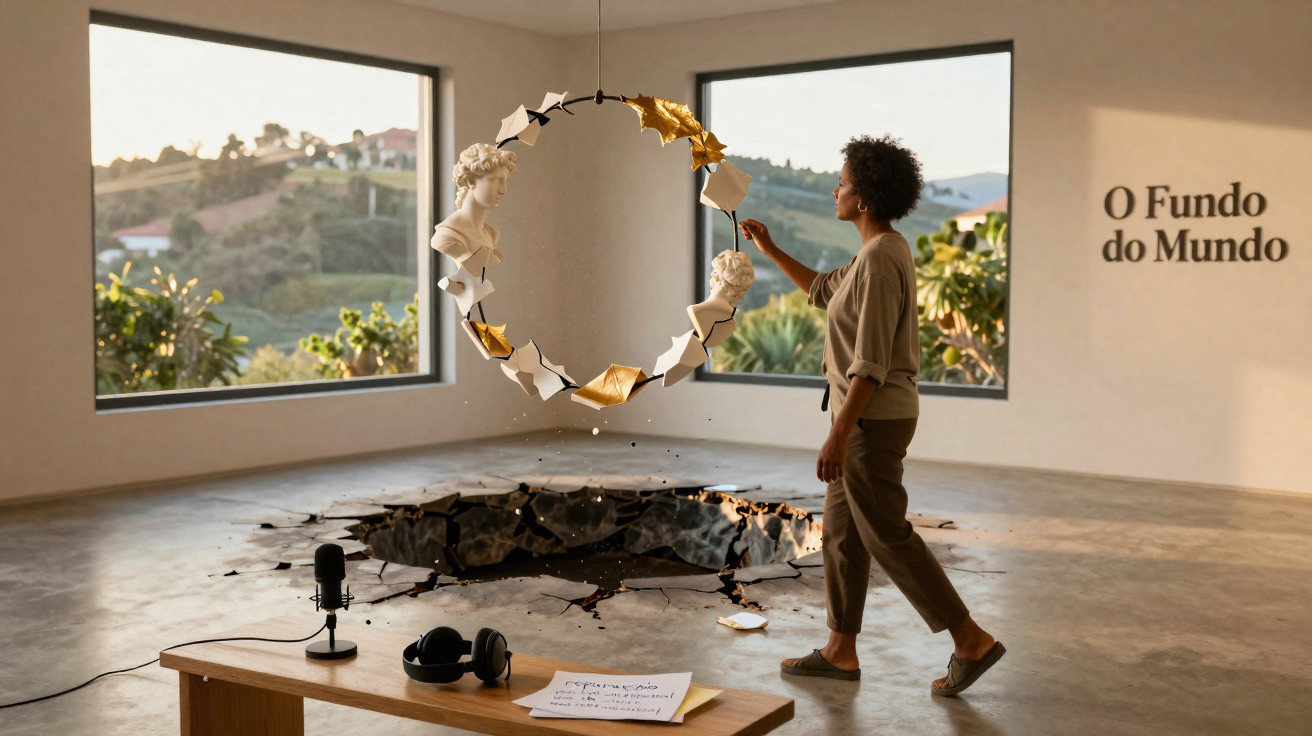
“What would the seabed tell us tomorrow, if it were drained of water today?”
This philosophical question projected into the future - one that imagines the ocean floor as a site of memory and the burial place of so many acts of violence and tragedies spanning human history - provided the starting point for visual artist Grada Kilomba’s latest work.
The creation opens to visitors at the Albuquerque Foundation in Sintra from 30 May.
Grada Kilomba’s O Fundo do Mundo
Grada, an artist of international standing who now lives between Lisbon and Berlin, has titled the exhibition O Fundo do Mundo (The Bottom of the World). It brings together a selection of her works never previously exhibited in Portugal, including the sculptural installation 18 versos (18 Verses): charred wooden blocks, scattered and wrapped in black fabric, which evoke a shipwreck and refer to the “dramatic migration routes that cross the waters of the Mediterranean.”
It is a variation on the monumental work O Barco (The Boat), first shown in Lisbon at the BoCA – Biennial of Contemporary Arts in 2021. The work is currently on display at Inhotim, Minas Gerais, Brazil, until September 2026.
O Fundo do Mundo examines the recurring nature of violence. From slavery and colonialism to the many wars, climate crises and today’s tragic genocides, it descends into the underside of human ‘glory’, concealed in the ocean’s depths.
In her words, “the function of art is to remind us of our humanity. Through the language of the unconscious, it addresses the most impossible and incomprehensible subjects.”
This is Grada Kilomba’s first major solo exhibition in Portugal. As one of the most significant Portuguese artists of her generation with an international career, she places at the heart of the discussion what has been silenced for centuries within the collective unconscious. Having uncovered and named what has long been hidden in the past, she proposes a different perspective on power, knowledge and the future.
Art, memory and historical violence
Her work is unsettling, giving a name to the centuries of oppression, exploitation, slaughter and greed that explain the racism still embedded systemically within society.
Yet it is also liberating and illuminating, if we accept that there can be no progress while humanity’s past continues to be remembered through “delusional” and “childish” visions.
What can art stir within the collective imagination? Can it repair, reimagine, reconcile and bring people closer together? Can it foster new awareness and different possibilities for the future? Grada answers these questions in this podcast.
Her works are political because, for Grada, “all art is political”.
They are as subversive as they are avant-garde: large-scale, immersive works that unfold through performance, dance, video, text, sculpture, installation and soundscapes.
Grada describes her art as a form of “domestic disobedience”, in which poetic, radical images - poised between beauty and the grotesque - disrupt a particular collective imagination and the cycle of what she calls “prevailing historical violence”, in both narratives and architecture, indoors and outdoors, and within public space.
Do we still live in a state of denial, repetition and glorification of Portugal’s colonial past, or have we moved beyond it?
How can we disarm and escape the cycles of violence in history, along with so much hatred and so many entrenched divisions?
What remains relevant to mention and remember, and what no longer does? Where are we in the post-colonial debate?
And, moreover, what exhaustion, irritation, saturation and fatigue do certain questions carry with them?
These are the questions put to her.
Grada Kilomba on art and psychoanalysis
So too is the statement by American philosopher, theorist and activist Angela Davis: “When the Black woman moves, the whole structure of society moves with her.” Is that so?
The podcast also recalls that, before establishing herself as an artist, Grada Kilomba - author of the essential book Plantation Memories – Episodes of Everyday Racism - studied ‘Psychology and Psychoanalysis’ in Lisbon.
She subsequently completed a doctorate in Philosophy in Germany, taught at two universities in Berlin and, in April 2023, was awarded an honorary doctorate by ISPA.
The artist explains that art and psychoanalysis are connected for her, “by bringing the unconscious to the surface”, in order to resolve, understand and make visible the problems, wounds and traumas buried beneath memory.
Does art take on an even more important role when hope in the world is fading, and the sky seems to be falling upon us? This podcast conversation begins precisely there.
In this new season, the theme music is now by A Garota Não. The portraits are by José Fernandes, while the podcast’s sound design is by Francisco Marujo.
The second part of this conversation will be available on Saturday morning.





Comments
No comments yet. Be the first to comment!
Leave a Comment