
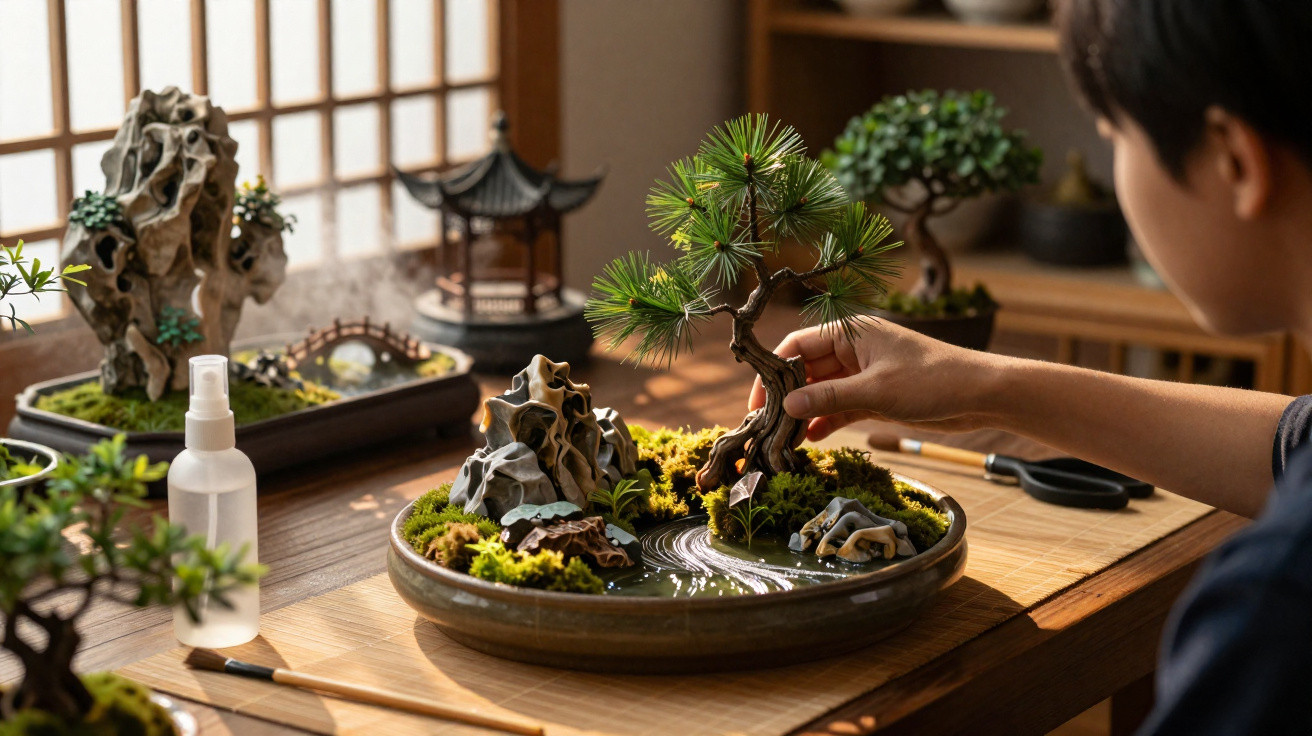
Anyone encountering Penjing for the first time may easily mistake it for Bonsai. Yet that first impression is misleading. This Chinese tradition goes much further, creating complete miniature landscapes that convey emotions, hint at stories and contain millennia-old philosophies of nature within a shallow tray. That is precisely why the art form holds such appeal for a modern, stressed audience.
What Penjing is – and why it is not Bonsai
Penjing can broadly be rendered as ‘landscape in a tray’. Its central idea is that artists create living scenes in miniature, using:
- Small trees and shrubs
- Stones, rocks and sand
- Areas of water or suggested rivers
- Miniature figures, including houses, people and animals
The result is not simply a ‘tree in a pot’, but an entire section of landscape: a mountain path, a river valley, a village on a slope or, at times, a surreal dream world. Plants are carefully pruned, wired and repeatedly adjusted. The intention is to create not merely an attractive shape, but an atmosphere.
Penjing is considered an attempt to make nature’s principles visible on a small scale – including chaos, wildness and stillness.
By comparison, Bonsai generally centres on a single tree as its ‘main character’. Its design tends to be more disciplined and controlled, almost like a sculptural practice. Penjing offers much greater scope for wildness and narrative detail. Many arrangements look as though a walker might appear around the corner at any moment, or a rain shower could begin.
Ancient origins: how Penjing developed
Penjing has a very long history. References date back at least to the 1st century AD, although its beginnings are likely to be older still. Daoist scholars explored the idea of ‘reducing’ entire landscapes at that time, so their forces could be concentrated and contemplated meditatively.
An old belief held that sages could ‘bring’ whole mountains and valleys into a tray. This mythological tale inspired artists to recreate landscapes with soil, rocks and plants. The concept later reached Japan through Buddhist monks, where it developed into what is now known as Bonsai.
In China, however, the approach remained broader. Rather than placing one tree at its centre, it focused on the relationship between numerous elements. Those wishing to study Penjing seriously often train for ten years or more with masters, in botanical gardens or at specialist schools. Pruning skills alone are not enough: composition, symbolism, plant knowledge and patience are all essential.
Three main Penjing styles: from trees to waterscapes
China is vast, and Penjing clearly reflects that diversity. Regional schools include the southern Lingnan style, variations from Shanghai and Taiwan, as well as other local traditions. Within this range, specialists commonly identify three broad categories.
Shumu: trees as elements of a landscape
In the Shumu style, trees and shrubs take priority. They are grown in a tray, pruned regularly and shaped with wire. Their roots are usually set in soil, while the surface is designed to resemble a forest floor or mountain track rather than a neatly raked bed.
Visually, Shumu is the closest style to Japanese Bonsai, though it often has a freer character. Several trees may form a group of trees or a ‘miniature forest’. Gaps between plants are deliberately used to imply distance and depth, as they would in a real landscape.
Shanshui: rocks and water in leading roles
With Shanshui, stones are the principal feature. Artists arrange rocks, gravel and water in a shallow tray. Sometimes a striking stone rises from an implied lake like a mountain peak.
Small plants, such as mosses or tufts of grass, are often added. They make the rocks appear more alive, like a mountainside after rain. These arrangements strongly recall classic Chinese ink landscapes of towering mountains and mist-filled valleys.
Shuihan: where every element meets
Shuihan brings together the two earlier styles. One tray combines:
- Trees and shrubs
- Rocks and stones
- Water features or dry riverbeds
- Miniature figures, buildings, boats or animals
The outcome often resembles a scene frozen from a novel. A small house among rocks suggests solitude, while a boat at a tiny jetty evokes trade or travel. The landscape consequently tells an abstract story without using a single word.
Many Penjing scenes feel like a silent film: you sense movement even though nothing happens.
Penjing today: a tradition in motion
Like every living art, Penjing continues to change. Contemporary artists experiment with new materials, unusual plants and miniature urban landscapes. Some deliberately explore minimalist forms, whereas others fill their trays with details, almost like a fantasy universe.
One guiding idea remains unchanged: “See the great in the small”. Penjing is intended to speak to universal feelings – longing, calm, solitude, hope and serenity. It makes no difference whether the tray stands on a balcony in Shanghai or in a living room in Berlin.
Penjing at home: getting started without a master’s qualification
Anyone intrigued by Penjing does not need to travel to China straight away. With a little preparation, a simple project can be started on a windowsill or terrace.
Basic equipment for beginners
Only a few items are needed for first attempts:
- A shallow tray with drainage holes
- Free-draining growing medium suited to the plants
- Bright light, without relentless direct sunshine
- One or two hardy, compact plant species
- A selection of stones, gravel and, if desired, moss
Miniature figures or a tiny house can be added if preferred. The best starting point is to ask: which real-life landscape fascinates you? A mountain path, a stretch of coast or the edge of a woodland? That scene can then be recreated on a smaller scale.
Plan before reaching for the shears
It is worth making a rough plan before planting. A simple sketch is enough: where will the rocks go, where should the ‘main tree’ sit, and where will an open area guide the eye? This creates a structure that will later feel coherent.
Many nurseries now stock compact woody plants, dwarf conifers and suitable ground-cover plants. Bonsai sections can also be useful, as many of the same plants work equally well for Penjing. Online image galleries offer ideas that can be adapted step by step rather than copied exactly.
Care: patience matters more than perfection
The greatest challenge is not buying the plants, but having patience afterwards. Trees grow slowly, moss is sensitive to dryness and excessive watering causes roots to rot. Anyone hoping to succeed should observe regularly:
- How quickly does the tray dry out?
- Where is new growth appearing?
- Which branches disrupt the intended line of the composition?
At first, gentle adjustments with shears and wire are entirely sufficient. Everything else comes through experimentation. Mistakes are part of the process: a tree may be pruned incorrectly, or a stone may be placed in the wrong position. Many Penjing enthusiasts say that this continual refinement is meditative – a counterpoint to overly polished social-media images.
Why Penjing suits the present day
Penjing brings together several trends already gaining momentum across the German-speaking world: urban gardening, mindfulness, minimalism and a desire for nature. A thoughtfully arranged tray cannot replace a walk in the woods, but it does bring a concentrated piece of landscape directly to a desk.
Psychologists have pointed out for years that simply looking at green plants can reduce stress. Penjing takes this a stage further: creating it actively requires focus, calm and a slower pace. While working on a miniature landscape, it is difficult to check emails or scroll through feeds at the same time.
Its cultural dimension is equally interesting. Penjing offers an accessible route into Chinese aesthetics without feeling didactic. Ideas such as ‘Qi’, or the pursuit of harmony within imbalance, can be understood far more immediately through a tray of soil and stone than through a specialist book.
Those who already care for Bonsai can add a new dimension through Penjing. Instead of refining only a tree’s shape, the whole setting comes into focus. Where does the tree exist in the imagination? On a rocky ridge? Beside a river? Next to a solitary temple? Such questions change how an arrangement is viewed – and often how nature itself is seen.





Comments
No comments yet. Be the first to comment!
Leave a Comment